English
  日本語
日本語  العربية
  Deutsch
  Español
  Français
  한국어
한국어  Português
  Татар теле
  Русский
 A stacked washer and dryer can look easy to enclose when you only compare the appliance width, height and depth with a cabinet opening. In real projects, stacked washer dryer cabinet dimensions must also include the approved stacking kit, hose space, valve access, plug position, dryer ventilation, cabinet door swing and a clear route for future service. If those checks happen after the cabinet is produced, the laundry tower may fit visually but fail in daily use or maintenance.
For an apartment laundry room, balcony cabinet or compact utility niche, the better question is not only “will the machines fit?” It is “can the installed stack still be connected, ventilated, opened, cleaned, serviced and removed?”
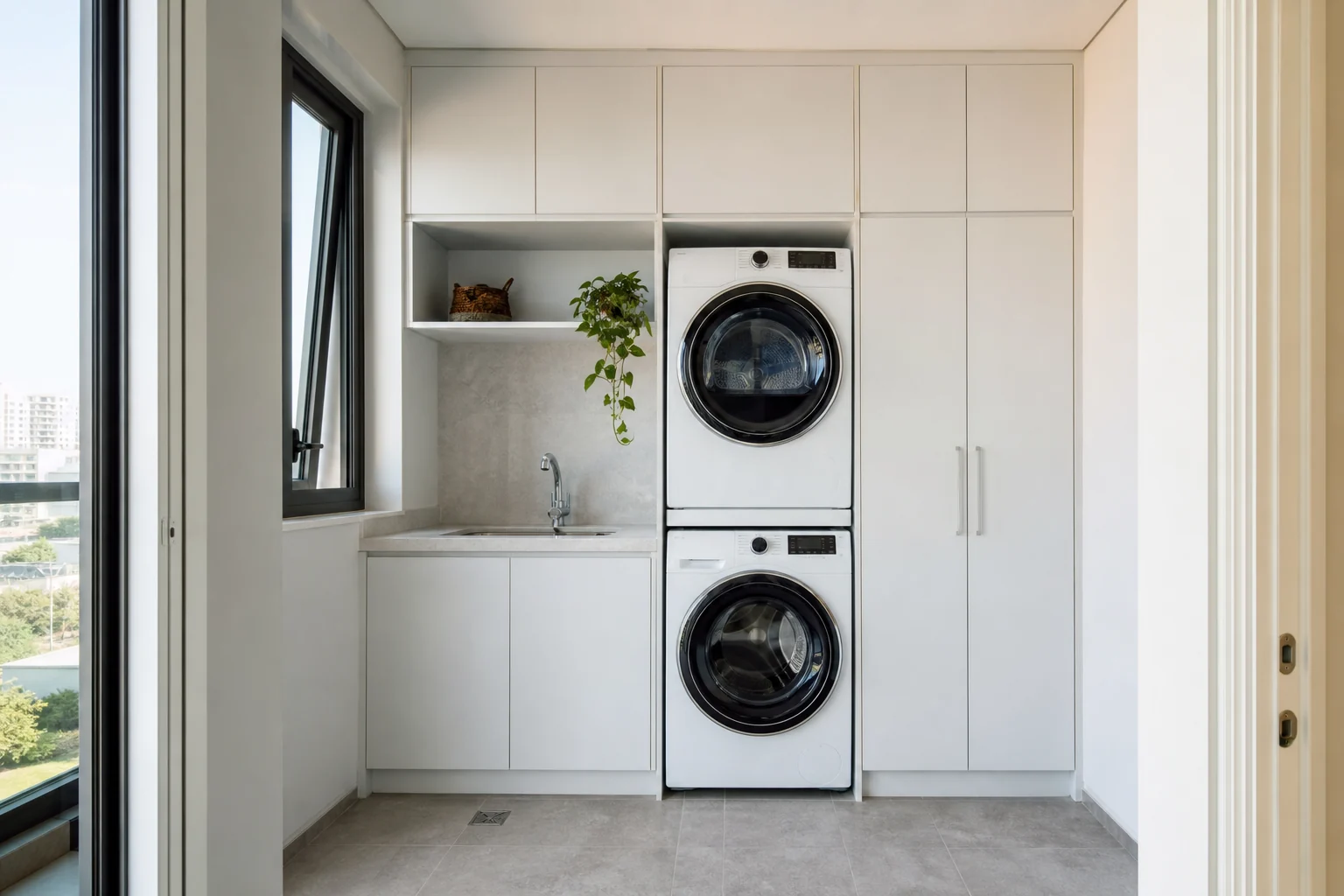
Quick Answer: Cabinet Dimensions Must Include the Installed Stack and Service Access
The quick answer is simple: a stacked laundry cabinet should be sized around the complete installed system, not around two appliance boxes. The system includes the washer, dryer, stacking kit, adjustable feet, handles, door projection, rear hose space, drain route, electrical connection, shutoff valve access, ventilation path and service removal space.
That does not mean every project should use the same clearance. Appliance brands, dryer types, installation manuals and local site conditions vary. A cabinet maker can plan the opening, panels, doors and access points, but the appliance manufacturer and local professionals should confirm installation, ventilation, plumbing and electrical requirements.
Why the appliance size alone is not enough
The published appliance dimension is usually a starting point. It may not include hose bends, plug depth, door swing, levelling feet, stacking hardware or the space a technician needs to move the tower. In a compact apartment laundry, those missing details can be the difference between a clean installation and a cabinet that has to be modified on site.
What should be checked before production
Before a custom laundry cabinet goes into production, check the appliance model numbers, approved stacking kit, installed height and depth, service access, dryer ventilation, cabinet door type and the route for pulling the machines forward. This is especially important for a tall matte white laundry cabinet where the finished look depends on accurate openings and aligned panels.
Start With the Actual Appliance Model and Stacking Kit
The first document to collect is not the cabinet drawing. It is the appliance information. Ask for the washer model, dryer model, installation manual and the exact stacking kit approved for those machines. If the dryer is not approved for stacking, the cabinet opening cannot solve that problem.
Confirm the dryer is approved for stacking
Some dryers are designed to sit above a compatible washer with a specific stacking kit. Others may need different installation conditions. Do not assume that any dryer can be placed above any washer because the footprints look similar. The appliance manual should be checked before the cabinet tower is designed.
Measure the washer, dryer and approved kit as one unit
The installed tower may be taller or deeper than the sum of the two product pages suggests. The stacking kit may add height, create a small front projection or change the way the upper machine is secured. For stacked washer dryer cabinet dimensions, the relevant measurement is the complete assembled stack.
Record feet, control panels, handles and door projection
Adjustable feet can affect height. Handles and door fronts can affect depth. Control panels and detergent drawers can affect the clear space needed at the front. These small projections matter when the machines sit behind cabinet doors or between tall side panels.
Treat the Rear Utility Zone as Part of the Cabinet Depth
One of the most common planning errors is treating appliance depth as the full cabinet depth. The rear utility zone is functional space. It has to hold water hoses, drain connections, plugs, outlets, valves and sometimes a venting path, depending on the dryer.
Leave room for hoses, plugs, valves and drain connections
Hoses should not be crushed between the machine and the back panel. Plugs should not be forced into a tight bend. Drainage should be planned so that it follows the appliance and plumbing requirements, not simply the neatest cabinet line. If the cabinet needs a back panel, consider whether an access opening or removable section is required.
Keep shutoff valves reachable after installation
Shutoff valves are not decorative details. They need to be reachable when the machines are installed. In some layouts, the valve may need to sit in an adjacent accessible zone rather than directly behind a fixed appliance tower. The exact approach should be confirmed with the project plumber or local professional.
Mistake and Fix: when the cabinet is deep enough but the hoses are crushed
Mistake: using the appliance depth as the cabinet depth and adding only a neat front alignment.
Fix: review the rear utility zone before production. Check where hoses, plugs, drains and valves actually sit. If access is needed behind the stack, design a removable panel or accessible side section rather than closing the space permanently.
Check Cabinet Doors Against Appliance Doors and Controls
Cabinet doors can make a laundry wall look calm and architectural, but they can also create the next obstacle. A full-height door, folding door or pocket door should be checked against the appliance door swing, control panel visibility, detergent drawer access and filter cleaning.
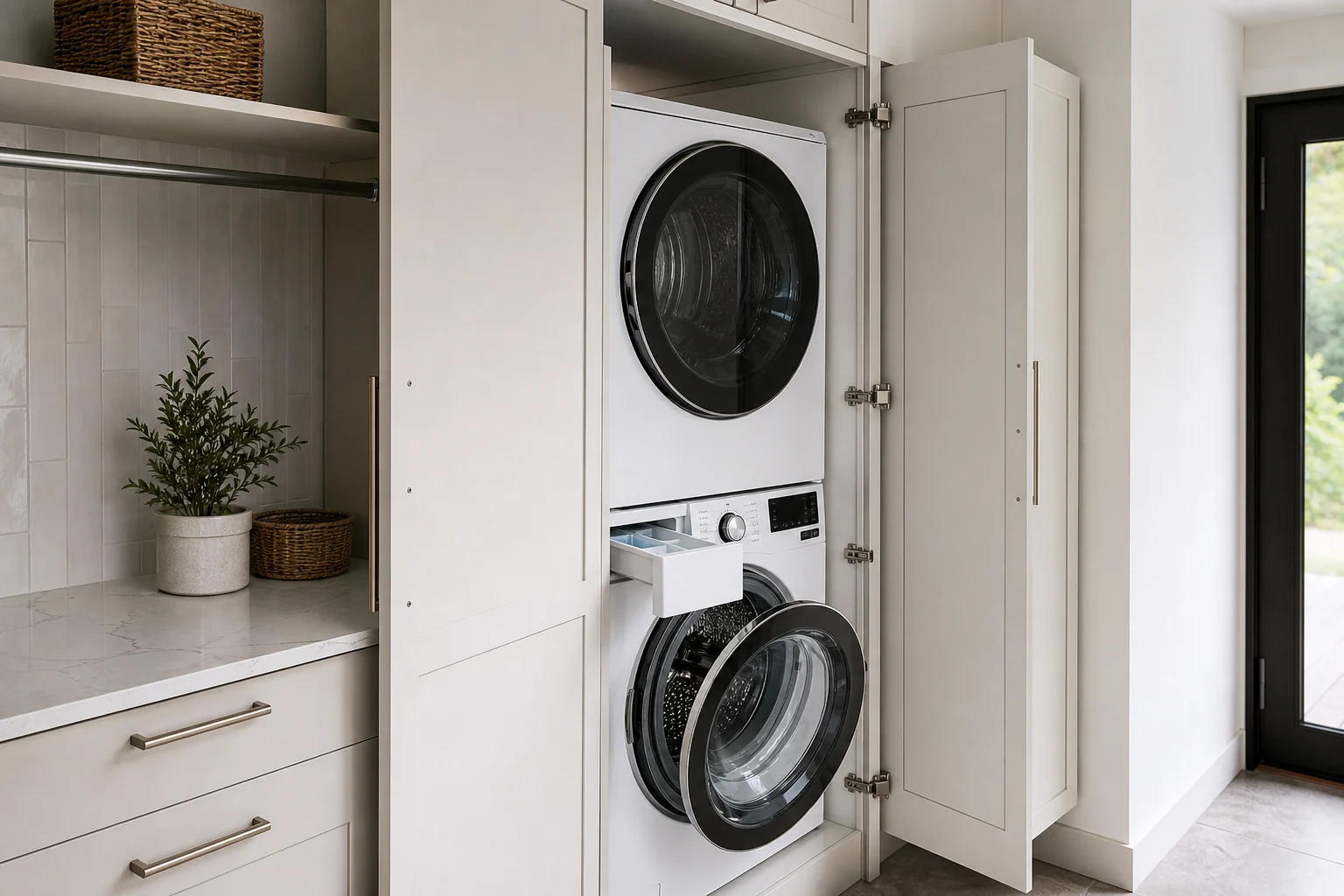
Test appliance door swing before choosing cabinet doors
The washer door, dryer door and cabinet doors all need space to move. If the cabinet door opens into a wall, sink, balcony door or hallway, the appliance may become awkward to load. For narrow rooms, test the door sequence: open cabinet door, open appliance door, load laundry, access controls, then close everything again.
Check detergent drawers, lint filters and control panels
Daily use depends on small access points. Can the detergent drawer pull out fully? Can the lint filter be cleaned? Can the control panel be read without leaning into a dark tower? If the cabinet uses bi-fold or pocket-style doors, check whether the hardware blocks these actions.
Mistake and Fix: when a tidy door design blocks daily use
Mistake: choosing cabinet doors only for a clean front elevation.
Fix: choose the door type after testing appliance operation. In some projects, full-opening doors, folding doors or an open tower may be more practical than a fully concealed front. The best door design is the one that keeps the laundry usable.
Plan Ventilation Around the Actual Dryer Type
Ventilation is where generic advice becomes risky. Different dryer types and models can have different requirements for airflow, heat release, condensate management and maintenance. A cabinet door with small gaps may not be enough, and a universal ventilation number should not be copied into every project.
Follow the appliance manufacturer’s installation instructions
The appliance manufacturer is the primary source for installation and ventilation requirements. The cabinet drawing should support those requirements rather than replace them. If the manual asks for specific clearances, airflow routes or maintenance access, those requirements must be respected in the cabinet plan.
Do not copy a universal ventilation gap
It is tempting to use one standard gap for every stacked laundry cabinet. That can be misleading. A vented dryer, condenser dryer and heat pump dryer may not behave the same way, and brands can differ. For overseas projects in Australia, Singapore, the UK or the Philippines, the final installation should also be checked against local professional advice.
Mistake and Fix: when full enclosure creates heat or airflow problems
Mistake: designing a fully enclosed cabinet because it looks quieter and cleaner in the drawing.
Fix: confirm the dryer type and manufacturer instructions first. Then decide whether the cabinet needs open areas, louvred or ventilated doors, service gaps, removable panels or a less enclosed layout. The cabinet should not trap heat or make normal maintenance difficult.
Make the Stack Removable for Future Service
Service access is not a luxury detail. It is part of the dimension plan. A technician may need to reach connections, inspect hoses, clean around the machines or pull the tower forward. If fixed shelves, side panels, doors or a nearby sink block the route, the original cabinet may need to be dismantled for a repair.
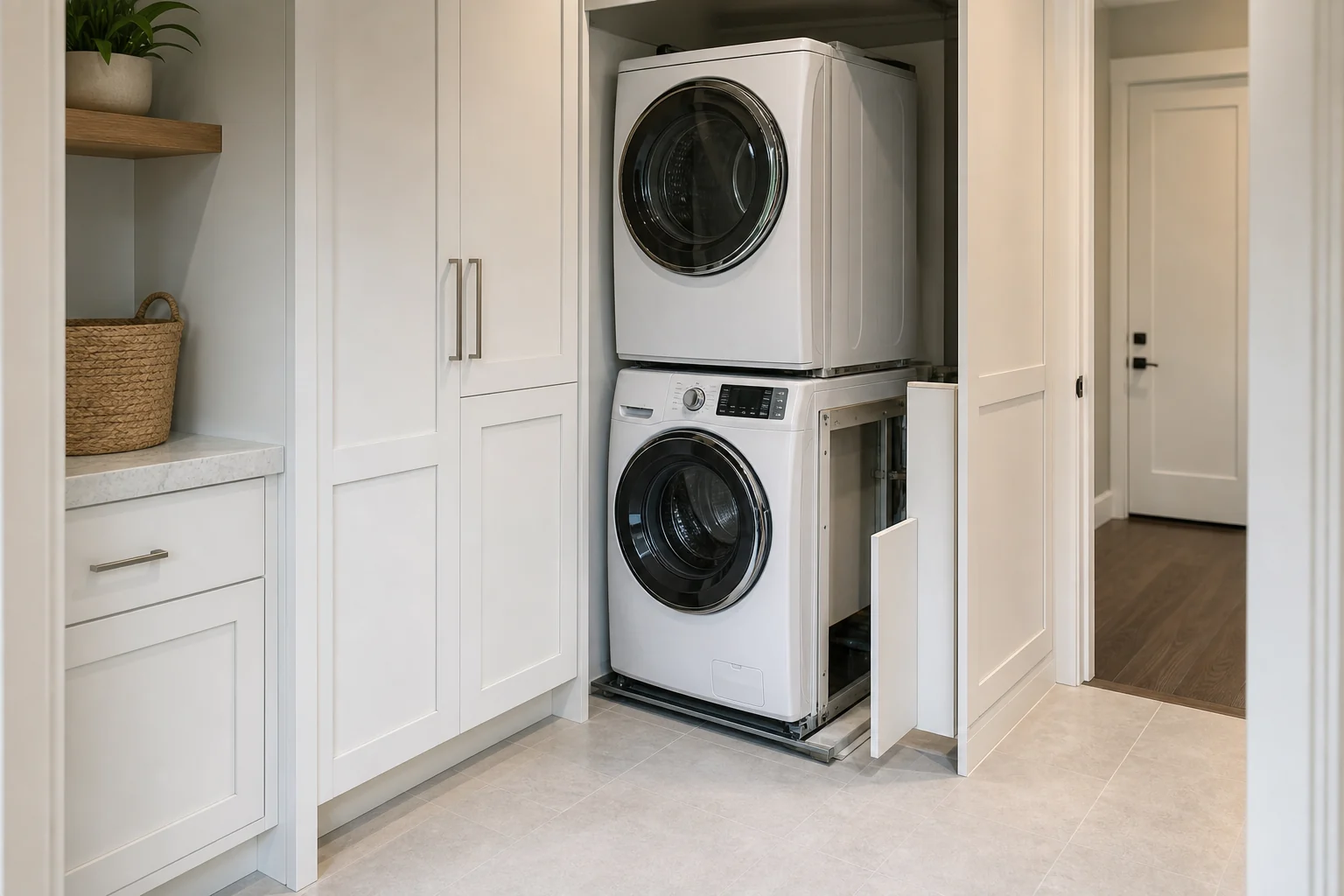
Keep a clear removal route in front of the cabinet
Measure the room in front of the laundry tower, not only the cabinet opening. Check hallway width, balcony door clearance, sink projection and any opposite wall. If the machines can only be removed by lifting over a fixed cabinet, the design is probably not service-friendly.
Avoid fixed shelves or panels that trap the machines
Tall storage beside the laundry tower is useful, but it should not trap the appliances. Fixed shelves, permanent toe kicks or tight side fillers can make future removal difficult. Where possible, plan removable parts in the zones that may need service access.
Plan removable access where valves or connections need inspection
If valves, drains or electrical connections sit behind or beside the stack, the cabinet should allow inspection. A removable back section, side access panel or adjacent utility compartment can be more practical than a completely closed tower.
Coordinate the Sink, Counter and Tall Storage Around the Tower
Most laundry cabinets are not just one appliance tower. They may include a sink, countertop, tall storage, cleaning supplies, open shelves or wall cabinets. These features should support the laundry workflow without blocking the washer-dryer stack.
Keep wet areas and electrical positions properly separated by local professionals
The relationship between water, drainage and electrical connections should be reviewed by qualified local professionals. The cabinet design can provide compartments, panels and access, but it should not make plumbing or electrical safety assumptions.
Place cleaning storage without blocking heat, vibration or service access
Cleaning products, baskets and tall storage should be planned away from heat, vibration and moving appliance parts. A storage module beside the tower can be useful, but it should not cover ventilation routes or the only path to a valve. For a matching product-side example, review a matte white stacked washer and dryer cabinet planned around appliance access, sink storage and service coordination.
Keep the machine removal path open
When the cabinet includes a sink or counter next to the tower, confirm that the machines can still move forward. A beautiful laundry wall is easier to maintain when the service path is planned from the beginning.
Pre-Production Checklist for Stacked Washer Dryer Cabinet Dimensions
Use this checklist before approving the laundry cabinet drawing. It is not a substitute for the appliance manual or local professional advice, but it helps organize the information a cabinet maker needs.
Appliance information to collect
- Washer model number.
- Dryer model number.
- Approved stacking kit model.
- Installation manuals for both machines.
- Manufacturer requirements for stacking, ventilation and service access.
- Door swing, handle projection, control panel location and detergent drawer movement.
Site and utility information to confirm
- Width, height and depth of the laundry niche or cabinet wall.
- Floor level and threshold conditions.
- Hose, drain, plug, outlet and shutoff valve positions.
- Dryer type and ventilation route.
- Nearby sink, counter, balcony door, hallway or opposite wall.
- Route for moving the appliances into and out of the room.
Cabinet drawing checks before approval
- Opening sized for the installed tower, not only the appliance boxes.
- Rear utility zone included in the depth plan.
- Cabinet doors checked against appliance doors and controls.
- Valves and connections reachable.
- Ventilation planned around the actual dryer model.
- Removable panels considered where inspection may be needed.
- Service removal route kept clear.
FAQs About Stacked Washer Dryer Cabinet Dimensions
Can a stacked washer and dryer be fully enclosed in a cabinet?
Sometimes, but it depends on the appliance model, dryer type, ventilation requirements and service access. Do not assume full enclosure is suitable for every project. Check the appliance manufacturer’s installation instructions and ask a qualified local professional to review the final plan.
Do shutoff valves need to stay accessible?
Yes, shutoff valves should remain reachable after installation. If the valves sit behind the machines, the cabinet may need a removable access panel or an adjacent accessible utility zone.
Do cabinet doors provide enough ventilation?
Not always. Cabinet doors may help hide the machines, but ventilation depends on the dryer type and manufacturer requirements. Some projects may need ventilated doors, open areas or a different enclosure strategy.
Should the machines be removable after the cabinet is installed?
Yes. A serviceable stacked laundry cabinet should allow the machines to be inspected, disconnected and removed when needed. The removal path should be checked before production, especially in compact apartment or balcony laundry spaces.
Final Thought: Fit Is Only the First Test
Good stacked washer dryer cabinet dimensions do more than make the machines fit. They protect the way the laundry works after installation: water connection, drainage, ventilation, door access, cleaning and future service.
If you are planning a matte white laundry cabinet with a stacked washer tower, prepare the appliance model numbers, stacking kit details, room photos and utility positions before the cabinet drawing is approved. With those details, a custom cabinet team can design a cleaner laundry wall while keeping the installed stack practical to use and service.