 English
  日本語
日本語  العربية
  Deutsch
  Español
  Français
  한국어
한국어  Português
  Татар теле
  Русский
 Clear glass can make every label, corkscrew, and half-filled shelf part of the dining-room view. A solid door removes that activity, but it also hides the collection. A smoked glass wine cabinet for dining areas should occupy the useful middle: the bottles remain legible, while the room no longer has to read every object behind the doors.
That result does not come from selecting a dark-looking sample in isolation. Glass tint, interior backing, shelf spacing, bottle density, cabinet lighting, windows, pendant lights, and black frame proportions all change what the door reveals. The practical question is therefore not “Is smoked glass stylish?” It is “What should the dining room still see, and under which lighting conditions?”
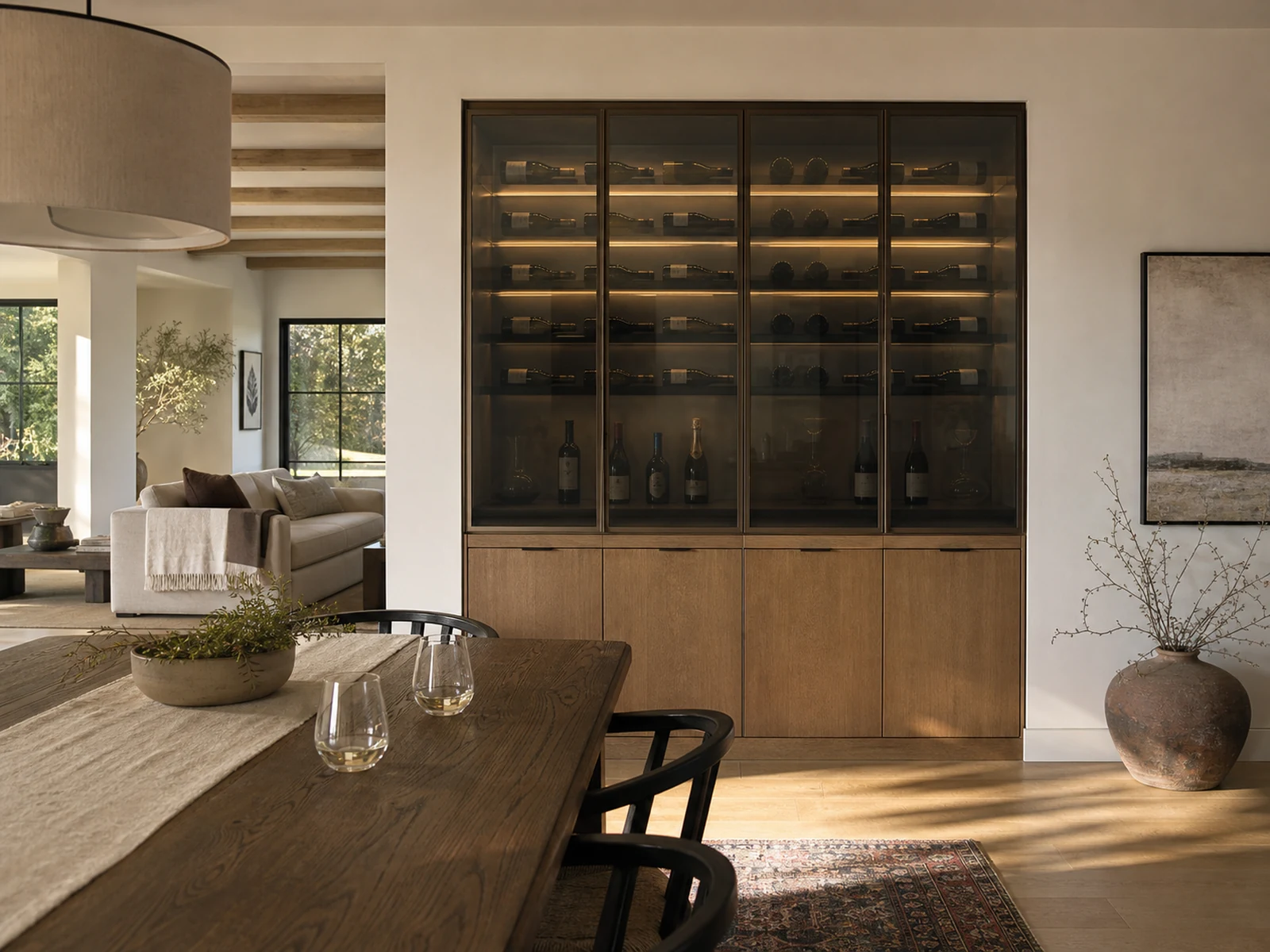
Decide What the Dining Room Should Still See
Start with a visibility target before comparing glass samples. “Smoked” is a broad visual description, not a precise promise that the same amount of detail will disappear in every room.
Bottle silhouettes, labels, and accessories are different targets
A calm display may still show the rhythm of horizontal bottles and the outline of a few upright bottles. It does not necessarily need to show every label color, shelf fitting, opener, napkin, or spare glass. Separating these targets makes the brief more useful:
- Silhouette visibility: bottle shapes remain readable from normal dining distance.
- Partial label visibility: some labels appear when the cabinet is lit, but they do not dominate the wall.
- Accessory screening: smaller, irregular objects move to drawers or closed lower storage.
- Display emphasis: only selected bottles or serving pieces receive brighter light or upright positions.
Clear, smoked, and solid fronts solve different problems
| Front type | What it does well | What needs attention |
|---|---|---|
| Clear glass | Shows labels, shelf details, and lighting clearly | Requires disciplined arrangement and can increase visual activity |
| Smoked glass | Softens detail while retaining depth and bottle outlines | Can become too dark or reflective when the full composition is not tested |
| Solid door | Hides accessories and irregular storage completely | Removes the visual connection to the collection |
Test the Glass With the Cabinet Interior, Not by Itself
A handheld sample against a white showroom wall cannot predict a finished wine cabinet. The material needs to be tested with representative bottles, the intended backing, the proposed shelf arrangement, and the lighting direction.
Backing color changes the apparent tint
A dark backing can make smoked glass read deeper and more opaque. A warm wood or medium-tone backing may keep more interior depth visible. A pale reflective surface can brighten the cabinet but may also make hardware, shelf edges, and label colors easier to see. None of these outcomes is automatically better; each should be compared with the visibility target set at the beginning.
When reviewing a black stainless steel wine cabinet with smoked glass, it is useful to place the glass sample beside the actual metal finish as well. A very dark frame, dark backing, and dense bottle arrangement can merge into one heavy block, even when each material looked acceptable on its own.
Shelf spacing and bottle density change visual noise
Shelf planning controls more than capacity. Closely packed horizontal bottles create a continuous band of necks, labels, and shadows. Wider spacing gives the eye breaks but may reduce storage. Upright bottles introduce stronger vertical shapes and often make labels more visible.
Internal lighting can reveal more than expected
Lighting behind smoked glass does not simply make the cabinet “warmer.” It changes the balance between reflection and transparency. Brighter interior light can bring bottle outlines and labels forward; a poorly placed strip can produce bright dots or reflections on shelf edges. A dimmable or separately controlled lighting plan may be useful, but the actual driver, channel, access, and switching arrangement must be confirmed for the project.
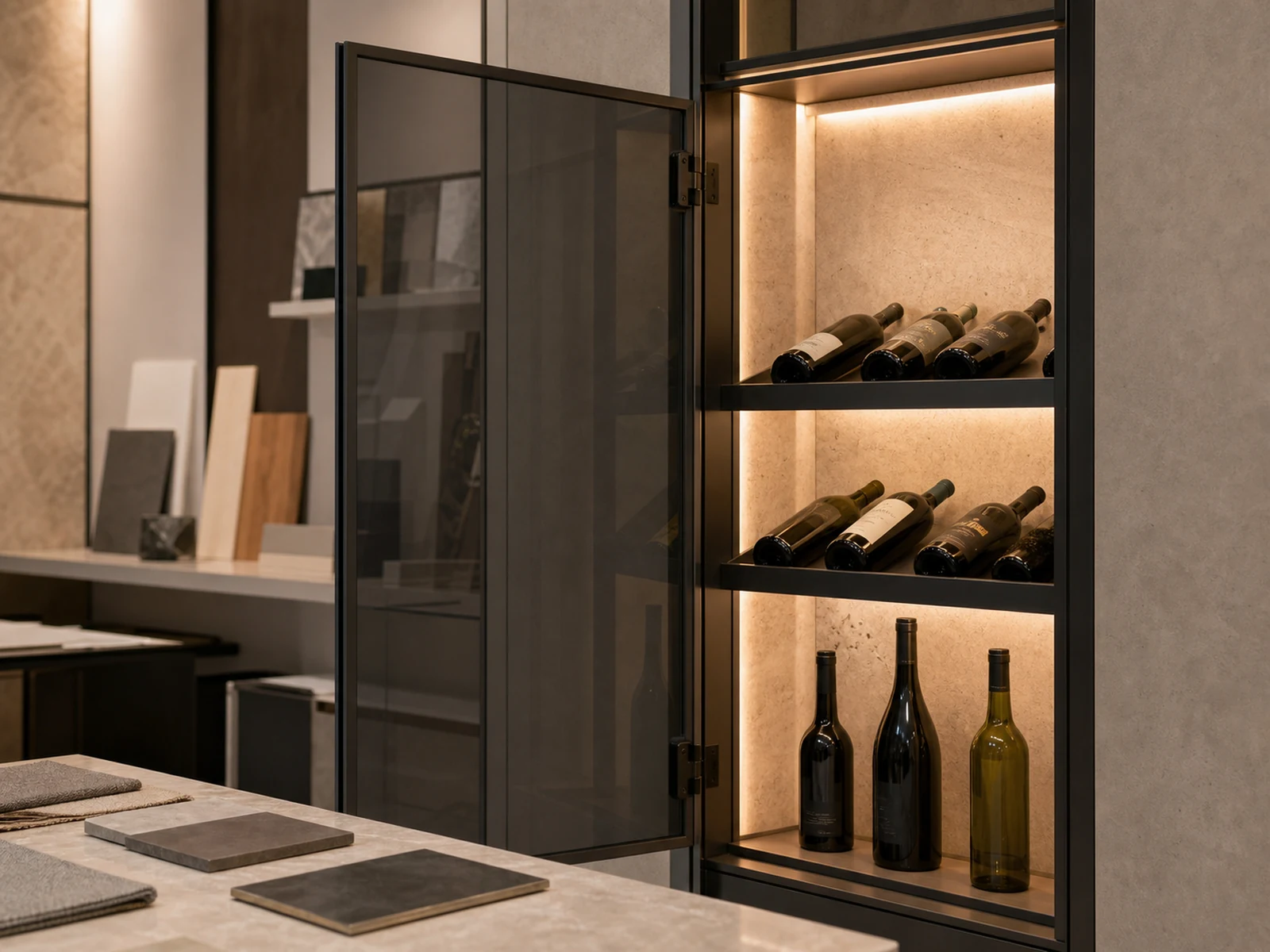
Read the Cabinet in Daylight and at Dinner
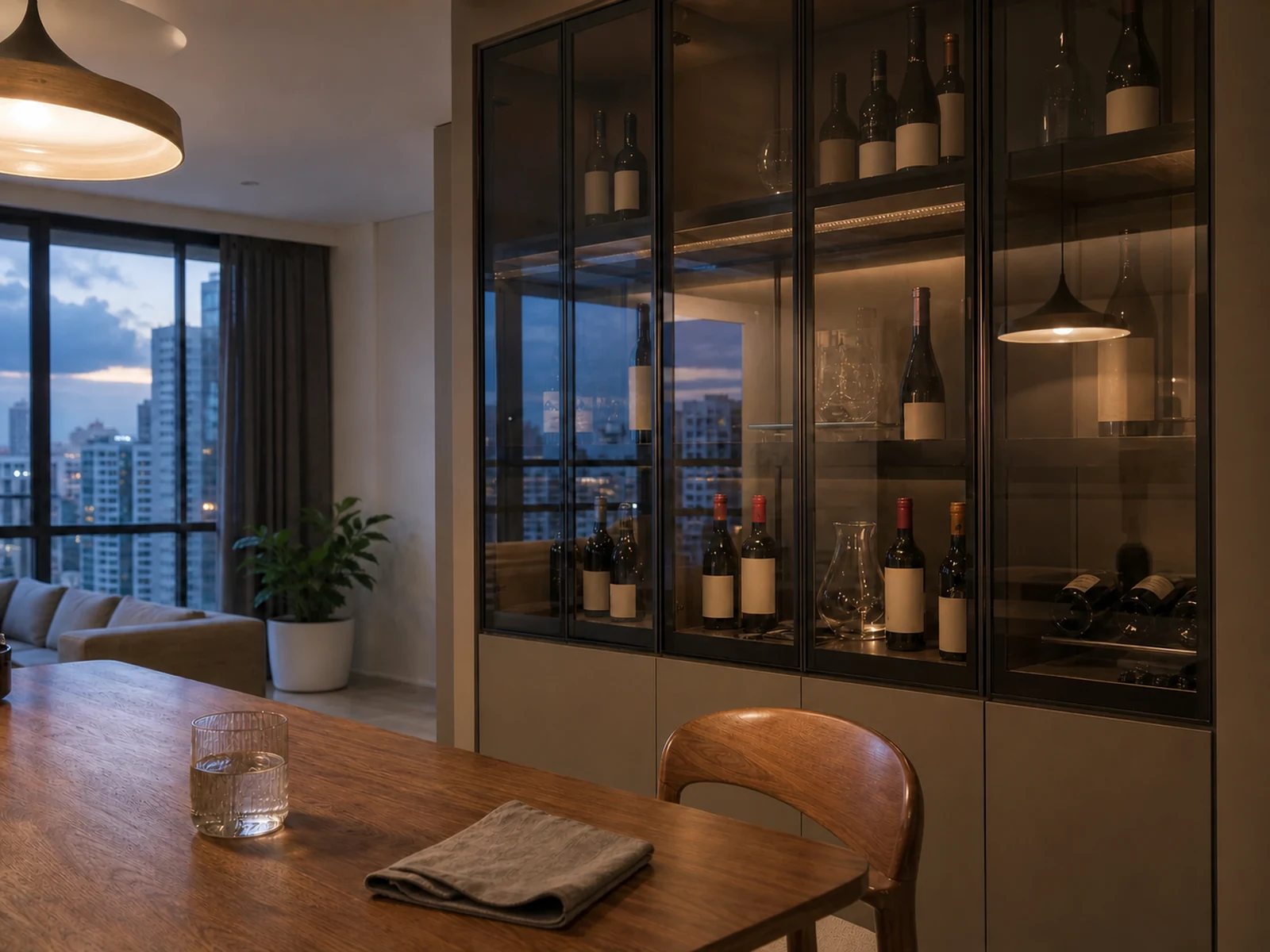
The same door can appear relatively transparent when the interior is brighter than the room and more mirror-like when the room is bright but the cabinet interior is dark. This is why a smoked glass wine cabinet for dining areas should be reviewed in both daylight and evening conditions.
Map windows, pendants, and seated sightlines
Stand where people will actually see the cabinet. Check the view from the main dining chairs, the kitchen approach, and the adjoining living area. A window opposite the cabinet may become a large reflected rectangle. A pendant can repeat as a bright point across several door leaves. Even a well-selected tint can feel busy when the reflection map was ignored.
Separate transparency from reflection
If the bottles are difficult to see, the glass may not be too dark; the front surface may simply be reflecting a brighter part of the room. Conversely, reducing room reflections does not guarantee that labels will disappear when cabinet lighting is on. Treat these as two separate checks:
- What can be seen through the glass?
- What can be seen on the surface of the glass?
This distinction leads to better decisions about tint, backing, lighting intensity, cabinet position, and door divisions.
Keep Black Stainless Steel in Proportion to the Room
Smoked glass often appears with black stainless steel or a dark metal-look frame. The frame provides structure, but its visual weight depends on the whole elevation.
Frame width and door divisions affect visual weight
More door leaves mean more vertical borders. Heavy perimeter frames, frequent divisions, dark side panels, and a dark backing can make a tall cabinet read like a solid wall. A slimmer frame language may feel lighter, but it still has to suit the door size, hardware, and construction. These details belong in the elevation and section drawings rather than being decided by a close-up finish photograph.
The dining table should remain part of the hierarchy
Judge cabinet width and height in relation to the dining table, wall length, ceiling, and adjoining openings. In a small apartment dining zone, a full dark wall may compress the room. In a larger villa dining room, the same finish may need sufficient negative space or a quieter lower section to avoid becoming a retail-style bottle wall.
Use Display and Concealed Storage as Separate Zones
“Show less” is easier to achieve when the cabinet is not asked to display everything.
Horizontal bottles, upright service zones, and edited display
Horizontal storage can create a steady visual rhythm behind smoked glass. A limited upright zone may support serving or a few selected bottles, but it should be planned around bottle height, door clearance, shelf support, and the intended lighting. Leaving some visual breathing room can be more effective than choosing a darker glass to hide an overcrowded interior.
Keep small accessories below the glass
Corkscrews, spare glasses, stoppers, napkins, packaging, and cleaning items create smaller irregular shapes. Closed lower doors or drawers can keep these objects accessible without making them part of the main display. The internal arrangement should still account for drawer travel, shelf loading, hinges, skirting, floor tolerances, and safe anchoring.
Confirm Storage-Only or Refrigerated Before Production
A smoked-glass cabinet with bottle shelves and lighting is not automatically a temperature-controlled wine cabinet. The base brief should state whether the project is:
- a storage and display cabinet;
- cabinetry built around a selected wine appliance; or
- a specified refrigerated system coordinated with custom panels and storage.
If equipment is required, its exact model and installation documentation should guide the cabinet drawing. Air intake, heat exhaust, power, possible drainage, access for maintenance, door ventilation, and removal clearance may change the base, shelf positions, and concealed-storage layout. These requirements cannot be inferred from the appearance of the smoked-glass door.
Similarly, do not assume that a darker tint provides a particular level of UV protection. Any UV, safety, or performance statement must come from the verified glass specification. The same trust rule applies to temperature, humidity, noise, and energy claims associated with cooling equipment.
What to Approve Before the Shop Drawing Is Released
For a smoked glass wine cabinet for dining areas, the most useful approval is a coordinated package rather than a single finish code.
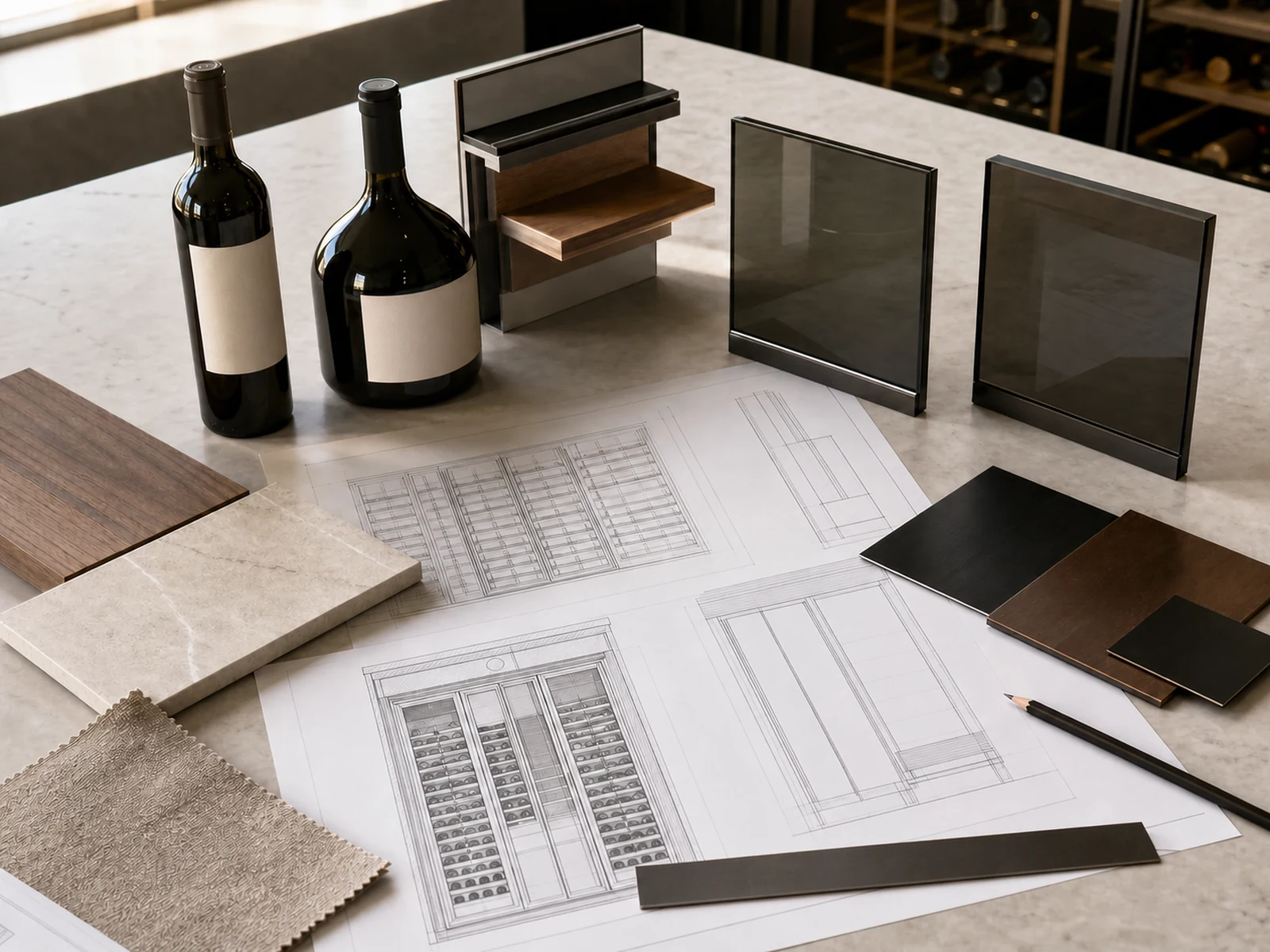
Confirm the following before production:
- the intended reveal level for silhouettes, labels, and accessories;
- a physical smoked-glass sample viewed vertically;
- the black metal or stainless-steel finish beside the glass;
- the actual backing color and shelf material;
- representative horizontal and upright bottle formats;
- shelf pitch, lighting-channel position, and hardware clearances;
- daylight and evening views from the dining table and adjoining spaces;
- cabinet width, height, depth, side treatment, fillers, anchoring, and door swing;
- the division between glass display and concealed storage;
- any selected appliance model, installation instructions, airflow, power, drainage, service, and removal needs.
Samples answer how the materials read. Drawings answer how the parts fit. The project is ready to move forward only when those two answers agree.
Frequently Asked Questions
Can you clearly see wine bottles through smoked glass?
Usually, bottle shapes remain visible, while label detail is softened. The result depends on tint, backing color, bottle density, internal lighting, room brightness, reflections, and viewing distance. Test a physical sample with representative bottles instead of relying on a sample name or online photograph.
Does a smoked glass wine cabinet need internal lighting?
Not always. Lighting can make the collection easier to read and support serving, but it can also reveal more labels or create bright reflections. Decide what should remain visible first, then test the proposed lighting position and control method with the glass and backing.
Does smoked glass protect wine from UV light?
Do not assume so. A smoked appearance is not proof of a particular UV-control performance. Use only verified information from the selected glass specification, and avoid describing the cabinet as protective storage without supporting data.
Is a smoked glass wine cabinet temperature controlled?
Only when a specific refrigeration system is included and correctly integrated. A custom storage cabinet with glass doors, shelves, and lighting does not provide temperature control by itself. Equipment requirements must be coordinated before the shop drawing is approved.
Make the Cabinet Quieter, Not Invisible
The strongest result is not the darkest door. It is a cabinet that reveals the intended parts of the collection, screens the rest, and still belongs to the dining room in daylight and at dinner.
Before finalizing the design, review the smoked glass together with the frame finish, backing, representative bottles, shelf plan, lighting, and room views. For a custom project, a dining-wall plan, photographs, display priorities, and any selected appliance documentation provide a practical starting point for material samples and shop drawings.