English
  日本語
日本語  العربية
  Deutsch
  Español
  Français
  한국어
한국어  Português
  Татар теле
  Русский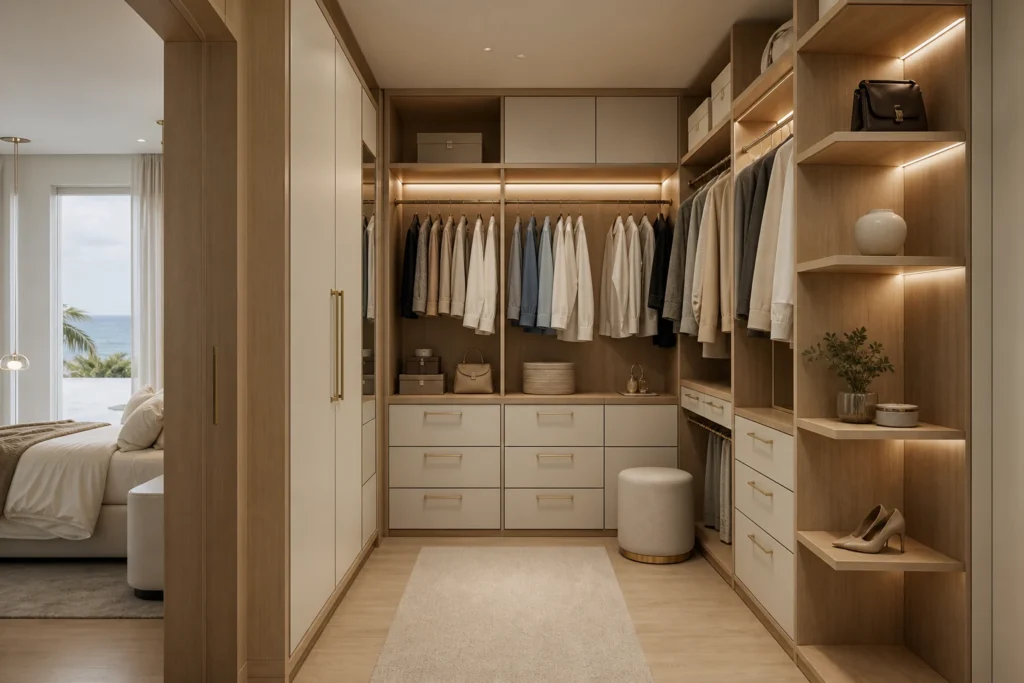
U Shaped Walk In Closet for Small Bedroom
Custom three-sided closet planning with reachable corner storage, measured drawer clearance, hanging zones, shelves, mirror details, and integrated lighting.
Compact U-Shaped Closet Planning for Small Bedrooms
A U shaped walk in closet for small bedroom spaces needs more than three cabinet walls. It needs a measured plan that protects the center standing area while still giving each side a clear storage role. Sunrise Furnishing plans compact U-shaped closet systems around the room entrance, ceiling height, wall length, cabinet depth, and the user’s clothing habits.
The layout can include long hanging, short hanging, shelves, drawers, shoe storage, bag shelves, mirror panels, and a small dressing shelf. The final structure should be confirmed through drawings before production, because not every small bedroom has enough clear space for a full U-shaped layout.
Corner Storage That Stays Reachable
Closet corners often look useful in a plan but become difficult to reach after hanging clothes, drawers, and doors are installed. For a compact U-shaped closet, corner storage should be assigned a clear function first. Open shelves, bag shelves, short hanging returns, angled modules, and internal lighting can make the corner easier to use than a deep closed cabinet.
For more layout guidance, our article on small walk in closet corner storage planning explains how to avoid dead zones, drawer conflicts, and awkward hanging areas before ordering custom cabinetry.
Hanging, Drawer, and Shelf Zones by Clothing Type
Different clothing categories need different cabinet details. Dresses and coats may need a deeper long-hanging section, while shirts, trousers, jackets, and folded clothing can work with short hanging, shelves, and drawer combinations. Shoes, bags, accessories, and seasonal items should be placed according to reach frequency, not simply wherever space remains.
Drawer banks are usually easier to use on straight cabinet runs where the user can stand directly in front of them. In a small U-shaped closet, drawers placed too close to the corner may compete with the center walkway or the opposite cabinet run. We review the pull-out direction, drawer height, and nearby cabinet doors during the drawing stage.
Cabinet Depth, Door Position, and Drawer Clearance
The door position decides where the first closet run can begin. A swing door, sliding door, or open entry affects the available cabinet length and the way the user enters the dressing area. Cabinet depth can also vary by side: hanging sections may need more depth, while open shelves or display zones can be shallower to protect the walkway.
Before production, the U-shaped closet drawing should show door swing, drawer movement, mirror position, and the remaining standing area together. This prevents a layout that looks full in elevation view but feels tight during daily use.
Lighting and Mirror Details for a Small Dressing Area
Lighting is important in a compact walk-in closet because hanging clothes and deep shelves can shade the corners. Integrated LED strips, vertical lights, and internal cabinet lighting can make folded items, bags, and accessories easier to identify. Lighting should be coordinated with wiring, sensors, switch position, and shelf layout.
A mirror panel or dressing shelf can be included when the remaining walkway allows comfortable use. If the mirror faces a drawer bank, the drawing should show where the user stands and how far the drawer opens. A small accessory drawer below the mirror can be useful when it does not block the main route through the closet.
Drawing Confirmation Before Production
For overseas homeowners, designers, and contractors, production drawings help align the cabinet design before manufacturing begins. We recommend confirming room measurements, wall conditions, entry position, ceiling height, cabinet depth, finish selections, handle style, lighting plan, and installation requirements.
Sunrise Furnishing can support compact closet projects with custom dimensions, material selection, color and finish coordination, storage zoning, and drawing review. The goal is a U-shaped closet that fits the room conditions and the user’s wardrobe, rather than forcing a standard layout into a small bedroom.
Frequently Asked Questions
Some small bedrooms can support a U-shaped walk-in closet, but the layout must be checked with real room measurements. Door position, wall length, cabinet depth, drawer opening space, and the remaining center standing area all affect whether a U-shaped plan is suitable.
Corners are easier to use when they have a clear storage role. Open shelves, bag shelves, short hanging returns, angled transition modules, and internal lighting can keep the corner visible and reachable. Deep closed storage or corner drawers should be used only when the access path is clear.
Drawers can be included, but they should not block the center walkway or collide with the opposite cabinet run. In many compact U-shaped closets, drawers work better on straight sections where the user can stand directly in front of them.
Internal LED strips, vertical lights, and focused cabinet lighting can help users see deep shelves, hanging returns, drawers, and accessories. Lighting should be planned together with wiring, sensors, shelf positions, and mirror placement.
Yes, a mirror panel, dressing shelf, or accessory drawer can be included when the room has enough standing and opening space. These details should be shown in the drawing so the mirror, lighting, drawers, and walkway work together.