English
  日本語
日本語  العربية
  Deutsch
  Español
  Français
  한국어
한국어  Português
  Татар теле
  Русский
 A custom balcony laundry cabinet for apartment spaces can make a small utility area feel cleaner, calmer, and much easier to use. But before you choose cabinet colors, door styles, or a built-in sink, there is a more practical question: is your balcony actually ready for a laundry cabinet?
In many apartments, the balcony looks suitable at first glance. There may be enough room for a washer, a narrow countertop, and a few upper cabinets. The real problems usually appear later: limited drainage access, poor ventilation around the washer, cabinet doors blocking the walkway, humid air affecting materials, or a sink that looks useful but leaves no space for storage.
That is why the best apartment laundry planning starts before the cabinet design. It starts with checking the balcony, the washer, the utility connections, and the long-term maintenance needs.
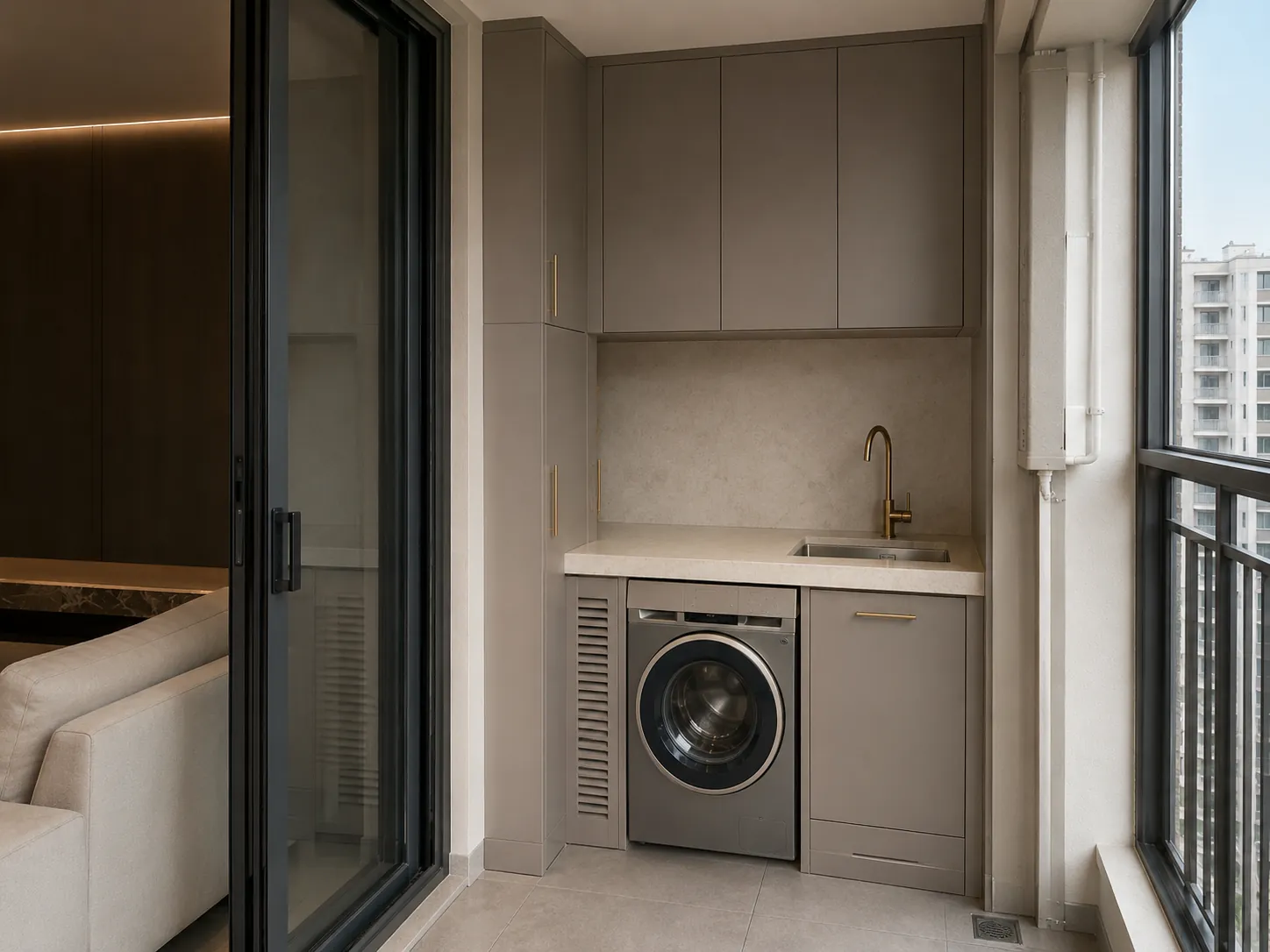
Why a Balcony Laundry Cabinet for Apartment Spaces Needs a Site Check First
A good balcony laundry cabinet begins with the balcony itself. In apartment projects, the available space is often smaller than it looks because the washer door, balcony door, window frame, pipe route, and walking space all take part of the layout.
Measure the usable width, depth, and height
Start by measuring the usable width, depth, and height. Do not only measure the wall. Measure the space after considering the washer depth, door swing, wall pipes, drain position, and any exposed columns or corners. A cabinet that fits on paper may still feel cramped if the washer door cannot open comfortably or if the user has to stand sideways to load laundry.
Check balcony doors, windows, and walking space
Also check how the balcony door or sliding door works. If a tall cabinet is placed too close to the entrance, it may block natural movement. If upper cabinets are too deep, they may make the balcony feel heavy or uncomfortable in a narrow apartment setting.
Look for sunlight, rain exposure, and daily humidity
Sunlight and humidity matter as well. A balcony laundry area may face direct sun, daily condensation, outdoor moisture, or occasional rain exposure depending on the building design. These conditions do not mean a cabinet cannot be installed, but they do affect material choice, edge sealing, hardware selection, and maintenance planning.
For apartment owners and designers, the first decision is not “Which cabinet style looks better?” It is “What can this balcony safely and comfortably support?”
Start with the Washer, Not the Cabinet Door
When planning a balcony laundry cabinet for apartment living, the washer should come before the cabinet door finish. Its size, loading direction, vibration, ventilation requirement, and service access will shape the entire cabinet layout.
Leave enough clearance around the washer
If the washer is placed under a countertop, leave enough clearance around the appliance. The cabinet should not squeeze the machine tightly on all sides. Space may be needed for vibration control, air movement, hose connections, and future maintenance. Always check the appliance manual and installation requirements before finalizing the cabinet dimensions.
Do not fully seal a washer without ventilation
A common mistake is fully hiding the washer behind cabinet doors without thinking about ventilation. A hidden washer can make the balcony look cleaner, but the cabinet should still allow air movement. Depending on the appliance type and layout, this may involve ventilation gaps, louvered details, open back sections, removable panels, or a design that allows the doors to stay open during use.
Plan service access before hiding the machine
Service access is another practical detail. If the water hose, drain hose, or power connection is buried behind a fixed cabinet panel, even a small repair can become difficult. For a custom balcony laundry cabinet, removable panels or accessible back spaces can make long-term use much easier.
This is where custom cabinetry becomes useful. The goal is not simply to hide the washer. The goal is to make it look integrated while still allowing the machine to work, breathe, and be serviced.
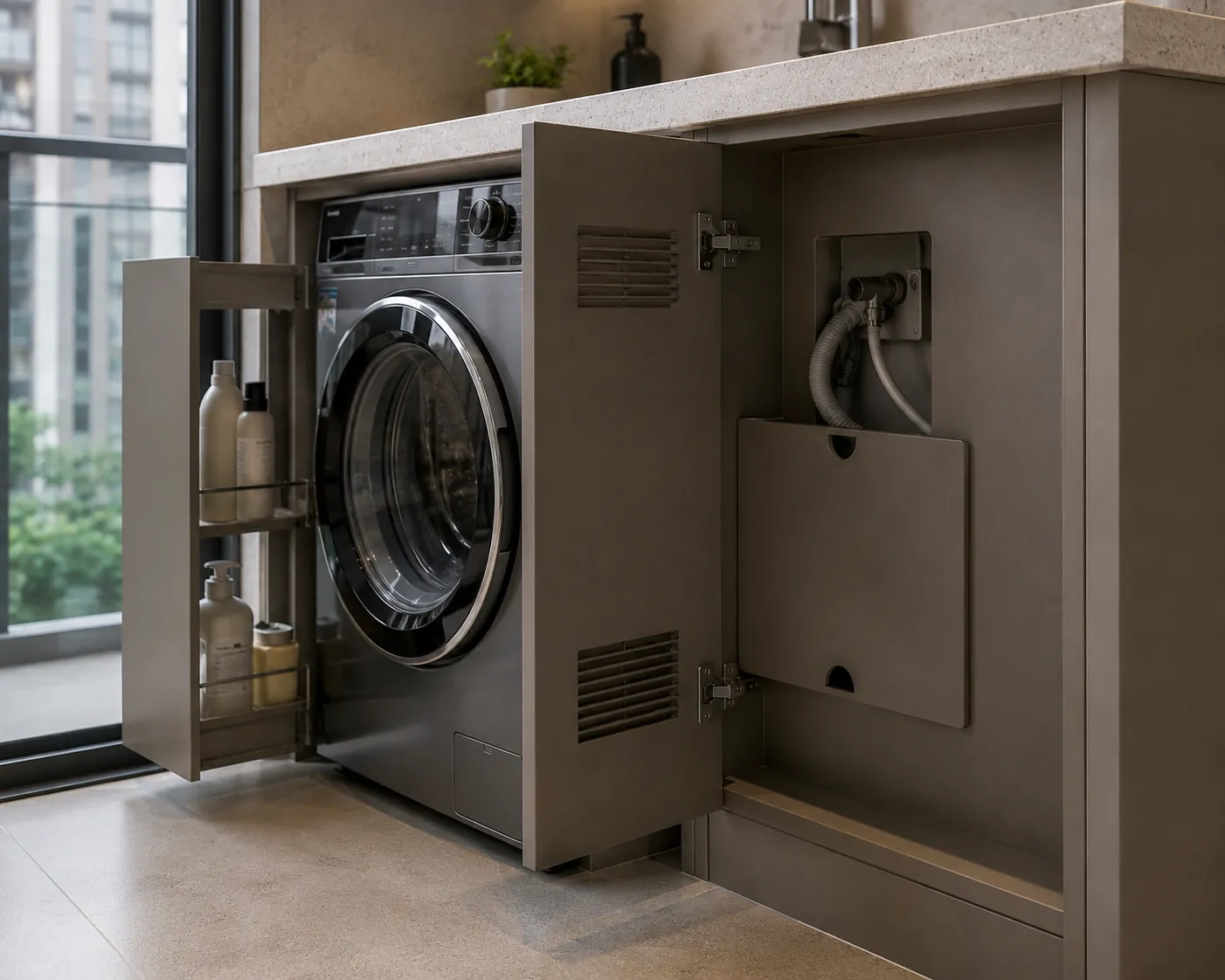
Drainage, Power, and Sink Planning Come Before Storage
For a balcony laundry cabinet for apartment projects, storage is important, but utility planning comes first. Drainage, water supply, power outlet location, and sink feasibility can decide whether the final cabinet works smoothly or becomes a daily annoyance.
Confirm the drain point and pipe route
Check the drain point before planning the sink or washer cabinet. If the drain location is far from the proposed washer position, the pipe route may affect cabinet depth, base cabinet structure, or maintenance access. If the drain is inside a tight corner, the cabinet may need a removable base panel or open service zone.
Decide whether a laundry sink is truly necessary
A laundry sink can be useful, especially for hand washing, cleaning tools, rinsing small items, or managing daily household chores. However, not every apartment balcony needs one. A sink takes up base cabinet space, requires water supply and drainage, and may reduce countertop or storage capacity. In a compact balcony, a washer and upper cabinet may be more practical than forcing in a sink.
Keep utility connections accessible
Power outlet placement should also be reviewed early. Outlets should be accessible and positioned in a way that supports safe appliance use. Avoid designing a fixed cabinet that makes the outlet difficult to reach. If electrical changes are required, they should be handled by qualified local professionals according to local requirements.
A good planning question is: will the sink be used often enough to justify the space and plumbing? If the answer is yes, plan the sink cabinet carefully. If the answer is no, use that space for a taller utility cabinet, pull-out storage, or a cleaner washer zone.
Moisture-Resistant Materials Are More Than One Board Choice
For a balcony laundry cabinet for apartment balconies, material planning should be more careful than in a dry indoor storage area. Laundry zones can involve humidity, water splashes, detergent, heat from appliances, and sometimes direct sunlight. This does not mean the cabinet must look industrial, but it does mean every layer of the cabinet should be considered.
Cabinet body, edge sealing, and back panels
The cabinet body should be suitable for a laundry environment, and the edge sealing should be handled carefully. Poor edge treatment can become a weak point in humid spaces. Back panels also matter because many laundry cabinets sit near pipes, walls, or semi-outdoor balcony conditions.
Countertop and backsplash choices for laundry use
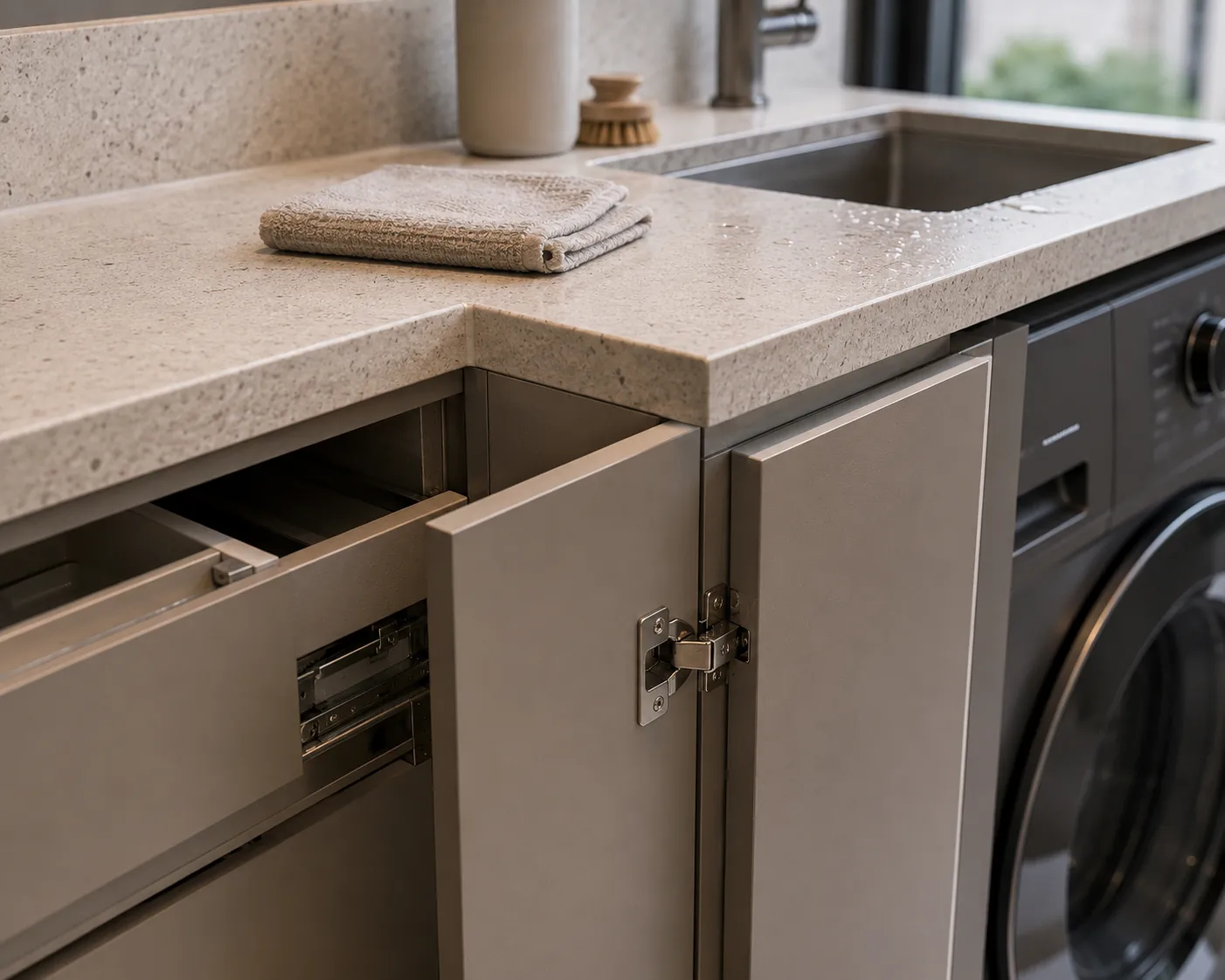
The countertop should be chosen for practical use. If there is a sink, the countertop and backsplash area should resist daily splashes and be easy to clean. A small raised edge, backsplash panel, or well-planned sink cutout can reduce water problems around the cabinet.
Hardware matters in a humid balcony area
Hardware is another detail that is easy to underestimate. Hinges, drawer runners, handles, and other metal fittings should be selected with the balcony environment in mind. In humid apartments, reliable hardware can make a big difference to how the cabinet feels after years of use.
A trustworthy material recommendation should not promise that a cabinet is “100% waterproof” or “maintenance-free.” A better approach is to design for moisture resistance, ventilation, easy cleaning, and accessible maintenance. This is especially important for an apartment balcony laundry cabinet that may face humidity, sunlight, and daily cleaning tasks at the same time.
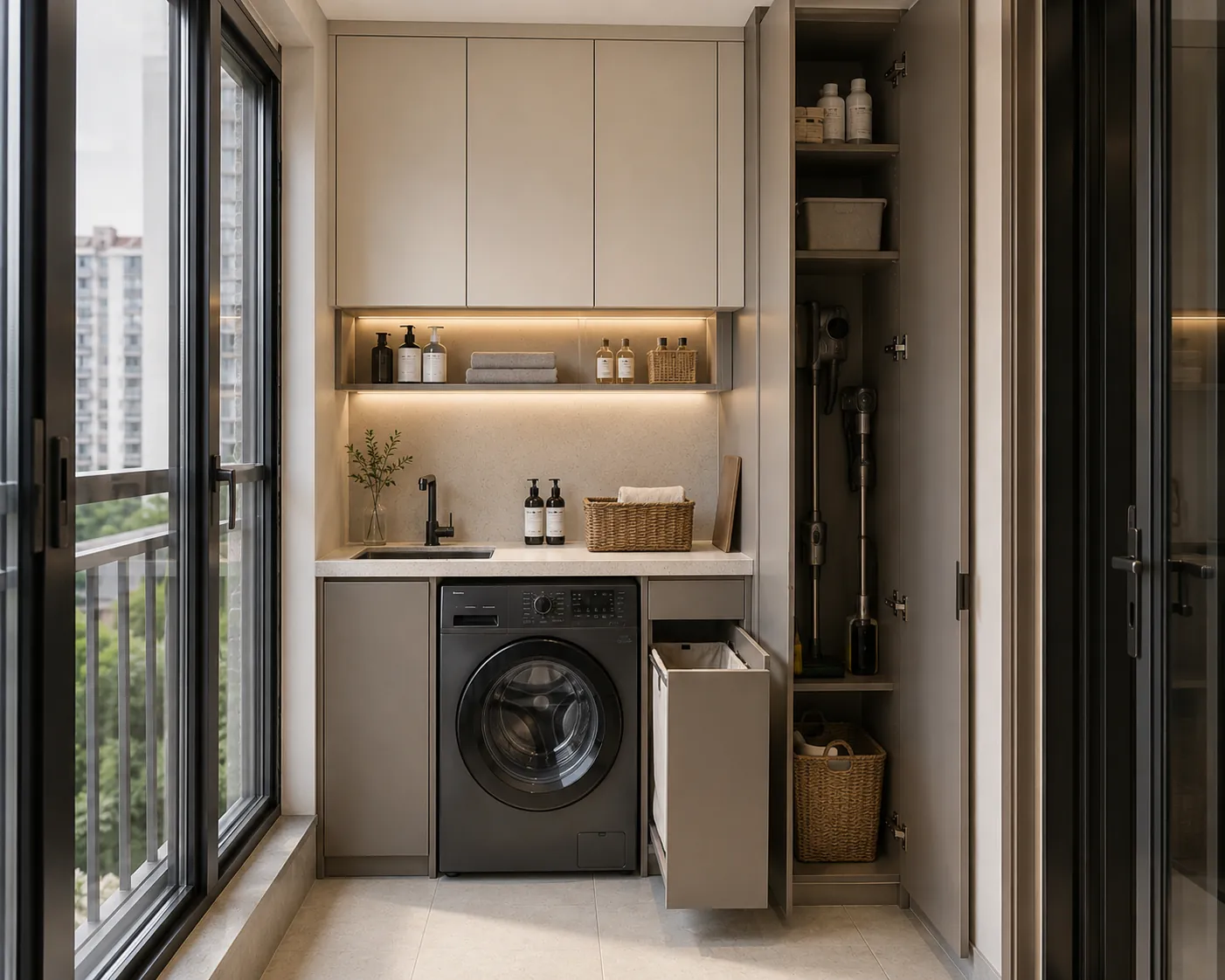
Layout Options for Apartment Balcony Laundry Cabinets
A balcony laundry cabinet for apartment use works best when the layout balances appliance access, storage, airflow, and daily movement. After the balcony conditions and utility points are checked, the layout can be planned with more confidence.
One-wall washer cabinet for narrow balconies
A one-wall washer cabinet works well for narrow balconies. It keeps the washer, countertop, and upper storage along one side, leaving the remaining space open for movement. This layout is practical when the balcony width is limited or when the laundry area shares space with windows, drying racks, or cleaning tools.
Washer and sink combination cabinet
A washer and sink combination cabinet is suitable when there is enough width and a convenient water connection. In this layout, the washer sits under the counter while the sink occupies one side. Upper cabinets can hold detergent, laundry bags, and small cleaning items. The key is not to make the sink too large for the space.
Tall utility cabinet for cleaning tools
A tall utility cabinet can be helpful when the apartment lacks a separate cleaning closet. It can store mops, vacuum accessories, laundry baskets, or bulk cleaning products. In a compact balcony, vertical storage often works better than adding more base cabinets.
Upper cabinets for detergent and daily laundry items
Upper cabinets are useful for light daily items, but their height and depth should be planned carefully. If they are too low, users may hit their heads while loading the washer. If they are too deep, the balcony may feel narrow. For smaller apartments, clean proportions matter as much as storage volume.
Custom Cabinet or Ready-Made Unit: Which Makes More Sense?
Before ordering a balcony laundry cabinet for apartment renovation, it helps to compare a ready-made unit with a custom cabinet. A ready-made laundry unit can work well when the apartment balcony is simple. If the washer is freestanding, the wall is straight, there is no sink, and storage needs are light, a standard cabinet may be enough.
When a ready-made laundry cabinet may be enough
Ready-made units are better suited to simple spaces with standard appliance dimensions and limited storage needs. They may work when the balcony has enough open space, when utility points are easy to reach, and when the cabinet does not need to hide unusual pipes or fit around awkward corners.
When custom cabinetry becomes more practical
Custom cabinetry becomes more practical when the balcony has tight dimensions, unusual pipe positions, a built-in sink, a washer-dryer combination, tall storage needs, or a specific design style that must match the rest of the home. In these situations, a standard cabinet may leave awkward gaps, block access, or fail to use vertical space properly.
What information to prepare before asking for a custom design
Before asking for a custom design, prepare the key information. This usually includes balcony width, depth and height, washer model and size, drain location, water supply point, power outlet location, sink requirement, storage list, preferred cabinet finish, and photos of the existing balcony.
For designers, contractors, or project clients, clear measurements and appliance information help the cabinet supplier produce a more accurate layout. For homeowners, this preparation also prevents unrealistic designs from moving too far before the technical conditions are checked.
A custom cabinet should not only look built-in. It should make the washer, storage, sink, and utility connections work together in one practical laundry zone.
Balcony Laundry Cabinet for Apartment Checklist
Before confirming a balcony laundry cabinet for apartment spaces, review the following checklist. It can help turn a vague laundry idea into a clear custom cabinet brief.
- Washer size: width, depth, height, door direction, and clearance needs
- Dryer type: separate dryer, washer-dryer combo, stacked unit, or no dryer
- Balcony dimensions: usable width, depth, height, and walking space
- Drain location: floor drain, wall drain, pipe route, and access needs
- Water supply: sink connection, washer connection, and shut-off access
- Power outlet: position, accessibility, and appliance compatibility
- Ventilation: airflow around the washer and inside any enclosed area
- Sink requirement: whether the sink is truly useful for daily life
- Storage list: detergent, laundry baskets, cleaning tools, mop, vacuum parts
- Material exposure: humidity, sunlight, splashes, and cleaning frequency
- Maintenance access: removable panels, open back areas, or service openings
- Cabinet door movement: swing doors, sliding doors, lift-up doors, or open shelves
- Visual style: finish, countertop, handle style, and match with nearby interiors
This checklist helps avoid one of the most common problems in small apartment laundry planning: designing a beautiful cabinet that does not leave enough room for the appliance, the user, or future repairs.
Frequently Asked Questions
Can a washer be fully hidden inside a balcony laundry cabinet?
A washer can often be integrated into a balcony laundry cabinet, but it should not be sealed in without considering ventilation, clearance, door movement, hose access, and future maintenance. The exact design depends on the washer model, balcony size, and appliance requirements.
What material is better for a balcony laundry cabinet for apartment use?
A good material choice should consider moisture resistance, edge sealing, back panels, countertop performance, hardware quality, and the actual balcony environment. Instead of relying on one “waterproof” label, the whole cabinet structure should be planned for humidity, splashes, cleaning, and long-term use.
Does a balcony laundry cabinet need ventilation gaps?
In many cases, yes. If the washer is built into a cabinet or hidden behind doors, ventilation should be considered to support appliance performance and reduce trapped heat or moisture. The required solution depends on the appliance type and cabinet structure.
Is a sink necessary for an apartment balcony laundry area?
A sink is useful for hand washing, rinsing cleaning tools, and handling small laundry tasks. However, it is not necessary for every balcony. In a very compact apartment, the space may be better used for storage, countertop space, or easier washer access.
Plan the Cabinet After the Balcony Is Ready
A balcony laundry cabinet can make an apartment feel more organized, but the best result comes from checking the practical details before the design becomes fixed. The washer needs space. The cabinet needs ventilation. The sink needs the right plumbing. The materials need to match the humidity level. The layout needs to support daily use, not only look clean in a photo.
Before discussing a custom layout, prepare your balcony measurements, washer size, drain location, power outlet position, sink requirement, and storage list. With these details ready, a custom cabinet manufacturer can help turn a small balcony laundry area into a more efficient, durable, and visually integrated part of the home.
For apartment owners, designers, and project clients planning a balcony laundry cabinet for apartment projects, the smartest first step is not choosing the final finish. It is checking whether the space is ready.