 English
  日本語
日本語  العربية
  Deutsch
  Español
  Français
  한국어
한국어  Português
  Татар теле
  Русский
 Part One: The Ultimate Realm of High-End Custom Kitchens — Where Beauty Meets Performance in Perfect Unity
Industry Reality: Custom Kitchens Trapped in “Aesthetic Homogenization”
For years, kitchen design has been caught in a frustrating binary: either chase fleeting Instagram trends at the expense of real functionality, or prioritize pure utility and settle for a space devoid of soul. Walk into any kitchen showroom today, and you will likely encounter the same predictable formula — monolithic white cabinetry, uniform quartz countertops, and a pervasive sense of visual sameness. Kitchens have become visually interchangeable, lacking the layered personality that makes a space feel genuinely lived in.
Yet kitchens have evolved far beyond mere cooking stations. They are now the heart of the home — where morning conversations unfold, where families gather, where daily life happens. Homeowners want sophistication without coldness, style without intimidation, and functionality without feeling strictly utilitarian. According to Decorilla lead interior designer Anna Tatsioni, the industry is undergoing a fundamental shift: “This year, I’m seeing clients move away from overly sterile, showroom-style finishes in favor of softer, more tactile materials, like stone, matte tile, and even fluted wood cabinetry.”
The Core Trend: Material Mixing as the New Mainstream
Strategic material mixing has evolved from an experimental design choice to a foundational principle of timeless kitchen design. In fact, 67% of kitchen designers now favor mixing materials, textures, and patterns to create unique spaces that stand apart from the cookie-cutter kitchens of the past decade. The era of monochromatic, all-white kitchens is giving way to layered, textured environments where materials work together to tell a story rather than blend into uniformity.
The Italian approach to 2026 kitchen design celebrates contrast and layering. No single material dominates; instead, designers combine wood, metal, glass, and stone for visual rhythm — creating depth without clutter. This multi-material philosophy reflects the idea of a “living composition,” where the kitchen changes mood with the light of day, behaving more like a piece of architecture than a piece of furniture.
The Core Logic: Wood + Sintered Stone / Ceramic as the Optimal Solution
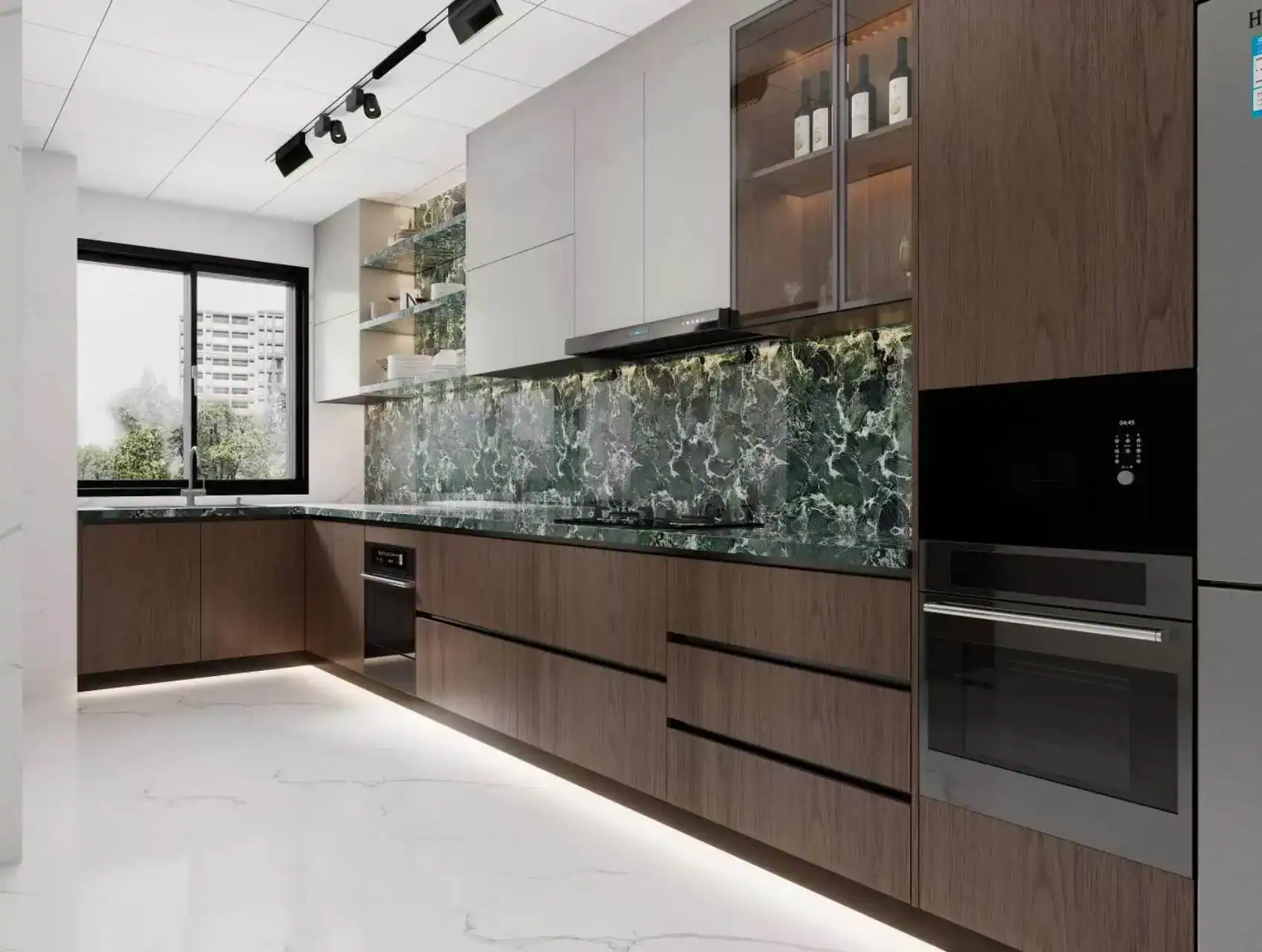
Among all material pairings, the combination of warm wood with cool, durable sintered stone or ceramic has emerged as the most compelling solution — one that elegantly balances temperature, aesthetics, and longevity. Organic materials like wood veneer and natural stone bring tactile warmth, while engineered surfaces like sintered stone deliver exceptional scratch, heat, and UV resistance. Together, they create a kitchen that feels both grounded and sophisticated — a space that is visually rich, functionally resilient, and deeply personal.
Part Two: The Core Value of Material Mixing — Why Wood + Sintered Stone / Ceramic Is the Golden Combination for Custom Kitchens
Texture Complementarity: Warmth Meets Cool Precision
Wood possesses an irreplaceable quality — its natural grain, organic warmth, and tactile softness bring a sense of comfort that no synthetic material can fully replicate. Sintered stone and ceramic, by contrast, offer sleekness, precision, and a certain cool elegance. When paired together, the warmth of wood tempers the inherent coolness of stone surfaces, creating a kitchen that feels welcoming rather than clinical.
The growing focus on natural materials in kitchen design reflects a broader desire for spaces that feel grounded, tactile, and enduring rather than overly polished. Where kitchens have sometimes skewed toward polished perfection in the past, the 2026 aesthetic leans into texture — brushed wood veneers instead of lacquer, honed counters that feel soft to the touch rather than mirror-bright. This interplay of warm and cool surfaces transforms the kitchen from a sterile workspace into a serene, inviting centerpiece of the home.
Performance Complementarity: Form Meets Function
Beyond aesthetics, the wood-and-stone pairing is fundamentally driven by practical logic. Wood excels in versatility — it can be shaped, carved, and configured to accommodate diverse storage needs and design expressions. From fluted cabinet fronts to open shelving and custom millwork, wood provides the structural and visual flexibility that makes a kitchen feel bespoke.
Sintered stone and high-spec ceramic, meanwhile, bring an entirely different set of performance attributes. These engineered surfaces offer exceptional scratch resistance, heat resistance up to extreme temperatures, and near-zero porosity — meaning they resist staining, repel moisture, and require minimal maintenance. They are ideal for the kitchen‘s core operational zones: countertops where hot pans land, splashbacks behind cooking areas, and islands where daily prep work happens.
The logic is elegantly simple: let wood do what wood does best — provide warmth, texture, and adaptable form — while letting stone and ceramic protect the surfaces that endure the most wear. This is not just an aesthetic choice; it is an engineered approach to functionality that reflects how kitchens are actually used.
Aesthetic Elevation: Texture, Color, and Visual Identity
When different textures, colors, and finishes collide, the result is a kitchen with genuine visual identity. Deep wood grains paired with dramatic stone veining create a rich interplay of light and shadow. Matte ceramic surfaces juxtaposed against glossy lacquered wood introduce subtle tension. The 2026 design direction favors warm neutrals — sand, greige, taupe — paired with richer, nature-inspired tones like olive green and deep navy, all anchored by the grounding presence of natural wood and stone.
The kitchen is no longer just a place to cook; it has become a hub for connection, creativity, and sustainable living. Material mixing allows each kitchen to tell its own story — one that reflects the homeowner‘s personality, the home’s architectural language, and the rhythms of daily life.
Part Three: Design Principles and Practical Techniques for Material Mixing
Core Design Principles: Hierarchy, Cohesion, and Restraint
The most successful mixed-material kitchens are not the ones that throw every texture into the mix — they are the ones governed by clarity and intention. Four principles should guide every decision:
Clear Hierarchy. Every kitchen needs a dominant material that anchors the space visually. Typically, cabinetry sets the foundation — whether in natural wood tones or a muted painted finish — while stone, ceramic, and metal accents play supporting roles. A kitchen might pair warm wood cabinetry with a stone island and metal hardware, creating depth without chaos.
Style Cohesion. Mixed materials must speak a common design language. A rustic, heavily textured wood paired with a high-gloss, ultra-modern sintered stone can create jarring dissonance unless carefully mediated. The most harmonious kitchens ensure that all materials — regardless of their differences — share a coherent stylistic identity, whether that be warm minimalism, Japandi serenity, or modern country charm.
Color Coordination. When combining multiple materials, the color palette must be tightly controlled. The 2026 trend favors tone-on-tone layering — woods in similar tonal families paired with stones that share underlying hues. Two-tone cabinetry remains a top design choice, but the approach has matured: it is now less about stark contrast and more about harmony, pairing colors and materials that feel natural together.
Functional Adaptation. Different kitchen zones demand different materials. Prep areas and cooking zones require surfaces that resist heat, stains, and moisture — here, sintered stone and ceramic are non-negotiable. Display shelving, dining nooks, and peripheral cabinetry can embrace the warmth and texture of wood more freely. Let function guide material placement, and the design will feel both logical and beautiful.
Combination One: Wood Cabinetry + Ceramic Countertops — The Ideal Pairing for Chinese Kitchens
For households where cooking is a daily, often intense affair — especially in Chinese kitchens where high-heat stir-frying is the norm — the combination of wood cabinetry with ceramic countertops offers a compelling balance. Ceramic surfaces are exceptionally resistant to heat, stains, and moisture absorption, making them ideal for the rigorous demands of daily cooking. Their impervious surface means oil splatters wipe away effortlessly, and acidic ingredients leave no lasting trace.
The visual pairing works beautifully as well. Light oak or ash cabinetry paired with matte white or warm beige ceramic countertops creates a fresh, clean aesthetic. For deeper, more dramatic spaces, walnut or dark-stained wood can be matched with ceramic surfaces that feature subtle stone veining in grey or taupe tones. New Chinese-style kitchens, for example, often pair black walnut cabinetry with white ceramic or quartz-like surfaces — the warm wood tones anchoring the space, while the light countertops provide visual lift and contrast. Materials in these designs follow a “dialogue between ancient and modern” — wood frames for structure, ceramic surfaces for functionality, all unified by a cohesive color story.
Combination Two: Wood Cabinetry + Sintered Stone Island — The Heart of Open-Plan Living
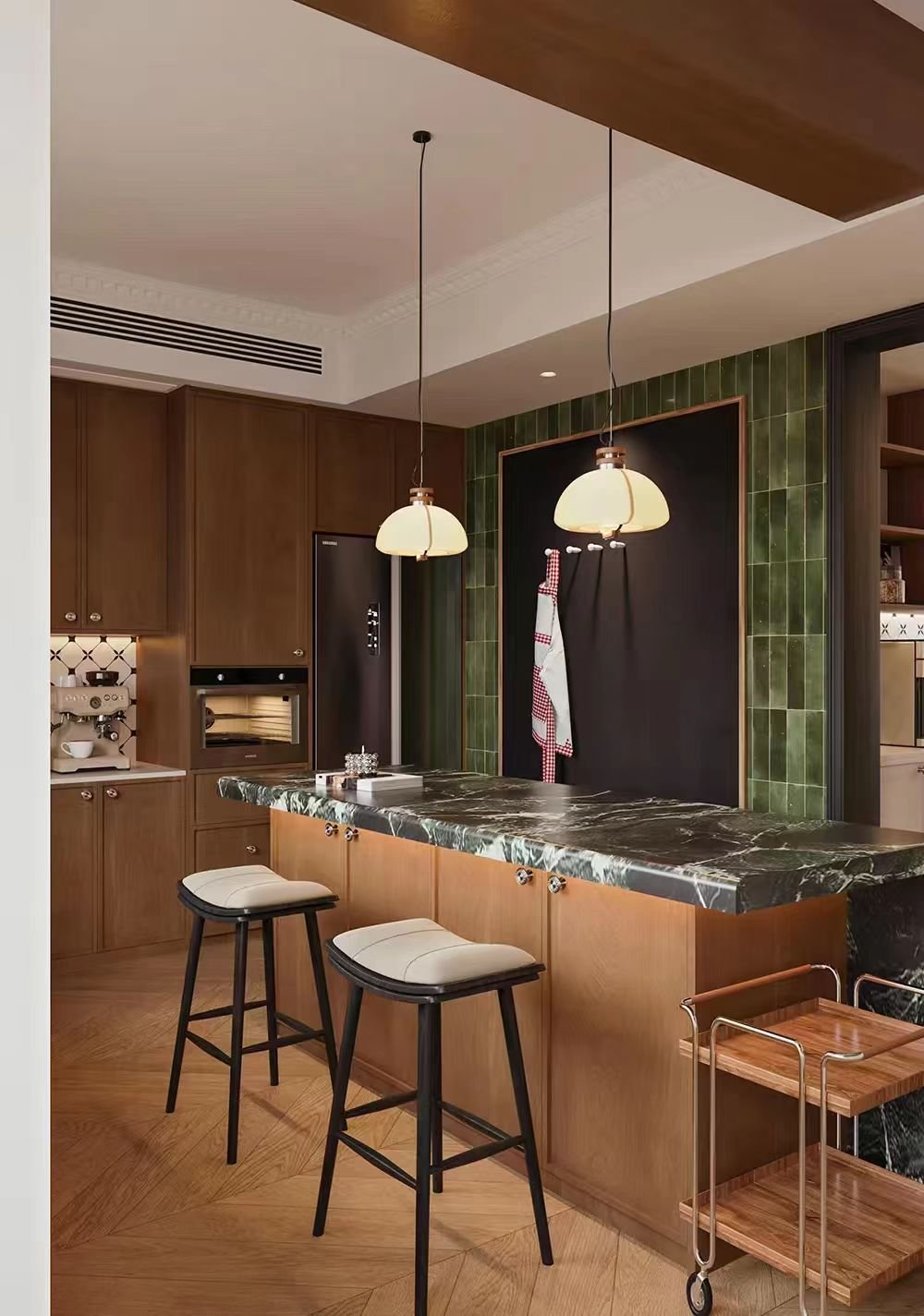
As kitchens increasingly merge with dining and living areas, the island has evolved from a simple work surface into a sculptural centerpiece. The combination of a wood-clad island base topped with a striking sintered stone slab has become one of the most sought-after configurations for 2026.
Dimensional Considerations. A functional island requires thoughtful sizing. For comfortable prep work and casual dining, aim for a width of 60–90 cm — too narrow and you lose usable surface area, too wide and the island dominates the space unnecessarily. Height should fall between 90–95 cm for standard use, with a possible lower section (around 78 cm) for integrated dining extensions. The sintered stone slab, typically 12 mm thick, should overhang the wood base slightly to create a crisp, intentional edge.
Functional Integration. A well-designed island does more than provide counter space. It can incorporate deep drawers for storage, integrated power outlets concealed in the side panels, and even under-counter appliances. The wood base provides the structural framework and warmth, while the sintered stone top delivers a seamless, virtually indestructible work surface that can handle everything from hot cookware to spilled wine.
Style Unity. The island should feel like a considered piece of furniture rather than an afterthought. In 2026, designers are treating the island as a standalone statement — pairing contrasting textures to add visual interest. Cold, polished stone waterfall edges on one side might be balanced by warm, vertical wood slats on the base. The goal is a composition that feels both integrated and distinct, anchoring the open-plan space without overpowering it.
Combination Three: Advanced Mixing — Wood + Sintered Stone + Ceramic for Large-Format Kitchens
For larger residences — open-plan apartments, sprawling villas, and homes where the kitchen is truly the center of gravity — the most sophisticated designs embrace a full trio of materials. In these spaces, wood defines the primary cabinetry volumes, sintered stone commands the central island and splashback, and ceramic appears as a textural accent on walls, open shelving niches, or even as a secondary countertop material.
The key to success with three materials is even stricter discipline: one must dominate (typically wood), one must perform the heavy functional lifting (typically sintered stone), and one should serve as a subtle accent (ceramic, perhaps in a fluted or textured finish). The 2026 trend of “warm minimalism” demonstrates this perfectly — natural wood accents and light stone textures create an effortless, welcoming look, while uncluttered countertops and hidden storage maintain a sense of calm order.
Part Four: A Practical Guide to Avoiding Pitfalls in Material Mixing
Craftsmanship Pitfalls: Joints, Transitions, and Reinforcement Standards
The most beautiful material pairings can be undermined by poor execution. Where wood meets stone, where ceramic transitions to wood, where different surfaces converge — these are the moments where craftsmanship makes or breaks the design.
Expansion and Contraction. Different materials expand and contract at different rates when exposed to temperature and humidity fluctuations. Wood is particularly responsive to moisture changes, while sintered stone and ceramic are dimensionally stable. When these materials abut one another, failing to account for differential movement can lead to cracking, buckling, or unsightly gaps. The solution lies in two key practices: first, always install a stable substrate beneath countertops — three parallel aluminum support bars or a full plywood base for imported stone slabs — to provide uniform backing; second, at material transitions, leave deliberate expansion joints of appropriate width, then fill with a flexible sealant in a matching color that absorbs movement without failing.
Edge Details and Transitions. How wood meets stone at the countertop edge is a defining detail. A clean, flush transition requires precise milling and careful installation. For sintered stone slabs, the edge can be mitered to create a seamless waterfall effect down the side of an island, meeting the wood base with an intentional shadow line or a discreet metal trim. Avoid “hard connections” where rigid materials are bonded directly without allowance for movement; instead, use flexible connectors like silicone sealant or engineered trim profiles that act as buffers.
Reinforcement for Heavy Slabs. Sintered stone, while incredibly strong in compression and scratch resistance, is relatively brittle when subjected to point impacts — a heavy pot dropped on an unsupported edge can cause chipping. Full-contact support across the entire underside is essential. For large islands, ensure the cabinet framework provides continuous bearing across the entire footprint of the stone slab. For extended overhangs beyond 30 cm, additional corbels or steel brackets concealed within the wood base should be specified.
Material Selection Pitfalls: Knowing Your Materials
Not all sintered stone is created equal. The market has seen an influx of “faux sintered stone” — resin-based slabs that mimic the look but lack the performance. Genuine sintered stone is manufactured through high-temperature sintering (over 1200°C) of natural minerals, resulting in a material with Mohs hardness of 7–8, near-zero water absorption, and true UV stability. When specifying, request certification and verify slab thickness — 12 mm is the standard for countertops; anything thinner may compromise edge durability. For ceramic surfaces, choose products specifically rated for countertop use; standard wall tiles lack the impact resistance required for work surfaces.
Wood selection matters equally. For kitchen cabinetry, engineered wood cores with real wood veneers offer superior dimensional stability compared to solid timber, reducing the risk of warping in humid environments. Matte and anti-fingerprint finishes are practical for daily use, while wire-brushed textures bring out the natural grain for a more authentic, artisanal look.
Design Pitfalls: The Art of Restraint
Perhaps the most common pitfall in material mixing is overenthusiasm. The 2026 design direction emphasizes that the goal is no longer to showcase as many materials as possible. Instead, homeowners should choose two or three key finishes that work well together and create a cohesive, tailored look.
Avoid the temptation to introduce every texture you love. If your cabinetry features prominent wood grain, let your stone surfaces be relatively restrained in veining. If your stone island makes a bold, dramatic statement, keep surrounding cabinetry quiet and understated. The kitchen should feel curated, not cluttered — a space where each material has a clear purpose and a distinct voice within a harmonious chorus.
Part Five: A Great Custom Kitchen Is the Unity of Material, Design, and Function
The Core of Material Mixing Is Not Simple Addition, but Precise Adaptation to Lifestyle
At its essence, the art of mixing wood with sintered stone and ceramic is not about piling materials together for visual effect. It is about understanding how a household actually lives — how they cook, how they gather, how they move through their space — and then selecting materials that respond to those realities with intelligence and grace.
The kitchen of 2026 is intelligent, sustainable, and deeply personalized. It blends smart technology with biophilic warmth, balances minimalism with character, and prioritizes durability over short-term trends. Wood and stone are not merely surfaces; they are partners in daily life — one offering warmth and flexibility, the other offering resilience and ease.
Elevation: Creating Kitchens with Beauty, Performance, and Soul
The most enduring kitchens are those that feel as good as they look. They welcome you in with the warmth of wood, support you with the unyielding performance of stone and ceramic, and reflect your identity through thoughtful, layered design. With deep material knowledge and disciplined design execution, it is possible to create a custom kitchen that is not just beautiful, nor merely functional — but truly a place where life unfolds with comfort, confidence, and quiet joy.
A well-designed kitchen is never just about cooking. It is about the mornings that start here, the conversations that happen here, the meals that nourish, and the memories that take root. And at the center of it all — the materials you choose.