 English
  日本語
日本語  العربية
  Deutsch
  Español
  Français
  한국어
한국어  Português
  Татар теле
  Русский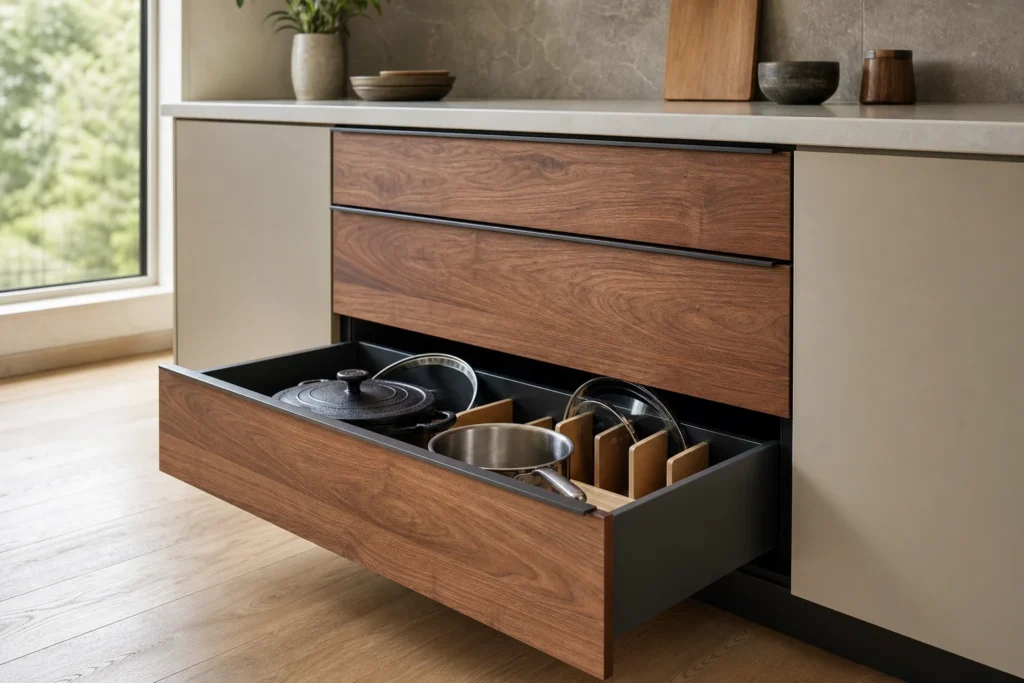
Walnut Drawer Base Kitchen Cabinet with Heavy-Duty Drawers
A walnut-finished three-drawer base cabinet engineered as a coordinated cookware storage system, with full-extension access, reinforced drawer construction and project-specific dimensions.
Bring Pots and Pans Into View Instead of Stacking Them Behind Doors
This drawer base cabinet is planned for frequently used cookware such as saucepans, frying pans, stockpots and lids. A shallow upper drawer can serve utensils or smaller accessories, while the deeper drawers keep larger cookware closer to the preparation and cooking zone.
Full-extension access allows the rear of a deep drawer to remain reachable, reducing the need to lift several stacked items before reaching one pot. The module can be developed within a custom Kitchen Cabinet layout while retaining its specific role as a cookware drawer base rather than a door cabinet or pantry.
The Drawer Box, Bottom, Slides and Cabinet Must Work as One System
A heavy-cookware drawer cannot be specified by the slide alone. The drawer box, bottom panel and its support, fasteners, slide fixing points, cabinet sides, back construction, leveling and installation all influence how the assembly behaves in use.
These parts should be reviewed against the intended contents and the final drawer size. Hardware samples, technical information and internal structure drawings can be used during project confirmation; a fixed load rating should not be published unless the complete selected system has been verified under the relevant conditions. The related drawing review for heavy cookware drawers shows how to check the load path across the full cabinet system.
Match the Drawer Span to the Cookware It Needs to Hold
A wider front may look calm and architectural, but excessive clear span can make load distribution and drawer adjustment more demanding. The useful width should be developed from the largest pans, lid storage, handle direction and the number of items that need to sit side by side.
During drawing review, cabinet width, internal drawer width, drawer depth, front proportions, side clearances and the selected slide system should be checked together. If the cookware inventory is especially dense or heavy, dividing storage across two drawers or adjacent modules may create a more practical arrangement than one oversized drawer.
Use Adjustable Dividers to Separate Pots, Pans and Lids
Adjustable dividers can create dedicated positions for pot bodies, pan handles and vertical lids. The aim is not to fill every gap, but to keep items from sliding across the drawer and to preserve a clear lifting path for the cookware used most often.
The divider layout should follow a real cookware list rather than a generic accessory package. Pot diameter, handle length, lid height and nesting preference help determine whether the drawer needs movable pegs, partitions, a lid rack or an open zone that can change with the household’s routine.
Coordinate Grain Direction Across All Three Drawer Fronts
Walnut veneer or a walnut-look panel gives the drawer base a warm visual weight below the countertop. Grain direction, panel sequence, tone variation, edge treatment and the spacing between fronts should be confirmed together so the three-drawer elevation reads as one composed unit.
A finish sample can be reviewed beside the countertop, floor and adjacent cabinet color under the project’s natural light. Because walnut appearance varies by material and batch, the approved sample and production method should guide the final tone instead of relying only on screen images.
Coordinate Drawer Count, Hardware and Cabinet Dimensions
Cabinet width, height and depth can be developed around the available opening, countertop level, toe-kick and neighboring modules. The drawer count and front heights can then follow the intended contents, from cutlery and tools in the upper drawer to pots, pans and lids below.
Other project variables include the drawer box, bottom support, slide functions, divider system, walnut tone, grain direction and handle profile. These options should be coordinated as one specification so that a visual change to the front does not conflict with internal clearance or the selected hardware.
Confirm the Cookware List, Drawings and Samples Before Production
For an initial quotation and layout review, provide the installation dimensions, countertop height, adjacent cabinet or appliance positions, preferred drawer count, representative cookware sizes, finish references and handle direction. Photos or a marked floor plan can clarify site conditions.
Before production, review the plan, elevations, cabinet sections, drawer clearances, hardware access, toe-kick, countertop junction and installation method. Finish and hardware samples, internal structure details and maintenance guidance provide a clearer basis for approval than broad claims about capacity.
Frequently Asked Questions
Yes. The cabinet and clear drawer width can be developed around the diameter, height, handle direction and quantity of the cast iron pieces you plan to store. Width should also be checked against drawer depth, load distribution, the drawer box, bottom support, slides and cabinet structure. A cookware list or photos with dimensions help determine whether one wide drawer or two more focused storage zones are more practical.
Full-extension access and soft-close operation can be specified, subject to the selected drawer system and project requirements. The final slide should be matched to the drawer dimensions, construction, expected contents, fixing method and supplier technical information. Rather than treating one slide as suitable for every cabinet, review it together with the drawer box, bottom panel, cabinet sides and installation adjustment.
Adjustable partitions, movable pegs or a dedicated lid rack can be planned according to the cookware inventory. Share the approximate pot diameters, pan-handle lengths, lid sizes and preferred nesting method. The divider arrangement should restrain movement without crowding the drawer, and it should leave enough space to lift heavy cookware safely and remove components for cleaning.
The design should control clear span, drawer-box rigidity, bottom support, slide selection, fastener positions, cabinet-side stability, leveling and load distribution. The drawer width should follow the actual cookware rather than an appearance target alone. During production review, the complete assembly and installation conditions need to be checked together; an unverified load number does not describe how every width or hardware combination will perform.
Provide the available width, height and depth, countertop level, adjacent modules, appliance positions, preferred drawer count, representative cookware dimensions, finish reference, handle preference and installation location. A marked plan, elevation or site photos are useful. These inputs allow the cabinet proportions, drawer-box system, slides, internal dividers, fillers and installation details to be reviewed before a final specification is released.