English
  日本語
日本語  العربية
  Deutsch
  Español
  Français
  한국어
한국어  Português
  Татар теле
  Русский
 On a floor plan, cabinetry can look simple: a wardrobe along one wall, a minibar cabinet beside a desk, a vanity between two partitions, or a row of storage units repeated across hotel rooms. In a real overseas project, production should not begin only because the cabinet list is written down. The custom cabinetry process for overseas projects becomes reliable when the floor plan, site dimensions, drawings, materials, hardware, packing method and installation support are checked as one connected system.
At Sunrise Furnishing, the work before production is often the part that protects the work after production. A clear pre-production process helps reduce drawing changes, material misunderstandings, packing confusion and installation delays once the cabinetry has already left the factory.

Why Production Should Not Start With Only a Cabinet List
A cabinet list may say “wardrobe,” “minibar cabinet,” “bathroom vanity” or “laundry cabinet,” but those words do not tell a factory enough to produce accurately. Before production starts, Sunrise Furnishing needs to understand how each cabinet will sit in the room, how it connects to walls and ceilings, and whether the surrounding site conditions support the proposed design.
Floor plans show intent, not every production detail
Floor plans are the first useful document because they show room function, circulation and approximate cabinet locations. They do not always show wall unevenness, exact ceiling height, socket locations, door swings, appliance openings or the installation sequence. Those details can affect cabinet width, depth, carcass structure, panel clearance, ventilation and hardware selection.
For an overseas buyer, this is why early drawing review matters. If a cabinet is approved only from a design rendering, changes may appear later when site measurements, electrical points or appliances are checked. A stronger process starts by turning the floor plan into a set of questions before it becomes a production file.
What Sunrise checks before drawings move forward
The first review usually focuses on room function, wall length, ceiling height, installation access, appliance requirements, visible finishes and any built-in lighting or hardware. For hotel or apartment projects, repeated room types also need attention. A small change in one room type can repeat across many units, so it is better to clarify the detail before batch production begins.
The First Information Set: Plans, Site Dimensions and Site Photos
The most useful starting point is not a perfect drawing package. It is a clear information set. Sunrise Furnishing can coordinate more efficiently when the buyer, designer or contractor provides plans, dimensions and site references that explain the actual installation environment.
Wall dimensions, ceiling height, door swing and socket positions
Key measurements include wall width, cabinet height, ceiling height, baseboard or skirting conditions, door swing direction, window position, socket locations, plumbing points and any appliance openings. These are not minor details. A socket hidden behind a wardrobe panel, a door that cannot open fully, or an appliance opening that is too tight can all create avoidable changes.
| Information to confirm | Why it matters | Risk if unclear |
|---|---|---|
| Wall width and ceiling height | Sets cabinet size and panel proportions | Cabinet may not fit or may need trimming |
| Door swing and passage width | Protects access and daily use | Doors or drawers may conflict with traffic |
| Socket and switch locations | Coordinates panels, lighting and appliances | Electrical points may be blocked |
| Appliance dimensions | Controls openings and ventilation gaps | Appliance may not fit or overheat |
| Site photos and videos | Shows real site conditions | Drawings may miss obstacles or finish issues |
Site photos, videos and installer notes
For overseas projects, photos and short videos can help bridge the distance between the jobsite and the factory. They show wall conditions, ceiling beams, finished flooring, existing services and installation access. Installer notes are also useful because local installers often know site limitations that are not obvious in the original plan.
This information does not replace drawings. It makes drawings more reliable.
Turning Concept Drawings Into Production Drawings
In the custom cabinetry process for overseas projects, one of the most important transitions is from concept drawings to production drawings. A concept drawing shows design intent. A production drawing tells the factory what to make.

Elevations, sections and internal cabinet layouts
Cabinet elevations show the front view, door proportions, open shelves, handle positions and visible design rhythm. Sections explain depth, height, panel thickness relationships, internal storage and connection details. Internal layouts show drawers, shelves, hanging rails, appliance zones and hidden service space.
For wardrobes, the internal layout may need long-hanging space, shelves, drawers and lighting. For minibar cabinets, the drawing should consider appliance size, ventilation, cable routing, countertop or worktop surface, and whether a door or panel can open without blocking the room.
Hardware, lighting and appliance coordination
Hardware and appliances should be coordinated before the production drawing is approved. Hinges, drawer slides, handles, lighting strips, transformers, sockets and appliances all affect structure. A cabinet that looks clean on the front can still require extra clearance, access panels or ventilation at the back.
This is where manufacturer coordination becomes practical. Sunrise Furnishing reviews whether the drawing can be produced, packed and installed, not only whether it looks correct in a presentation.
Material and Finish Approval Before Batch Production
Material approval is not only a design preference. It is part of production control. Before batch production, the buyer and manufacturer should confirm the main board, veneer, lacquer, laminate, metal, glass, hardware finish and any visible edge treatment.
Board, veneer, lacquer, metal and glass samples
Samples help align expectation before the factory produces a full set of cabinets. A dark wood veneer, for example, can look different under hotel room lighting than it does in a small sample photo. Lacquer gloss level, metal tone, glass transparency and edge treatment also influence the final result.
When the project is overseas, sample confirmation is especially important because the buyer may not inspect every cabinet during production. A clear sample approval record gives both sides a common reference.
Why finish approval matters before repeated work
In repeated apartment or hotel layouts, one finish decision may affect many rooms. If the finish is corrected after production starts, the change can influence panels, doors, trims and replacement planning. For this reason, Sunrise Furnishing treats finish approval as a control point before production, not a decorative afterthought.
Production Checks, Labels and Export Packing
Once drawings and materials are approved, production can move forward with clearer instructions. At this stage, the production drawing becomes the central reference for cabinet size, structure, panel finish, hardware, openings and special installation details.
The production drawing as the final instruction
Production teams need consistent information. If the approved drawing, material sample and packing plan do not match, the project becomes harder to control. A practical production process should connect the drawing number, cabinet number, room number or installation zone, and any special notes.
Quality checks should focus on visible finish, cabinet structure, hardware preparation, panel protection and whether the items match the approved project documents. The article should not promise that every risk disappears, but a controlled document process can reduce avoidable misunderstanding.
Room-by-room labels, hardware boxes and packing lists
Packing is a critical part of overseas cabinetry coordination. Cabinets may be packed by room, area, installation sequence or item type. Labels should help the site team identify which parts belong together. Hardware boxes, fragile components, glass, metal trims and lighting accessories should be protected and referenced in the packing list.
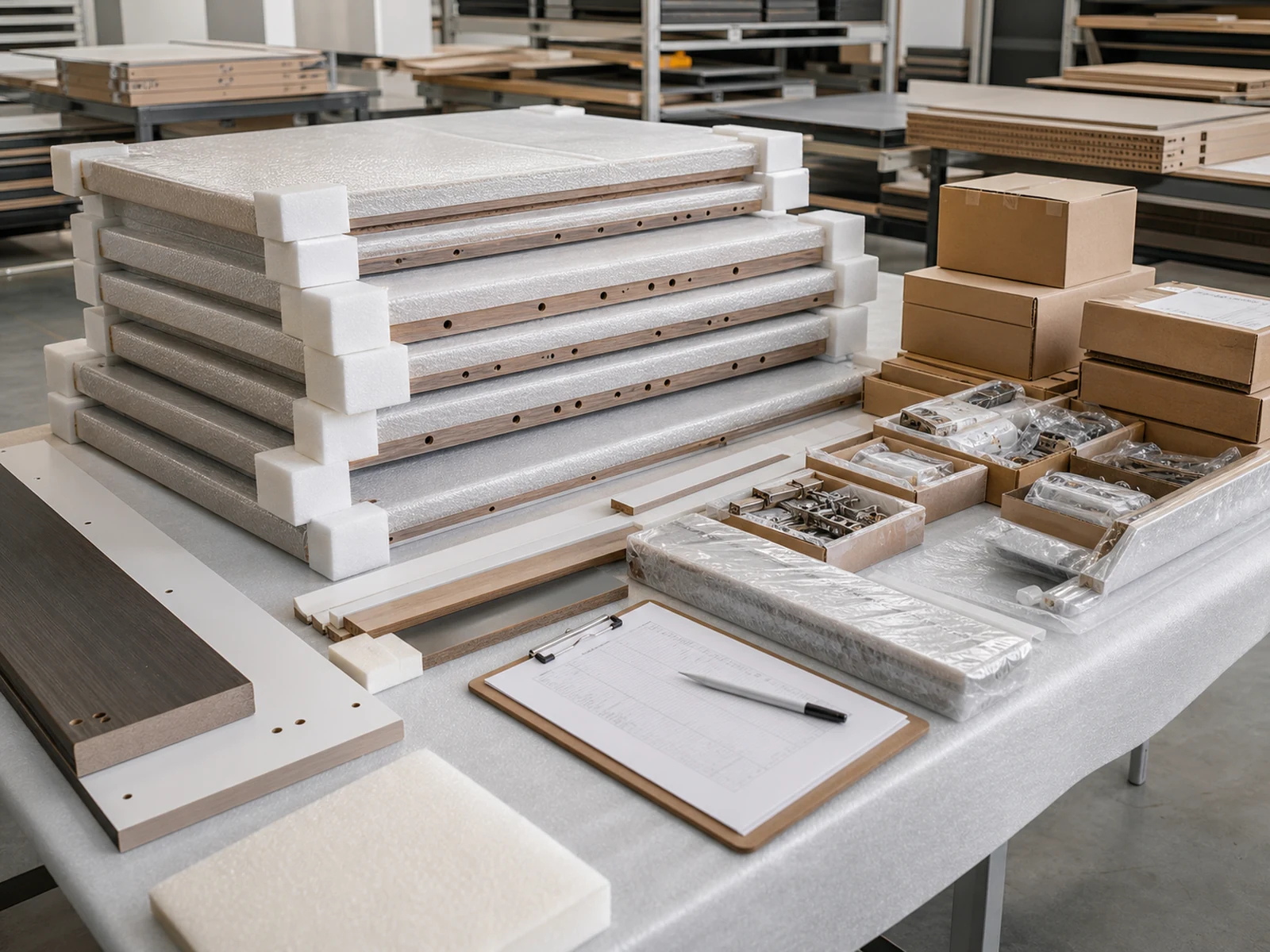
For projects with repeated rooms, labels can reduce confusion on site. A panel that is well made but not clearly identified can still slow installation.
Shipping and Installation Support for Overseas Sites
Shipping is not separate from project coordination. The way cabinets are packed and documented affects how easily the overseas site team can receive, store and install them.
Packing list, loading sequence and delivery coordination
A packing list should help the buyer understand what is inside each package and how it relates to rooms or installation zones. For large or repeated projects, loading sequence can also matter. Items needed early on site should not be buried behind items that will be installed later, unless the logistics plan requires it.
The goal is not to make overseas shipping sound effortless. The goal is to make the handoff more legible for the people who receive the goods.
Installation drawings and remote clarification
Installation drawings, labeled parts, site photos, videos and online communication can support overseas installers. These materials are most useful when they are prepared from the same approved production logic. If the production drawing says one thing and the installation reference says another, the site team has to guess.
For this reason, Sunrise Furnishing’s coordination work should be understood as a chain: drawings support production, production supports packing, and packing supports installation.
Where Hotel Wardrobes and Minibar Cabinets Fit in the Process
Hotel room cabinetry is a good example of why the pre-production process matters. A single room may include a wardrobe, luggage area, desk, TV wall, minibar cabinet and lighting details. When the same room type repeats across many rooms, small details become project-wide decisions.
Repeated room types and batch consistency
For hotel projects, repeated room drawings, approved samples, room-number labeling and finish control help maintain consistency. A dark wood hotel room wardrobe and minibar cabinet may look simple in one room, but the project requires stable dimensions, matching finish, correct ventilation and clear packing references across the batch.
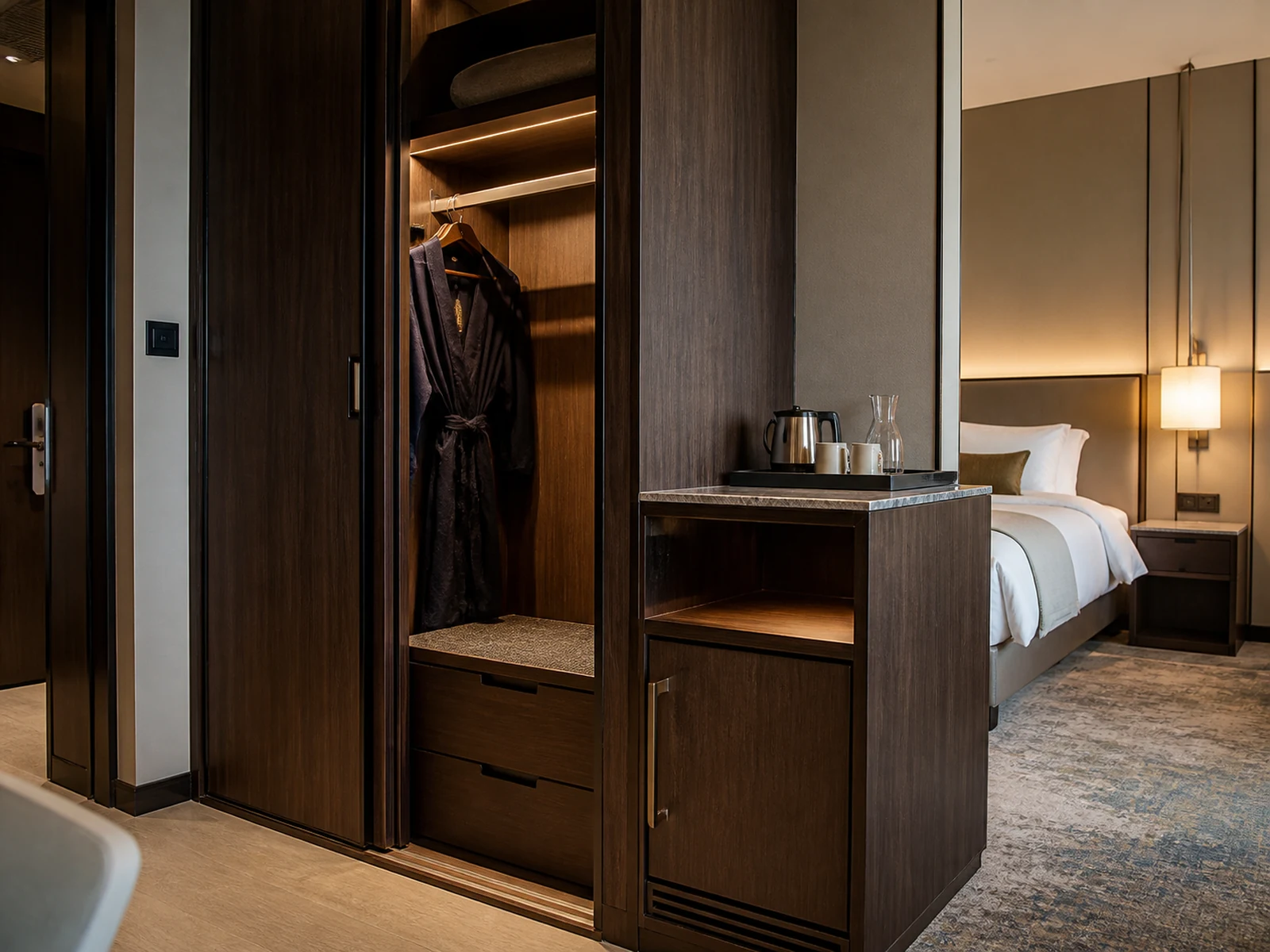
Wardrobe, minibar, lighting and ventilation coordination
Wardrobes need usable internal storage, durable hardware and alignment with walls, floors and doors. Minibar cabinets need appliance openings, ventilation, cable access and sometimes lighting or metal/glass details. If these are checked before production, the final cabinet set has a better chance of arriving on site with fewer unresolved questions.
This is why a hotel wardrobe and minibar project should not be treated only as furniture ordering. It is a coordinated drawing, material, production, packing and installation workflow.
Frequently Asked Questions
What information is needed to start an overseas custom cabinetry project?
Usually, the first useful information includes floor plans, room dimensions, ceiling height, site photos, appliance details, design requirements and any installer notes. For repeated rooms, a room schedule or room type list is also helpful.
Why are production drawings important?
Production drawings confirm cabinet size, structure, openings, materials, hardware, lighting details and installation relationships before manufacturing. They reduce the gap between design intent and factory execution.
How are cabinets packed for overseas projects?
Cabinets can be labeled and packed by room, installation zone or item sequence. Protective wrapping, hardware boxes, fragile component labels and packing lists help the overseas site team identify and install the parts more efficiently.
How are hotel room cabinets kept consistent in batch production?
Repeated room drawings, approved finish samples, hardware confirmation, room-number labels and controlled production references help keep hotel wardrobes and minibar cabinets more consistent across rooms.
Can installation be supported remotely?
Yes, remote support can be provided through installation drawings, labeled parts, site photos, videos and online communication. The support is most useful when the production and packing documents are already clear.
Before You Send a Project for Review
Before production starts, the most useful step is to prepare a clear project package: floor plans, room dimensions, site photos, appliance information, finish direction and any installation notes. Sunrise Furnishing can then review the custom cabinetry process for overseas projects with a more practical understanding of the site, the drawings and the final delivery requirements.
For overseas homeowners, designers, contractors and hotel project teams, this early coordination is not extra paperwork. It is the foundation that helps custom cabinetry move from design intent to production, packing and installation support with fewer avoidable questions.