English
  日本語
日本語  العربية
  Deutsch
  Español
  Français
  한국어
한국어  Português
  Татар теле
  Русский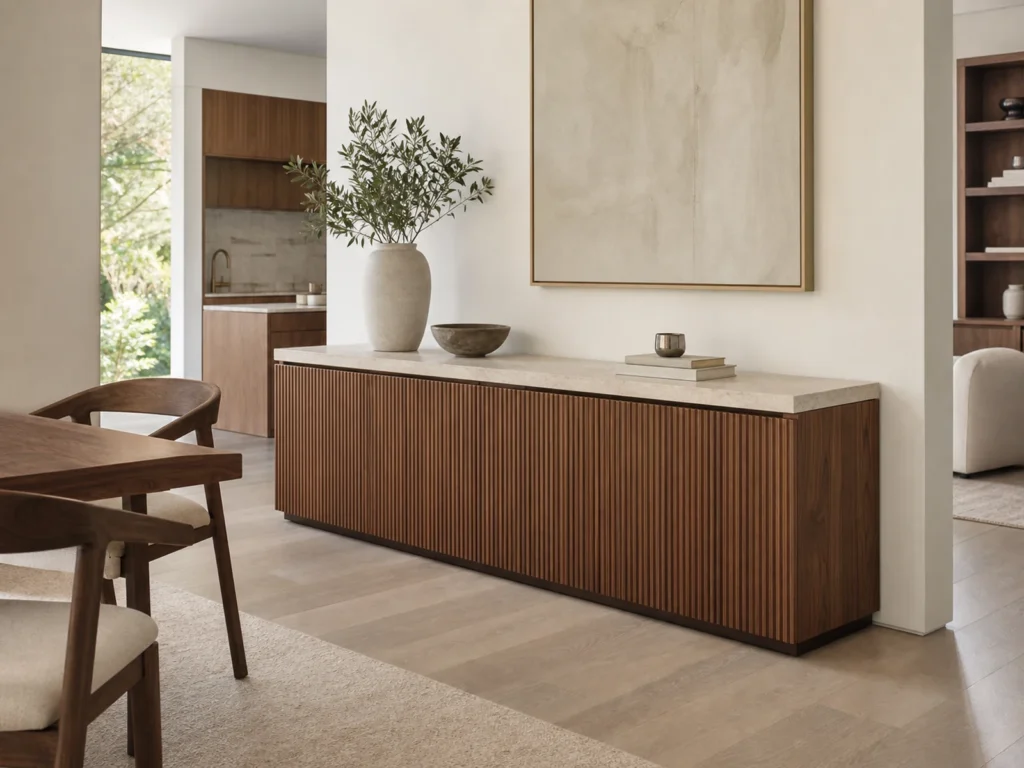
Fluted Walnut Sideboard Cabinet with Stone Top
A low horizontal sideboard cabinet with a fluted walnut facade, a pale stone serving top, and closed dining storage for open-plan homes where the kitchen, dining, and living cabinetry are all visible at once.
A Low Sideboard Designed as a Transition Piece
This fluted walnut sideboard cabinet with stone top is planned as a transition piece rather than a separate decorative cabinet. Its low horizontal proportion can sit along a dining wall, behind a sofa line, or beside an open kitchen, helping the dining zone feel related to nearby cabinetry without copying the full kitchen composition.
The final width, height, and depth should be reviewed against the wall length, dining table clearance, socket positions, skirting, and adjacent cabinet lines. A sideboard that looks calm in an open-plan layout usually depends on these proportions as much as on the finish itself.
Fluted Walnut Without an Overly Heavy Facade
The fluted walnut front gives the cabinet a controlled vertical rhythm, while the low cabinet shape keeps the overall mass grounded. Fluting can make a wide dining cabinet feel more detailed, but the profile, groove depth, edge treatment, and grain direction should be confirmed with samples before production.
For open-plan interiors, walnut does not need to cover every visible cabinet surface. The sideboard can carry a stronger wood texture in the foreground while nearby kitchen or living cabinetry uses quieter solid-color panels, matching metal details, or a related stone tone.
A Stone Top for Serving and Daily Placement
The stone top gives the sideboard a practical surface for serving dishes, drinks, coffee equipment, tableware staging, or daily placement near the dining area. Pale stone also helps lighten the walnut facade and can echo kitchen countertops or nearby stone accents.
Stone type, slab tone, edge thickness, overhang, joint position, and care instructions should be confirmed during material review. Natural stone and stone-look materials may show variation, so approved physical samples are more reliable than screen images alone.
Storage Planned for Dining Objects
The closed storage can be planned for dinnerware, serving bowls, glassware, cutlery, table linens, trays, small appliances, or seasonal dining items. Adjustable shelves, internal drawers, divided drawer inserts, and soft-close hardware can be specified according to the objects you actually store.
Drawers may sit behind a unified fluted facade when the design needs a cleaner front. Door swing, drawer clearance, handle position, and internal shelf spacing should be checked against the dining table, chairs, and walking route before drawings are approved.
Wall, Skirting and Socket Coordination
A dining sideboard often meets real site conditions that are easy to miss in a simple product image. Wall flatness, skirting height, socket location, cable access, floor level, and any nearby door swing can affect the final cabinet line. These items should be recorded before the cabinet is confirmed for production.
The sideboard can be planned with a recessed plinth, a shadow gap, legs, wall fixing, cable openings, or a small stone upstand depending on the project. The right detail depends on the site and the expected use of the serving surface.
Finish Options for Open-Plan Interiors
Because the sideboard is often seen together with kitchen cabinets, dining furniture, and living storage, the finish plan should be reviewed as a small material system. Walnut, pale stone, muted metal, wall color, floor tone, and any solid cabinet color should each have a clear role.
If you are still deciding how many visible finishes to use, our guide to cabinetry finishes for an open plan home explains how to build a material hierarchy across kitchen, dining, and living cabinetry without repeating the same cabinet finish everywhere.
Prepare Your Sideboard Brief
To discuss a fluted walnut sideboard cabinet with a stone top, prepare the dining wall width, ceiling height, skirting details, socket positions, floor plan, preferred stone direction, walnut sample preference, storage list, and any kitchen or living cabinetry finishes that need to coordinate with it.
Sunrise Furnishing can review the information and help organize cabinet dimensions, finish direction, internal storage, hardware, and drawing details for production review.
Frequently Asked Questions
Yes. Cabinet depth can be planned according to wall width, dining table clearance, storage needs, socket positions, and the selected internal hardware. The final depth should be confirmed in drawings before production.
A small upstand can be considered when the wall condition, stone thickness, cabinet design, and site details support it. Upstand height, edge detail, and joint position should be reviewed together with the main stone top.
Fluted fronts need more attention than flat slab doors because the grooves can collect dust. Groove depth, finish coating, edge radius, and cleaning method should be reviewed with physical samples and care guidance before the final specification is approved.
Yes. Internal drawers can be planned behind fluted doors or behind a coordinated facade when the design needs a cleaner exterior. Drawer height, runner type, handle access, and door clearance should be confirmed in the cabinet drawings.
The sideboard can repeat one kitchen material, such as stone or metal, while changing the cabinet height, front texture, or walnut proportion. This helps the dining zone relate to the kitchen without making both areas look identical.