English
  日本語
日本語  العربية
  Deutsch
  Español
  Français
  한국어
한국어  Português
  Татар теле
  Русский
 A glass display cabinet with LED lights can make tableware, wine glasses, collectibles, and decorative objects feel intentional. But when it is planned only from a beautiful rendering, the result can easily become too bright, too reflective, or visually busy.
The problem is rarely the glass itself. More often, the cabinet was designed before the display items, lighting angle, shelf structure, wiring access, and dust control were properly considered. A high-end glass cabinet should not simply reveal everything inside. It should decide what deserves to be seen, how softly it should be lit, and how the cabinet will still work after daily use begins.
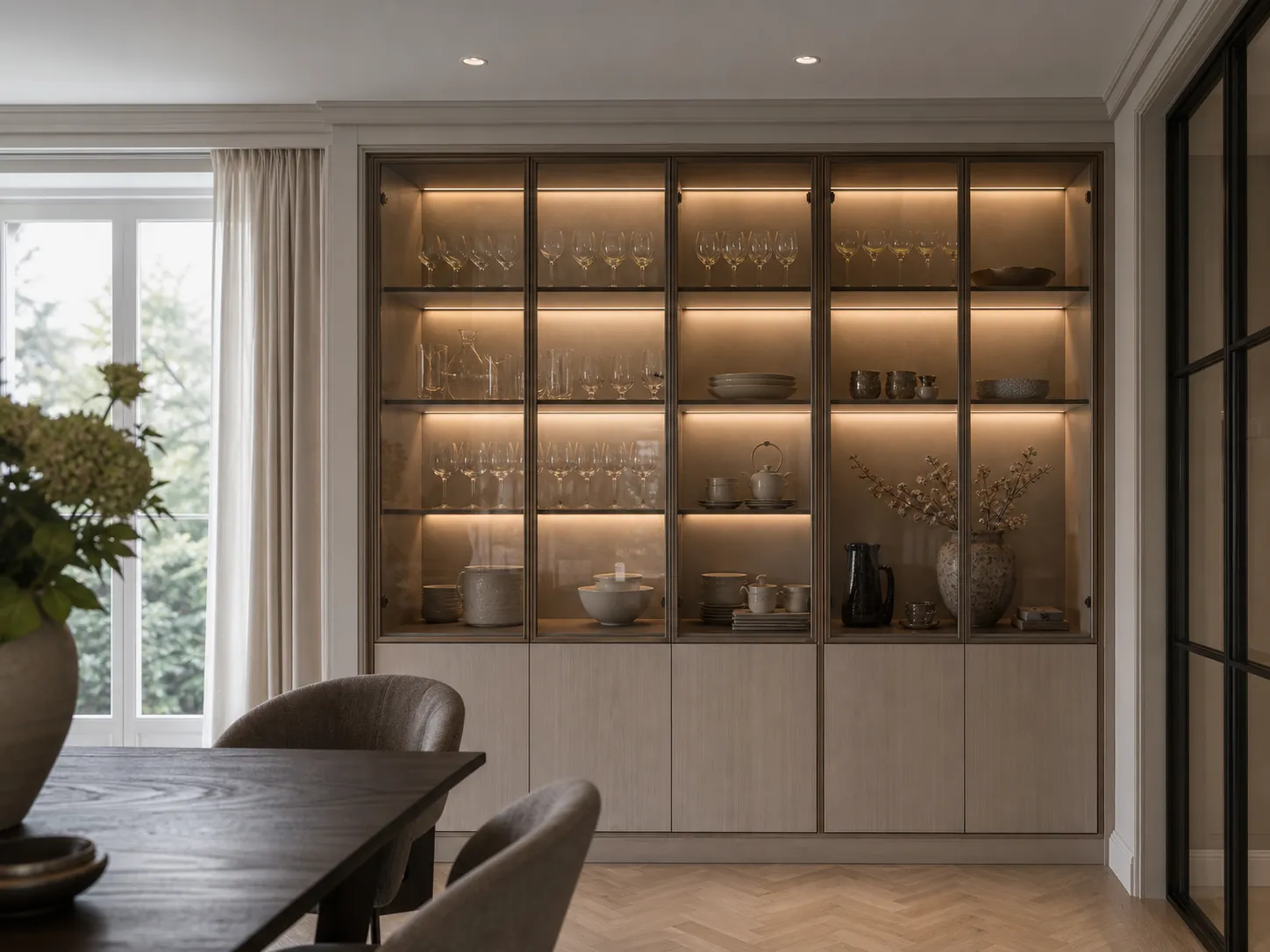
A Glass Display Cabinet Should Not Show Everything
A good glass display cabinet begins with editing. Before choosing glass doors or LED strips, decide what should actually be visible. Fine tableware, wine glasses, ceramics, collectibles, awards, books, or decorative pieces all need different shelf heights and different levels of lighting.
If every everyday item is placed behind clear glass, the cabinet can start to feel like open storage rather than display storage. This is why many custom designs combine glass sections with closed drawers or solid cabinet doors. The glass area creates the visual focus; the closed area hides items that are useful but not attractive enough to display.
For a dining room, the glass section might hold wine glasses, serving pieces, or a small collection of ceramics. For a living room, it may display books, sculpture, or travel objects. For a luxury apartment, a smaller built-in display cabinet can be more effective than a full-height glass wall if the space is narrow.
Start with what deserves to be visible
A simple way to plan is to divide items into three groups: display, daily use, and hidden storage. Display items should have enough space around them. Daily-use items should be easy to reach. Hidden storage should stay behind solid doors or drawers.
This one step can prevent a glass display cabinet from becoming visually crowded before the cabinet is even built.
Balance glass display with closed storage
A cabinet made entirely of glass doors can look impressive in a showroom, but it is not always practical at home. A balanced design often includes glass doors at eye level, closed cabinet doors below, and perhaps drawers for small accessories. This gives the room a calmer rhythm.
Plan LED Lights Around Reflection, Not Just Brightness
LED cabinet lighting should not be treated as decoration added at the end. In a glass cabinet, light interacts with glass doors, glossy objects, mirrors, metal frames, and the room’s natural light. If the LED strips are too exposed or too bright, the cabinet can look harsh instead of refined.
For a glass display cabinet with LED lights, the best lighting is usually controlled, softened, and placed with reflection in mind. Side lighting can outline objects gently. Vertical strips can create a balanced glow across tall shelves. Back lighting can make a display wall feel deeper, but it should be used carefully if the objects are reflective.
The goal is not to make the cabinet shine as much as possible. The goal is to make the objects visible without making the viewer notice the lighting hardware first.

Side lighting, vertical strips, and back lighting
Side lighting is often useful for tall glass cabinets because it spreads light along the height of the cabinet. Vertical strips can make shelves feel connected rather than separated. Back lighting can work well when the cabinet has a textured or matte back panel, but it may be too strong with mirror or glossy surfaces.
For display cabinets with glass shelves, lighting can travel through the shelf edges and create bright points. This can look elegant when controlled, but distracting when overdone.
Why softer lighting often looks more expensive
Soft lighting usually feels more high-end because it supports the display instead of fighting for attention. Warm or neutral LED tones are often easier to live with than cold blue-white light, especially in dining rooms and living rooms. If dimming is available, it can help the cabinet shift between everyday use and evening atmosphere.
Choose Glass That Fits the Display Purpose
Glass is not only a visual choice. It affects safety, cleaning, reflection, privacy, and how much visual detail the room has to absorb. Clear glass gives the most open display effect, but it also shows everything. Fluted or ribbed glass can soften the view and reduce visual clutter. Tinted glass can feel more architectural, especially in darker or luxury interiors.
For daily-use cabinets, tempered glass is commonly considered because it is designed for safer performance than ordinary glass. The final choice should still depend on cabinet size, door design, hardware, local requirements, and how the cabinet will be used.
Tempered glass for safety and daily use
If the cabinet doors will be opened often, safety and stability matter. Tempered glass, suitable hinges, and proper door sizing should be discussed during the design stage. Large glass doors need more careful hardware planning than small framed glass panels.
Do not treat all glass cabinet doors as the same. Door height, weight, frame material, hinge type, and handle position all affect how the cabinet feels in daily use.
Clear, fluted, tinted, or framed glass doors
Clear glass is best when the items inside are carefully arranged and worth showing. Fluted glass can hide small visual disorder while still giving a light display effect. Tinted glass can create a calmer, more dramatic mood. Framed glass doors can add structure and help the cabinet connect with metal, wood, or lacquer finishes in the room.
Shelves, Load, and Spacing Decide Whether the Cabinet Works
The shelf plan should come from the objects, not from a fixed drawing template. Wine glasses need height. Stacked plates need stronger support. Collectibles may need more empty space around each piece. Books need depth and weight support. Decorative objects may need flexible shelf spacing.
A glass shelf display cabinet can look light, but the structure behind it still matters. Shelf thickness, support method, cabinet width, and the weight of displayed items should be reviewed before production. If the items are heavy, the design may need reinforced supports, framed shelves, or a different shelf material.
Plan shelf height for wine glasses, tableware, and collectibles
Before finalizing shelf spacing, list the tallest items, the widest serving pieces, and the objects that need to stand alone. A cabinet that looks balanced on paper may become awkward if a wine decanter, vase, or large plate does not fit comfortably.
Adjustable shelves can be useful, but they should not be used as an excuse to skip planning. Some display areas look better with fixed, well-proportioned shelves.
Do not guess shelf load without checking the structure
Avoid assuming that every shelf can hold heavy tableware or books. Load depends on the shelf material, span, support detail, and cabinet construction. If you plan to store heavy objects, confirm the structure with the cabinet maker before approving the design.

Hide the Wiring, But Keep the LED System Serviceable
Clean design does not mean hiding every technical detail forever. LED strips, drivers, transformers, switches, and wiring need to be planned so the cabinet looks clean but can still be serviced later.
This is one of the most important differences between a beautiful rendering and a cabinet that works in real life. If the LED driver is sealed in a place that cannot be reached, a future repair becomes difficult. If the wiring path is not considered early, the installer may have to make compromises on site.
Where transformers and drivers should be considered
The driver or transformer should be placed where it can be accessed without damaging the cabinet. The exact location depends on the cabinet layout, wall condition, power supply, and local installation method. In some projects, it may be placed in a serviceable top section, side panel area, or lower cabinet compartment.
The key is to ask this question before production: if the LED system needs service later, how will it be reached?
Why maintenance access matters after installation
LED systems are generally long-lasting, but no lighting system should be treated as impossible to fail. Planning for maintenance does not make the design less beautiful. It makes the design more responsible.
For overseas custom cabinet projects, this detail is especially important because the cabinet may be produced in one country and installed in another. Clear drawings, wiring notes, and installation coordination reduce confusion later.
Door Hardware, Dust Control, and Daily Cleaning
Glass doors make a cabinet feel lighter, but they also require stable hardware and realistic cleaning expectations. Soft-close hinges, proper alignment, and suitable handles can make a glass cabinet feel more refined in daily use. Poorly planned hardware can make the doors feel heavy, noisy, or fragile.
Dust control also needs a realistic approach. A glass display cabinet is not automatically dust-free. Door gaps, frame details, room airflow, and how often the cabinet is opened all affect dust levels. A tighter design can help, but it should not be described as maintenance-free.
Soft-close hinges and stable glass doors
Soft-close hardware can reduce impact when the doors close. For larger glass doors, the door frame and hinge selection should be discussed carefully. The cabinet should not only look elegant when closed; it should feel stable when opened.
Glass display is not dust-free, so plan the gaps
If the cabinet will store wine glasses or tableware, dust control becomes more important. Framed glass doors, better alignment, and thoughtful door gaps can help reduce dust entry. However, regular cleaning is still part of owning a display cabinet.
This honest expectation is better than promising a perfect dust-free cabinet that no real home can guarantee.
Where a Glass Display Cabinet with LED Lights Works Best
A glass display cabinet with LED lights can work in several parts of the home, but the design should change with the room. In a dining room, it often works as part of a sideboard or tableware storage wall. In a living room, it may become a built-in display feature. In an apartment, it may be a slim vertical cabinet that adds depth without occupying too much floor space.
For villas or larger homes, glass display can be combined with closed storage, wine storage, wall panels, stone surfaces, or metal details. The display cabinet should feel connected to the surrounding cabinetry, not like a separate retail showcase placed inside the home.

Dining room and sideboard display
In dining spaces, glass display often works best when paired with sideboard storage. The lower section can hide serving tools, linens, or extra tableware, while the glass section highlights wine glasses, ceramics, or decorative pieces.
Living room display wall
In a living room, the cabinet may need to coordinate with a TV wall, sofa area, or fireplace. Lighting should be softer here, because the cabinet may be seen in the evening while people are relaxing.
Apartment display storage and villa feature walls
Apartments usually need lighter proportions, shallower depths, and more closed storage. Villas can support larger feature walls, but the design still needs restraint. More glass does not automatically mean a better display.
Custom Planning Checklist Before You Order
Before ordering a custom glass cabinet, prepare more than a style reference. A useful design brief should include what you want to display, the approximate size and weight of key items, where the cabinet will be installed, and how often the doors will be opened.
You should also confirm the lighting direction, preferred glass type, shelf material, hardware style, power supply location, and whether the LED system can be reached later. These details help the manufacturer create drawings that are closer to real use, not just a nice front view.
Display items, dimensions, lighting, glass, hardware, and maintenance
Use this checklist before approving a design:
- What items will be displayed?
- Which items should stay hidden?
- What are the tallest and heaviest display pieces?
- Should the glass be clear, fluted, tinted, or framed?
- Where should LED strips be placed?
- Is the light warm, neutral, dimmable, or fixed?
- Where are the driver, transformer, and switch located?
- Can the lighting be serviced later?
- What type of hinge or door frame is planned?
- How will dust and cleaning be handled?
What to prepare before contacting a custom cabinet maker
Photos of the room, wall dimensions, ceiling height, preferred finishes, and a list of display items are more useful than inspiration images alone. If you are planning a full dining wall, living room display wall, or apartment display cabinet, share the surrounding cabinet layout as well.
Frequently Asked Questions
Where should LED lights be placed in a glass display cabinet?
LED lights can be placed along the sides, vertically inside the cabinet, behind a back panel, or under shelves. The best position depends on the display items, glass type, shelf material, and how much reflection the cabinet creates. For most homes, softer and more controlled lighting is better than very bright exposed strips.
Is tempered glass necessary for a display cabinet?
Tempered glass is often considered for safety, especially for doors that will be opened frequently or used in family homes. However, the final specification should depend on cabinet size, door design, hardware, and local project requirements.
How do I stop a glass display cabinet from looking cluttered?
Do not display everything. Combine glass display areas with closed storage, leave space around important objects, and plan shelf heights around the items you actually want to show. Fluted or tinted glass can also soften the visual effect.
Can LED lights be repaired or replaced later?
They can be easier to repair or replace if the driver, transformer, wiring path, and LED strips are planned with access in mind. This should be discussed before production, not after installation.
How do I reduce dust inside a glass display cabinet?
Use well-aligned doors, suitable frames, thoughtful door gaps, and avoid opening the cabinet unnecessarily. A glass display cabinet can reduce dust exposure compared with open shelves, but it should not be treated as completely dust-free.
Final Planning Notes
A refined glass display cabinet is not created by glass and LED lighting alone. It comes from deciding what should be visible, how the light should touch those objects, how the shelves should support them, and how the cabinet will be cleaned and maintained after installation.
Before ordering, prepare your display item list, room dimensions, preferred glass type, lighting preference, and any surrounding cabinetry plans. For a custom project, these details help turn a beautiful idea into a cabinet that feels calm, useful, and suitable for the home.
If you are planning a custom glass cabinet for a villa, apartment, dining room, or living room project, Sunrise Furnishing can review the display purpose, cabinet layout, glass options, LED lighting approach, and production details before the design is finalized.