 English
  日本語
日本語  العربية
  Deutsch
  Español
  Français
  한국어
한국어  Português
  Татар теле
  Русский
 A cabinet front can make the whole piece look like a single material choice. It isn’t. Custom cabinet materials work as a layered assembly: a panel core supports the component, a finish creates the visible surface, an edge treatment closes exposed boundaries, and hardware makes doors and drawers move.
That means MDF, particleboard, plywood, melamine, PET and acrylic do not all belong in the same comparison. Some are cores. Some are surfaces. None of them, by name alone, tells you the full construction. A useful specification starts with the cabinet component and the room, then records the exact core, finish, edge, hardware and supporting documents.
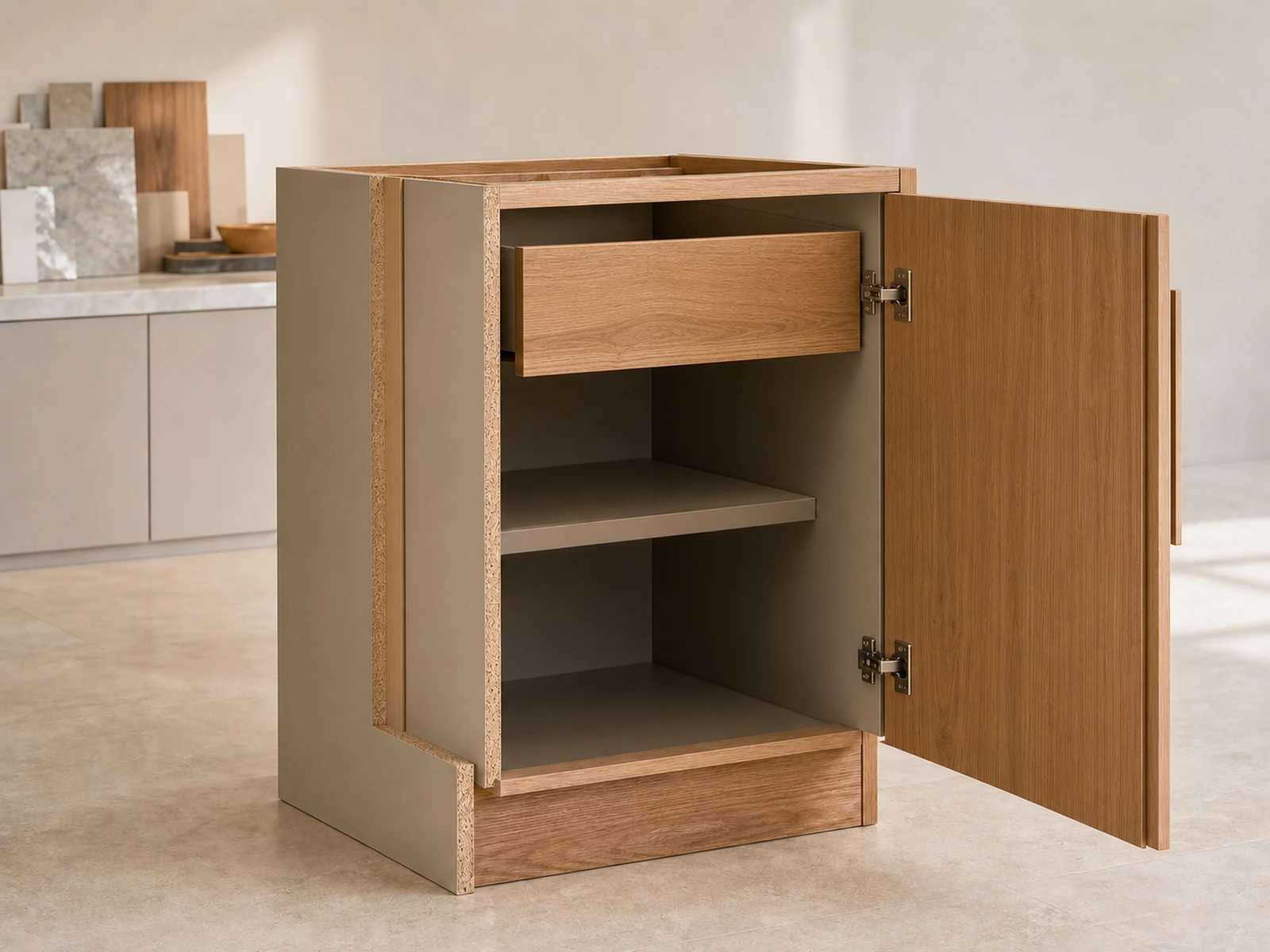
Understanding Custom Cabinet Materials Starts With the Component
Before asking which material is better, identify what is being made. A tall wardrobe side, a routed door front, a sink-cabinet base and a thin back panel do different jobs. They may reasonably use different constructions even when every visible surface belongs to the same colour palette.
This component-first map keeps the material discussion comparable:
| Cabinet component | What the specification needs to resolve |
|---|---|
| Carcass sides and base | Panel type, grade or product reference, thickness, finish on both faces, edges and connection details |
| Shelves | Panel construction, thickness, span or support condition, finished faces and exposed edges |
| Doors and drawer fronts | Core, face and reverse finish, edge or profile treatment, dimensions, weight and hardware compatibility |
| Back panels | Material, thickness, finish, fixing method and any service or ventilation openings |
| Wet-zone or heat-adjacent components | Exact exposure, joint and cut-out details, protected edges and applicable product documentation |
| Moving hardware | Function, product family, exact series or model, mounting pattern and compatibility with the front |
A quotation that says only “melamine board” or “plywood cabinet” skips several of these decisions. The material name is a starting point, not a finished specification.
The Core: What the Panel Does
The core provides the main panel body. Its suitability depends on the component, the exact product, its thickness and construction, the environment and the way it will be machined and supported. A universal ranking hides those conditions.
Particleboard
The Composite Panel Association’s particleboard definition describes a composite panel made from cellulosic particles bonded with resin or another binder under heat and pressure. The association also notes that particle geometry, resin level, density and manufacturing process can be adjusted for particular uses.
That variation matters. “Particleboard” on its own does not confirm a grade, thickness, moisture-related property, emissions documentation or finished-panel system. Those details should come from the quoted product and the documents applicable to the project.
MDF
Medium-density fibreboard is made from cellulosic fibres combined with resin or another bonding system under heat and pressure. Its flat, smooth and uniform surface explains its common use for precise machining, shaped profiles and finished cabinet components.
Those useful characteristics do not make every MDF panel interchangeable. A routed painted front, a flat laminated front and an interior shelf present different finishing, edge and service conditions. The selected MDF product still needs to be identified and checked for its intended application.
Plywood
APA describes plywood as thin sheets of cross-laminated veneer bonded under heat and pressure. It is available in many appearance grades, thicknesses and constructions.
This is why “plywood” should not be treated as one fixed performance level. Veneer quality, panel grade, bond classification, face quality, thickness and intended use can all change what is appropriate. If a quote presents plywood as an automatic upgrade, ask which plywood product is actually being supplied and what part of the cabinet it will form.
The useful question is not “Which core always wins?” It is “Which documented core suits this component and the conditions around it?”
The Surface: What You See Is Not Always What Supports It
The visible layer may look like wood, stone, a solid colour or high-gloss acrylic, but its name may describe only the surface. It does not necessarily identify the core beneath it.
Thermally fused laminate, or TFL, is a clear example. The Composite Panel Association explains TFL as a decorative surface panel created with a resin-impregnated décor layer. The term has long been associated with “melamine,” while particleboard and MDF are common substrates for this kind of finished panel.
PET and thermolaminate products are also surface systems. RENOLIT’s furniture-surface range, for example, separates two-dimensional laminates and three-dimensional thermolaminates by application. Acrylic is similarly product-specific: REHAU’s acrylic-surface range includes variants with different constructions and technical data. A lacquered front adds another set of questions about the substrate, preparation, coating schedule, colour standard and approved sample.
| Term on a sample or quote | Its usual role in the assembly | What still needs confirmation |
|---|---|---|
| Particleboard, MDF or plywood | Panel core or substrate | Exact product, grade, thickness, construction and intended component |
| TFL or melamine-faced panel | Decorative surface fused to a substrate | Substrate, décor code, texture, face/reverse construction and edge match |
| PET or thermolaminate | Applied furniture surface | Film product, substrate, face/reverse build, profile suitability and technical data |
| Acrylic surface | Decorative face system | Product variant, backing or balancing layer, substrate, edge detail and care data |
| Lacquer or paint | Coating system | Substrate, coating schedule, sheen, colour reference, sample and repair expectations |
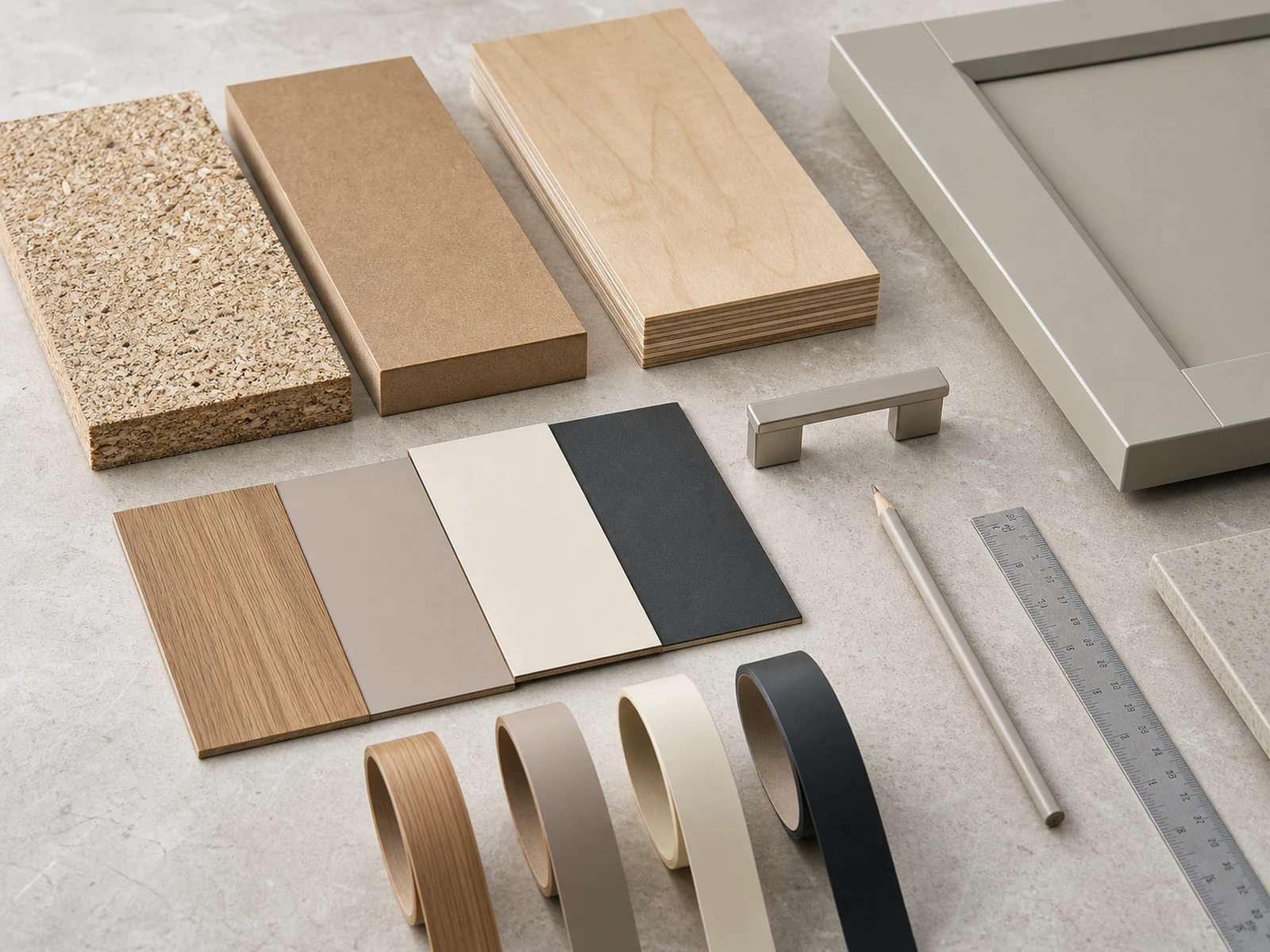
A finish sample can confirm colour, texture and sheen. Unless it is labelled in detail, it cannot confirm every layer behind the face.
Edges and Machining Complete the Panel
The centre of a panel receives most of the attention in a showroom. In production and daily use, boundaries matter just as much: exposed edges, hinge cups, shelf-pin holes, service cut-outs, mitres and joints all interrupt the panel.
A useful edge specification records:
- the edge material;
- its nominal thickness and colour;
- which sides receive it;
- whether the edge should match or intentionally contrast with the face;
- how corners, profiles and cut-outs are treated;
- which sample or production reference governs approval.
Adhesive choice and application process are separate manufacturing facts. A label such as “PUR edge banding” should not be translated into a blanket promise that the finished cabinet is waterproof. The result still depends on the panel, edge material, preparation, application control, joint geometry and exposure. Wet areas also require coordinated detailing around floors, walls, plumbing, sealants and ventilation.
Machining should be read in the same way. A routed profile may favour a different core or finishing process from a flat door. A sink or appliance cut-out creates local boundaries that need their own detail. The drawing should show where those conditions occur rather than leaving them inside a general material note.
The Same Finish Can Need a Different Build by Room

Whole-home cabinetry often aims for a continuous visual language. That does not require every hidden layer to be identical.
In a kitchen
Frequent opening, cleaning, appliance interfaces and local water exposure make component-by-component decisions important. The sink base, dishwasher-adjacent panels, tall appliance housing and dry pantry do not share exactly the same conditions. Edges, service openings, ventilation requirements and hardware should be resolved with the layout and appliance information.
In a wardrobe
A wardrobe may have fewer wet-zone concerns, but tall doors, long shelves, internal accessories, lighting channels and wall conditions introduce their own coordination questions. Door dimensions and construction need to agree with the selected hinge or sliding system. Shelf design needs to be considered together with span, support and intended storage rather than inferred from the core name.
In a vanity
A bathroom vanity brings together splashes, plumbing penetrations, wall and floor junctions, cleaning and ventilation. Calling one panel “moisture resistant” does not resolve an unprotected cut-out or a poorly detailed joint. The panel product, finished surfaces, edges, backing, service penetrations and installation interfaces have to work as one system.
The visible finish can remain consistent across these rooms. The less visible specification may change because the components and exposures have changed.
Hardware: Specify the System, Not Just the Logo
Hardware brands contain multiple product families, and those families contain individual series and models. The official product pages for Hettich furniture fittings, Blum cabinet hardware and GRASS movement systems show categories such as hinges, drawer systems, runners or slides, and opening systems. GRASS is an Austrian company, not a German one; its official company page describes its production as “High-tech made in Austria”.
These links are useful for identifying product families, not for declaring a universal winner. “Blum hinges,” for example, is still incomplete if the quotation does not identify the hinge family, exact model and mounting application.
For each moving component, confirm:
- the required movement and opening condition;
- the exact brand, family, series and model;
- compatibility with the door or drawer construction;
- front dimensions, thickness and weight conditions;
- opening angle, overlay or inset condition where relevant;
- drilling, mounting and adjustment requirements;
- the technical sheet and warranty terms that apply to the selected product and market.
Do not transfer a load rating, cycle claim or warranty from one model to another. It belongs to the documented product and test conditions.
Compliance Follows the Destination Market
Environmental and emissions language is meaningful only when the product, document and destination market line up. A label used for one jurisdiction should not be treated as a global substitute for every requirement.
For the United States, the EPA’s TSCA Title VI composite-wood rules cover hardwood plywood, MDF and particleboard, as well as certain finished goods containing them. The framework includes testing, third-party certification, labelling, recordkeeping and import provisions.
That is a US example, not a universal cabinet-material label. For an international project, the specification should identify:
- the destination market;
- the regulated product or component;
- the manufacturer and product reference shown on the document;
- the applicable test method or certification scheme;
- document validity, scope and traceability;
- any labelling or import records required for the shipment.
Avoid broad terms such as “eco board” or “zero-formaldehyde board” unless the exact meaning and evidence are supplied. A useful document identifies a product and a requirement; a marketing adjective usually does not.
Turn Choices Into a Buildable Material Schedule

The most practical outcome of material selection is not a longer list of names. It is a schedule that connects each decision to a component, drawing and approved sample.
| Schedule field | What to record |
|---|---|
| Component | Room, cabinet reference and part: carcass, shelf, front, back, worktop or special detail |
| Core or substrate | Exact panel type, product reference and supplier or manufacturer if confirmed |
| Thickness | Nominal thickness for the identified component |
| Front and back finish | Surface family, colour, texture, sheen and sample code on each face |
| Edge | Material, thickness, colour and applicable sides |
| Hardware | Brand, product family, exact series/model and application |
| Evidence | Technical sheet, test report, certificate or care document and its applicable market |
| Approval | Sample status, drawing revision, date and responsible party |
The schedule should agree with the elevations, sections and details. If a door sample changes, the reverse face, edge colour, hardware compatibility and drawing reference may also need review. If a core changes, thickness, machining and connection details may need another check.
Revision control matters because an approved sample and an outdated drawing can both appear correct in isolation. The production record should make clear which version governs.
Seven Questions That Expose an Incomplete Specification
Use these questions before approving a cabinet material package:
- Which component is this material intended for? A door, carcass side, shelf and back panel should not be treated as the same decision.
- Is the term a core, a surface, an edge or a complete finished-panel product? This prevents unlike materials from being compared.
- What exact product, grade, thickness and construction are quoted? A category name alone is not enough.
- What room and exposure conditions apply? Include local water, heat, cleaning, ventilation, appliance and installation interfaces.
- How are edges, cut-outs, joints and machined areas finished? These boundaries need component-specific details.
- Which exact hardware models are included? Check compatibility with the front and movement rather than approving only the logo.
- Do the sample, schedule, drawings and evidence share the same revision and product reference? If not, approval is not yet coordinated.
This sequence is more reliable than choosing a material winner first and searching for conditions later.
Frequently Asked Questions
Is melamine a board or a finish?
In cabinetry, “melamine” commonly refers to a decorative surface associated with a panel substrate. A complete description should identify the substrate—often particleboard or MDF—along with the décor, texture, face/reverse construction and edge treatment.
Are particleboard and chipboard the same?
The terms are often used for the same broad panel category in different markets, but naming conventions and product grades vary. Do not create two performance categories from the words alone. Check the manufacturer’s product definition and technical data.
Is plywood always the better cabinet core?
No. Plywood is a family of products with different veneers, grades, thicknesses, bond classifications and intended uses. Suitability still depends on the cabinet component, finish, machining, support, exposure and project requirements.
Which cabinet material is best for a wet area?
There is no useful answer based on one material name. Review the exact panel product together with its surfaces, exposed edges, cut-outs, joints, backing, ventilation, plumbing interfaces and installation details. The relevant evidence should match the intended exposure.
Is naming a hardware brand enough?
No. A brand may offer many hinge, runner, drawer and opening systems. The specification should identify the product family, exact series or model, mounting application and compatibility with the cabinet front.
Read the Cabinet as a System
The material inside a cabinet cannot be understood from the door finish alone. Start with the component. Identify the core. Add the surface and edge. Match the hardware to the movement. Then check the room conditions and the documents that support the selected products.
For a whole-home project, the same method can be carried into a whole-house custom cabinetry schedule so rooms share a visual language without forcing the same internal specification everywhere.
If you are preparing a cabinetry brief, you can begin the material discussion with Sunrise Furnishing by sharing the room list, drawings or dimensions, finish references, target market and required documentation as one coordinated input package. Those records give a more useful starting point than a request for the “best” board.