English
  日本語
日本語  العربية
  Deutsch
  Español
  Français
  한국어
한국어  Português
  Татар теле
  Русский
 Small walk in closet corner storage is rarely solved by adding one more shelf or one more hanging rod. In a compact walk-in closet, the corner may look generous on a plan, but it can become the hardest place to reach once cabinet doors, drawers, hanging clothes, and the center walkway are all in use.
The better question is not simply, “How can I fill the corner?” It is, “What should this corner do, and how often do I need to reach it?” That question is especially important when a small bedroom is being converted into a compact dressing area or when a U-shaped closet layout is being considered.
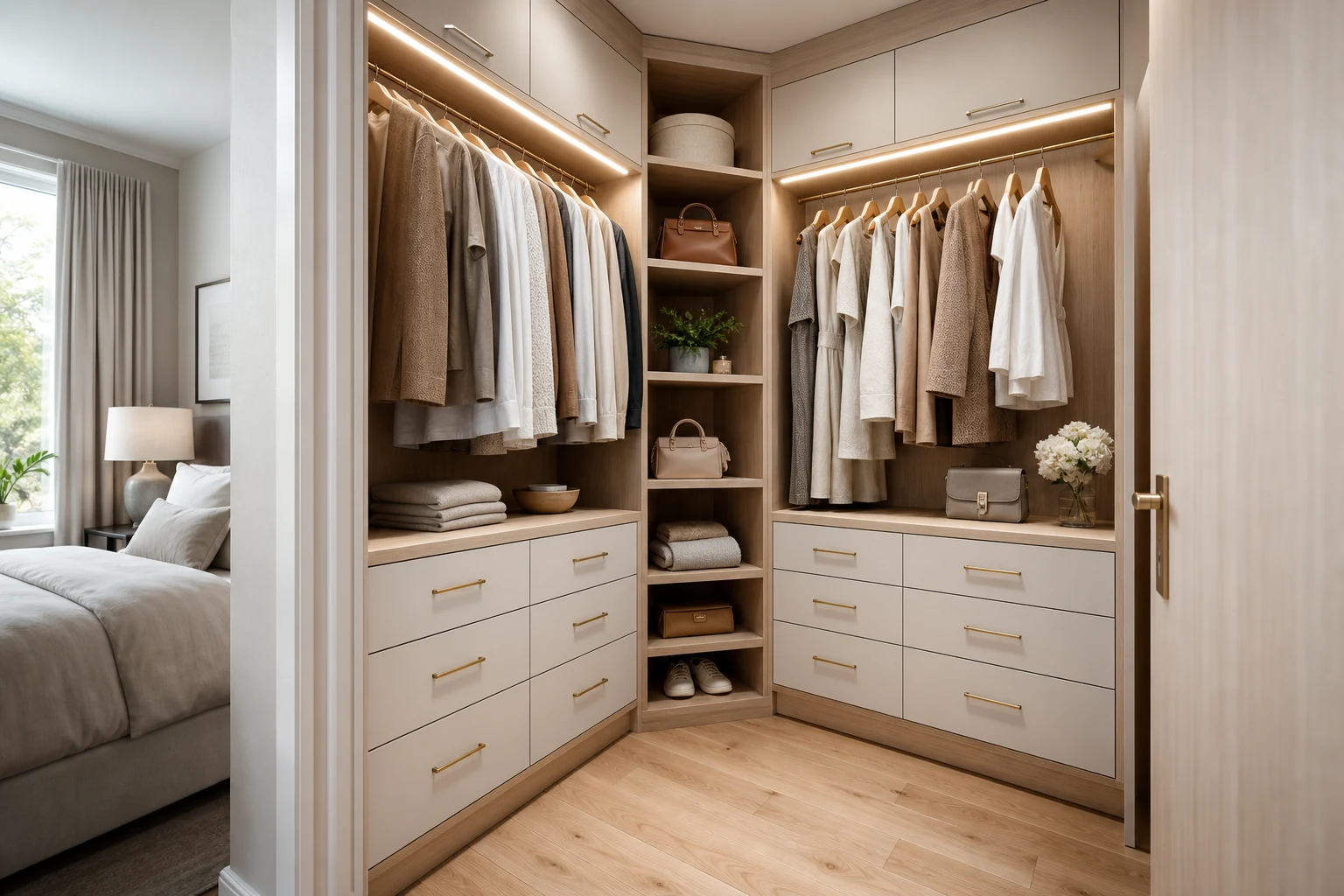
Why Corners Become Dead Space in Small Walk-In Closets
Corners become dead space because two cabinet runs meet at an angle, but the user’s body still needs straight access. A hanging rod may turn the corner neatly on paper, yet long garments can overlap. A drawer may look useful in a drawing, yet it may hit the opposite cabinet, the closet door, or another drawer front. Deep shelves can hold more items, but the back area may be too dark or too low to use comfortably.
In small walk-in closets, the center space is part of the storage system. If the standing area is narrow, every open drawer, cabinet door, mirror position, and hanging section affects how the user moves. The corner is only useful when it works with the walkway, not against it.
Layout planning note: before selecting a corner module, check the door swing, cabinet depth, drawer pull-out direction, and the height at which the user can comfortably reach into the corner. These details should be confirmed in the production drawing, not left for installation day.
Decide What the Corner Should Store First
The most reliable way to plan a corner is to give it a clear storage job. A corner used for everyday shirts should not be treated the same way as a corner used for occasional luggage, handbags, folded knits, or seasonal bedding. Access frequency matters as much as capacity.
If the corner must be reached every day, keep it visible and simple. If it stores less-used items, it can be slightly deeper or higher, but it should still have lighting and a logical retrieval path.
Long hanging, short hanging, shelves, or bags
Long hanging can work in a corner when the user has coats, dresses, or longer garments that do not need to be pulled from both sides at the same time. However, two long-hanging runs meeting tightly in a corner can create overlap. If the closet is compact, one side may be better for long hanging while the adjacent side uses shelves or short hanging.
Short hanging is often easier to combine with shelves because shirts, trousers, and jackets leave space below for drawers or open cubbies. For bags, hats, folded sweaters, or storage boxes, open corner shelves at eye level can be more useful than a closed deep cabinet. Items remain visible, and the user does not need to pull one item out to reach another.
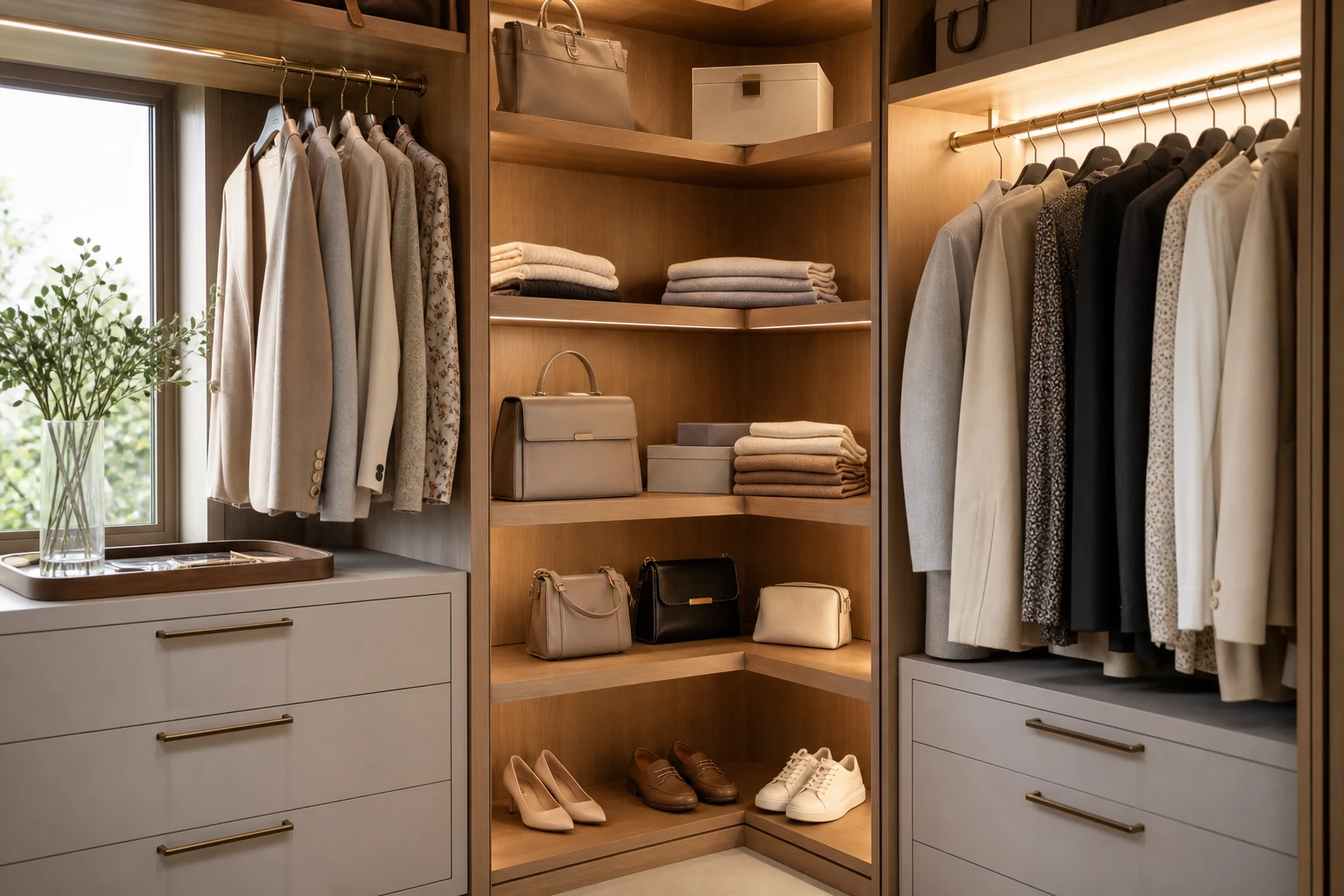
Why drawers are not always the best corner choice
Drawers feel efficient, but a corner is not always the right place for them. A drawer needs space in front of it, and in a U-shaped closet that space may overlap with the opposite cabinet run. If two sides both include drawers near the corner, the user may only be able to open one side at a time.
Drawers also hide the depth of the corner. If the drawer box is shallow to avoid a conflict, the corner may not gain much storage. If it is deep, it may become heavy or awkward. For small walk in closet corner storage, drawers usually work better near the straight sections where the user can stand directly in front of them.
Layout planning note: place drawers where the user has a clear pull-out zone. Use the corner for open shelves, a hanging return, an angled transition, or a lit display and storage area unless the drawing proves the drawer path is clear.
U-Shaped Layouts Need Clear Center Space
A U-shaped closet can use three sides of a compact dressing area, but it also concentrates movement in the middle. The layout only works when the center space remains usable while doors and drawers are open. If every wall is filled to the same depth, the closet may feel full on paper and tight in daily use.
For homeowners comparing custom options, a U-shaped custom closet should be reviewed as a measured layout, not as a fixed formula. Door location, wall length, ceiling height, cabinet depth, and the user’s clothing mix all affect whether the U-shape makes sense.
Door position and cabinet depth
The door position decides where the first cabinet run can start. A swing door, sliding door, or open entry will each change the usable wall length. If the entry is close to a corner, a full-depth cabinet beside the door may feel heavy or may interfere with movement.
Cabinet depth can vary by side. A hanging side may need more depth than an open shelf side. A shallow shelf run near the entry can make the closet easier to enter, while deeper hanging can sit on the back wall. This is often better than making all three sides identical.
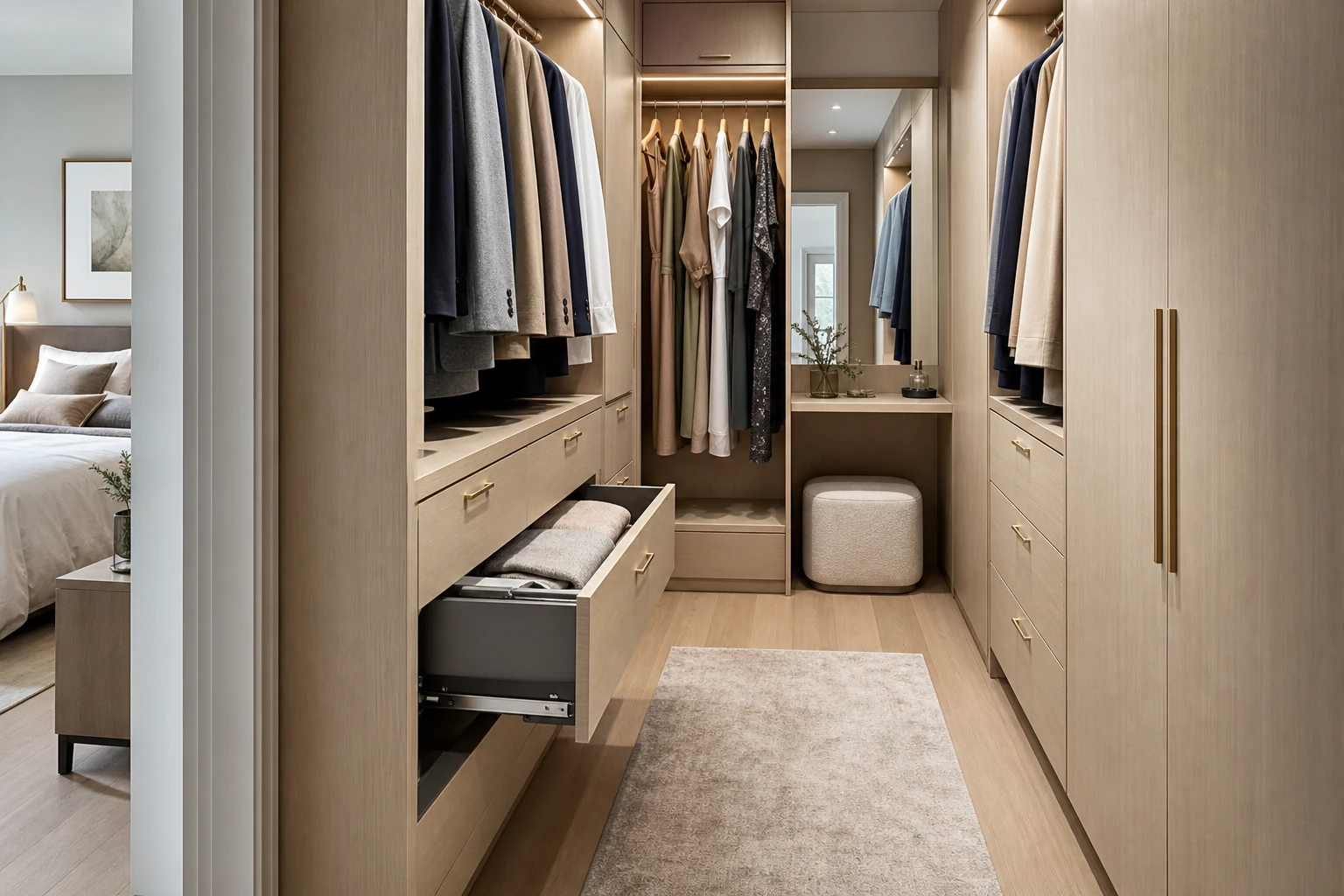
Mirror, dressing light, and drawer opening space
A mirror changes how people stand in the closet. If the mirror is placed opposite a drawer bank, the user may need room to step back and open the drawer. Dressing lights should also be placed where the body does not block them. Lighting that only shines from the ceiling may leave deep corners dim.
Drawer opening space should be checked with the mirror, stool, door, and hanging clothes shown in the same plan. This is where a custom closet drawing becomes useful: it can show the cabinet front, the pull-out direction, and the walkway relationship before the parts are produced.
Designer Notes for Better Corner Access
Good corner access is usually a result of small design decisions rather than one special accessory. Visibility, hand reach, lighting, and the transition between cabinet runs all matter.
Open shelves at eye level
Open shelves at eye level are one of the most practical corner choices. They keep bags, folded garments, hats, or storage boxes visible. They also avoid the swing and pull-out conflicts of doors and drawers.
The shelf depth should match what will be stored. A bag shelf can be deeper than a folded T-shirt shelf, but both should allow the user to see the back of the corner. If the corner is too deep, it may need lighting or a stepped shelf arrangement.
Rounded or angled transition modules
Rounded or angled transition modules can soften the point where two cabinet runs meet. In a compact U-shaped closet, this can reduce the feeling of a hard inside corner and make the entry into the storage zone smoother.
An angled module can also create a more accessible display area for bags, shoes, folded items, or accessories. It should still match the main closet structure, finish, handle style, and lighting plan so it feels like part of the same built-in system.
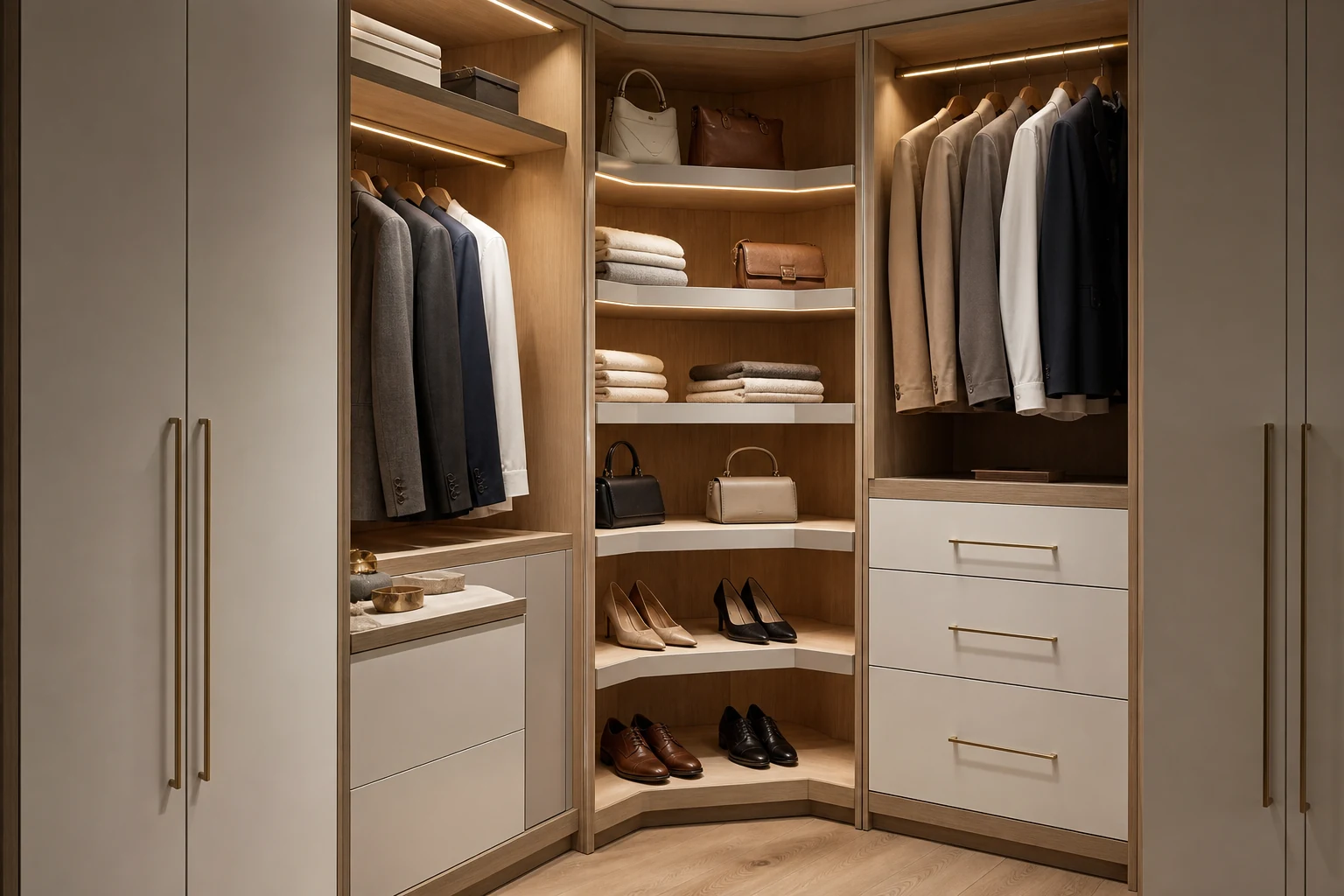
Lighting inside deep corner zones
Lighting is not only decorative in a small closet. It helps the user see what is stored at the back of a shelf or behind a hanging return. LED strips, vertical lights, or small internal cabinet lights can make a deep corner easier to use.
Lighting should be planned with wiring, switch position, door sensors, and shelf layout in mind. For overseas projects, these details may need to be coordinated with the local electrician or contractor before installation.
Mistakes to Avoid in a Small Walk-In Closet
Small walk-in closets fail most often when the plan treats every wall as storage surface without checking how the user will move. The following mistakes are common and preventable.
Blocking one cabinet door with another
Two cabinet doors near a corner can block each other. A door may also block the room entry or collide with a mirror position. If closed storage is needed near a corner, consider sliding, open, or lift-up solutions only when they suit the cabinet structure and usage.
Making every side the same depth
Equal depth can look tidy in a drawing, but it may not match the user’s clothing. Hanging, shoes, folded garments, bags, and accessory drawers do not all need the same depth. In a small closet, varied depth can protect the center walkway and make the corner easier to reach.
Putting rarely used storage too low
Low corner shelves are easy to forget because the user has to bend, reach, and search. If the item is rarely used, a higher shelf may be better. If the item is used often, keep it at a comfortable hand level. Low deep corners should be reserved for items that are easy to pull out, not small loose accessories.
When a U-Shaped Custom Closet Makes Sense
A U-shaped custom closet makes sense when the room or bedroom zone has enough clear center space, the entry does not block the cabinet runs, and the clothing mix benefits from three connected storage sides. It is not the answer for every small bedroom. Sometimes an L-shaped closet, one straight wardrobe wall, or a shallow open shelf run will work better.
The value of a custom U-shaped design is that the corner, hanging, shelves, drawers, mirror, and lighting can be planned together. Before production, the homeowner should review the measured drawing, confirm cabinet depth on each side, check drawer and door movement, and decide which items need the most accessible positions.
If your project is still at the planning stage, prepare the room measurements, door position, ceiling height, clothing categories, preferred hanging length, and any mirror or dressing-light requirements. Those details make it much easier to design a compact closet that feels usable in daily life.
Frequently Asked Questions
What is the best use of a corner in a small walk-in closet?
The best use depends on what you need to reach most often. Eye-level open shelves, bag shelves, short hanging, or an angled transition module often work better than a deep closed cabinet. The corner should store items that match its reach depth and visibility.
Are drawers a good idea for closet corners?
Drawers can work only when the pull-out path is clear. In many compact U-shaped closets, corner drawers conflict with the opposite cabinet run or reduce the center walkway. Drawers are often more comfortable on straight sections where the user can stand directly in front of them.
Can a small bedroom fit a U-shaped walk-in closet?
Some small bedrooms can fit a U-shaped walk-in closet, but not all. The decision depends on room width, entry position, cabinet depth, drawer opening space, and how much clear standing area remains. A measured layout review is necessary before production.
How can lighting improve corner closet storage?
Lighting helps users see deep shelves, hanging returns, and dark corner zones. Internal cabinet lighting or vertical LED strips can make items easier to identify and retrieve, especially when the closet has no window or the corner is shaded by hanging garments.
Final Planning Note
Small walk-in closet planning should begin with the corner, not end with it. Once each corner has a clear storage job, the rest of the U-shaped layout becomes easier to judge. Hanging zones, shelves, drawers, mirror position, lighting, and center space can then be checked as one connected system before the closet is made.