English
  日本語
日本語  العربية
  Deutsch
  Español
  Français
  한국어
한국어  Português
  Татар теле
  Русский
 A weather resistant outdoor cabinet does not fail only because the visible material is wrong. In real patio, garden and BBQ areas, problems often start in quieter places: water sitting near the cabinet base, hardware exposed to moisture, door panels facing strong afternoon sun, countertop seams around a sink, or grill heat trapped beside a closed storage unit.
That is why choosing an outdoor cabinet should not begin with color alone. Before you confirm the finish, layout or countertop, check the weak points that decide whether the cabinet can handle rain, sunlight, cleaning, outdoor cooking and long-term use.
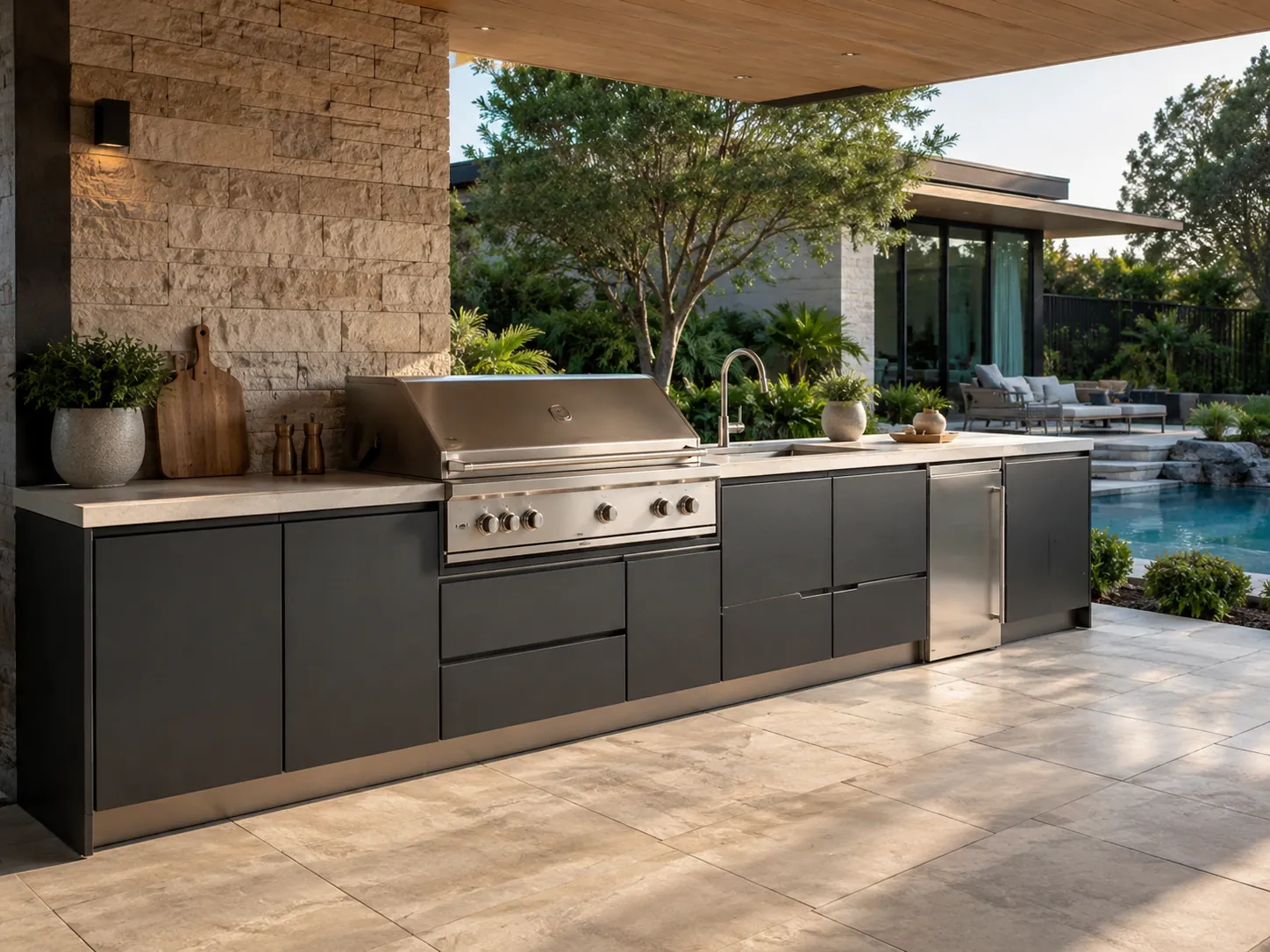
What “Weather Resistant Outdoor Cabinet” Really Means for an Outdoor Cabinet
A weather resistant outdoor cabinet is designed to handle outdoor exposure better than a standard indoor cabinet. But “weather resistant” should not be read as “can be ignored after installation.” Outdoor spaces are active environments. Rain, humidity, sun, temperature changes, cooking heat, grease, cleaning water and dust all work on the cabinet over time.
For a patio or garden BBQ area, weather resistance comes from a full system: cabinet body material, surface finish, hardware, base design, countertop detailing, ventilation, drainage and maintenance access. A stainless steel or aluminum cabinet body may help, but poor drainage or trapped heat can still shorten the life of the installation.
A better way to judge the cabinet is simple: ask where water, heat and movement will go. If water has no escape, heat has no ventilation, and hardware is not suitable for outdoor conditions, the cabinet may look refined on day one but struggle after seasons of use.
Quick answer: A good outdoor cabinet should be judged by material, base design, drainage, ventilation, hardware, heat clearance and maintenance access, not by the visible finish alone.
Weather resistant is not the same as fully waterproof
This is an important difference. A weather resistant cabinet is planned for outdoor exposure, but it still needs correct installation, drainage and maintenance. If rainwater sits at the base for hours, if the cabinet is placed under direct spray without protection, or if water gathers around a sink cutout, even strong materials can face problems.
Avoid choosing an outdoor cabinet only from a product photo. Ask how the cabinet handles water movement, not only what the door finish looks like.
Outdoor cabinets must deal with sun, rain, heat and cleaning
A patio cabinet may face strong sunlight in the afternoon, rain during storm seasons, heat from a BBQ grill and frequent cleaning after outdoor meals. These pressures affect different parts of the cabinet. Sunlight works on color and surface stability. Rain tests drainage. Grill heat affects surrounding panels and ventilation. Cleaning water tests seams, hardware and the cabinet base.
Material choice matters, but structure decides long-term performance
Materials are important, but they are not the whole answer. A good outdoor cabinet design also considers airflow behind the unit, how the cabinet meets the floor, where the sink drains, how the countertop is sealed, and whether the storage zones are separated from heat and moisture.
Weak Point 1: The Cabinet Base and Standing Water
The base is one of the first areas to check. In many outdoor spaces, water does not fall evenly and disappear neatly. It can gather near a wall, sit along a patio edge, or flow toward the cabinet after rain or cleaning. If the cabinet sits directly in that water, the bottom area becomes the first stress point.
A well-planned outdoor cabinet should avoid trapping water at floor level. Depending on the project, this may involve a raised base, adjustable feet, drainage gaps, a suitable plinth design, or enough clearance for cleaning. The exact solution depends on the floor condition, slope, exposure level and visual requirements.
For a custom outdoor BBQ cabinet, the floor plan should be checked before production. A beautiful cabinet placed in the wrong water path can become a quiet little pond goblin after heavy rain.
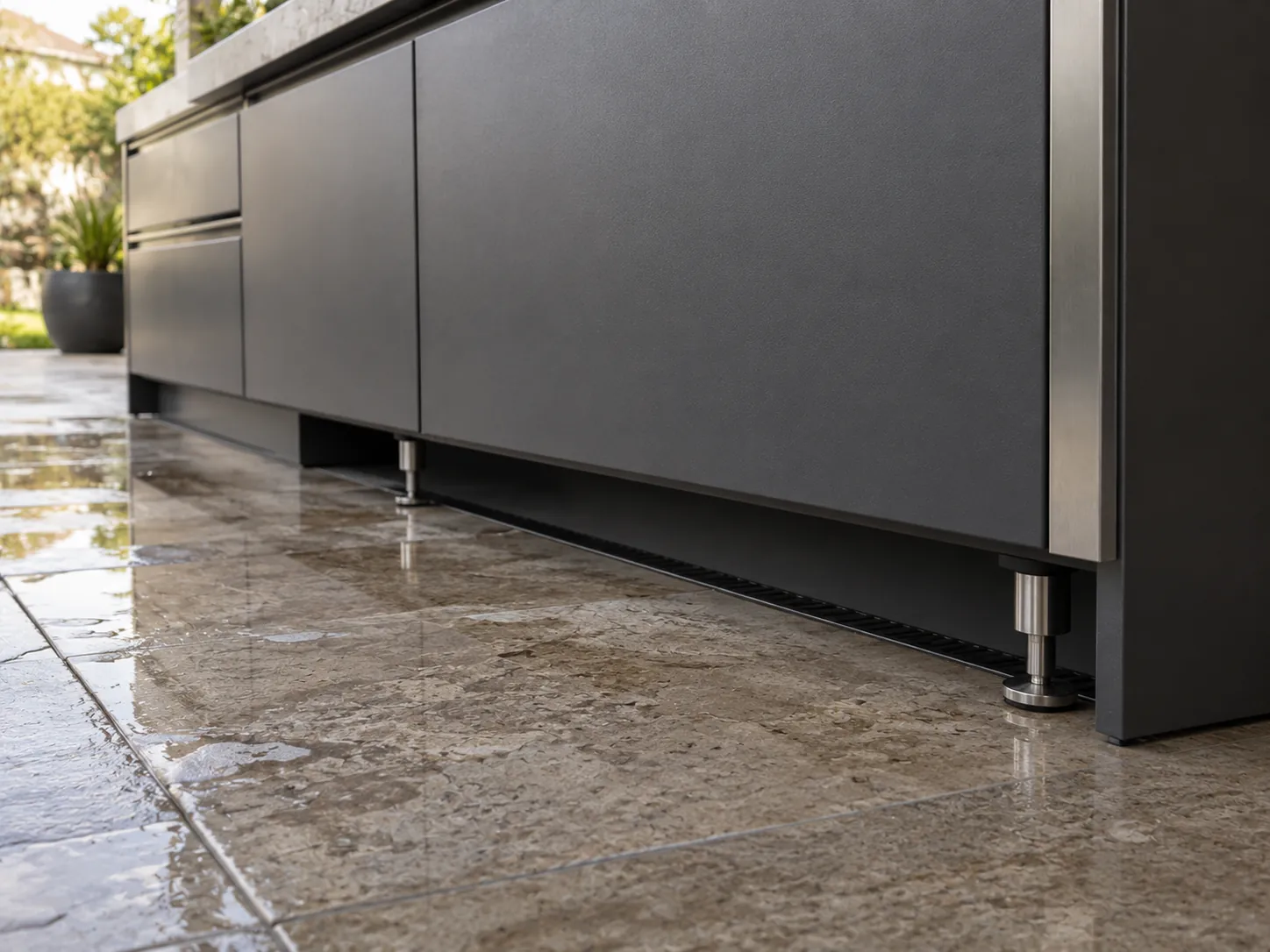
Why outdoor cabinets often fail from the bottom first
The bottom of the cabinet faces splashing water, floor moisture, cleaning water and sometimes soil or leaf debris. Even if the upper surface looks dry, the base may remain wet longer. This is especially important for poolside areas, uncovered patios and outdoor kitchens near a garden.
Raised base, drainage gaps and ground slope matter
Before confirming a layout, check whether the floor slopes away from the cabinet or toward it. If the floor sends water toward the cabinet, the design needs a way to reduce standing water risk. Drainage gaps, raised legs or a better installation position can help the cabinet breathe and dry more easily.
What to check before installation
Before installation, confirm these points: where rainwater flows, whether there is a nearby drain, how the patio is cleaned, whether the cabinet sits under a roof, and whether water can gather behind or below the unit. These details are not decorative, but they decide how the cabinet behaves in daily outdoor use.
Weak Point 2: Door Panels, Finishes and Direct Sun Exposure
Outdoor cabinet doors carry a lot of visual weight. They define the style of the patio kitchen, garden bar or villa BBQ area. But they are also exposed surfaces, which means they must handle sunlight, temperature changes and cleaning.
Indoor cabinet finishes are not always suitable for outdoor use. Some finishes are designed for controlled indoor spaces where temperature and humidity stay more stable. Outdoors, strong sun can affect color, surface feel and panel stability. In hot climates or open terraces, the difference becomes more obvious.
For a weather resistant outdoor cabinet, the door finish should be chosen with the installation environment in mind. A shaded patio, a rooftop terrace and a coastal villa may need different material decisions.
Why indoor cabinet finishes do not always work outdoors
Indoor finishes may look refined, but some are not designed for frequent outdoor exposure. If a project needs a warm wood look, the finish still has to match the environment. For uncovered patios, metal, stone-look panels or outdoor-suitable finishes may be more practical than delicate indoor surfaces.
How sunlight affects color, surface and door stability
Strong sunlight can make some surfaces fade unevenly or feel hotter to touch. Repeated expansion and contraction may also affect door alignment over time. This does not mean every outdoor cabinet must look industrial. It means the surface choice should be honest about the climate.
When metal, stone and outdoor-grade finishes make more sense
Stainless steel, aluminum, powder-coated metal, stone, sintered stone and other outdoor-suitable surfaces can support a more durable outdoor cabinet system. The best choice depends on the visual goal, maintenance expectation, budget and exposure level. A high-end patio cabinet should feel refined, but it still has to behave like outdoor furniture, not indoor furniture wearing sunglasses.
Weak Point 3: Hardware, Hinges and Hidden Corrosion
Hardware is small, but outdoor hardware does not live a small life. Hinges, runners, screws, handles and fasteners are exposed to moisture, cleaning water, temperature changes and sometimes salt air. If they are not suitable for the environment, the cabinet can become difficult to open, adjust or maintain.
This is where a manufacturer’s view becomes useful. The visible door material may get attention, but the hidden hardware often decides how the cabinet feels after months of use. Smooth drawers, aligned doors and stable hinges are part of long-term quality.
When discussing custom outdoor cabinets, ask about hardware suitability. For damp climates, poolside areas or coastal projects, hardware and fasteners deserve extra attention.
Why hardware is a small detail with a big outdoor impact
A cabinet can use a strong body material but still feel poor if the hinges corrode, the drawer runners become stiff, or screws react badly to moisture. Hardware affects daily use, not just construction.
Moisture, salt air and cleaning chemicals can affect hardware
Outdoor environments vary. A shaded garden in the UK, a dry villa patio in the UAE and a poolside area in Singapore do not create the same conditions. Moisture, salt air, pool chemicals and cleaning agents can all affect hardware over time.
Ask about outdoor-suitable hinges, runners and fasteners
Before production, ask the cabinet supplier what type of hinges, runners and fasteners will be used. This does not need to become overly technical, but it should be part of the specification discussion. Strong outdoor design is often a collection of small, well-made decisions.
Weak Point 4: Countertop Seams, Sink Areas and Drainage
The countertop is not only a work surface. In an outdoor kitchen or BBQ zone, it is also where water, oil, food preparation, heat and cleaning meet. If the cabinet includes a sink, the planning needs to be even more careful.
An outdoor cabinet with sink should not be treated like a dry storage cabinet. Water supply, drainage position, sink cutout, countertop seams and cabinet body protection all need to be confirmed before production. If the sink area is poorly planned, water can collect near seams, enter cabinet joints or make maintenance harder.
For patio kitchens, stone or sintered stone countertops are often considered because they can handle heat and cleaning demands well when properly specified. But the countertop material alone is not enough. The detailing around the sink and seams matters just as much.
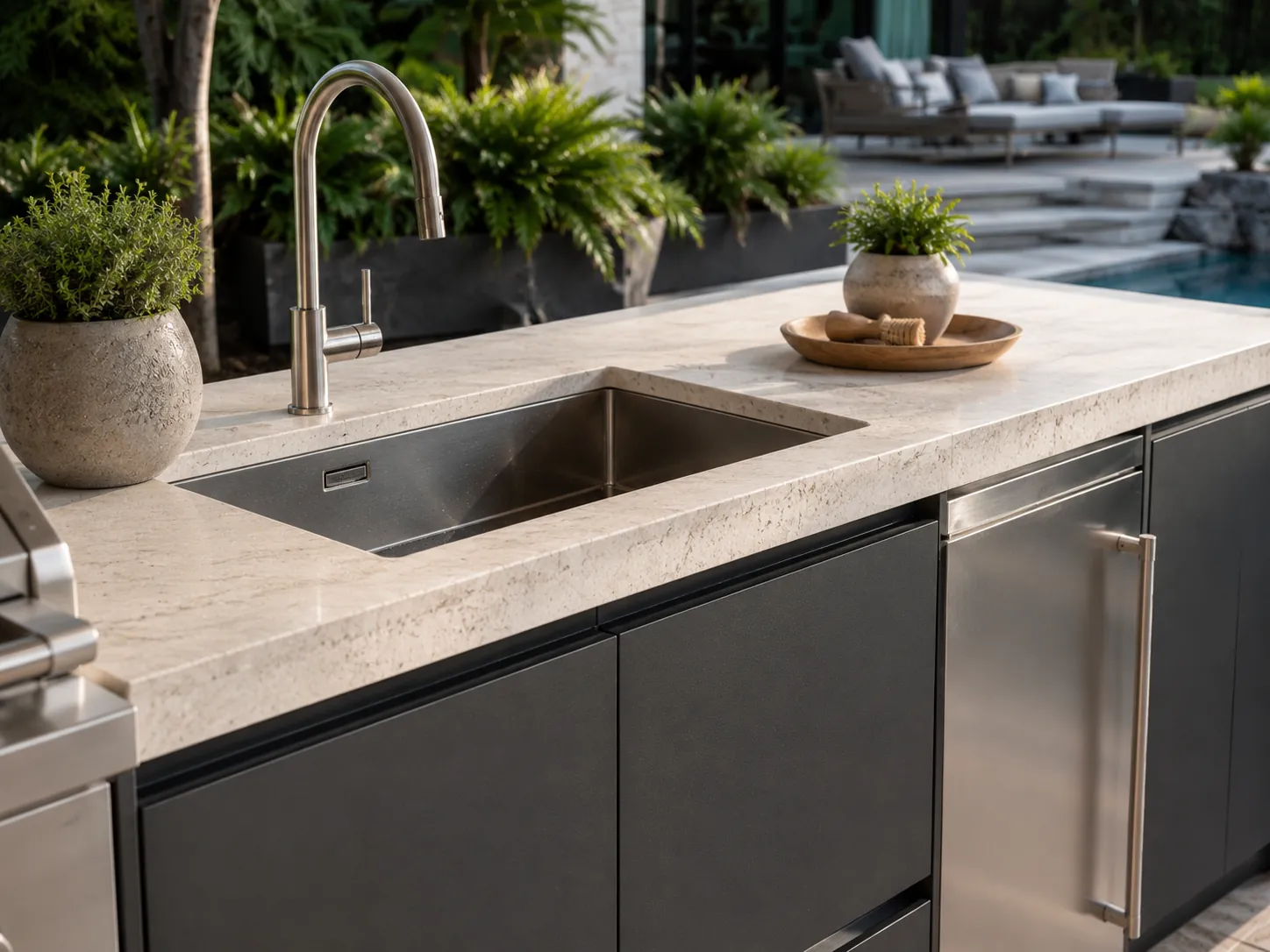
Why sink cabinets need more planning than dry storage cabinets
A dry storage cabinet mainly deals with weather exposure and cleaning. A sink cabinet adds water inside the working zone. That means the design must consider where water enters, where it leaves and which cabinet parts may be exposed during normal use.
Countertop seams should not trap water around the cabinet body
Seams and edges should not create small areas where water sits for long periods. Around sinks, grills and prep zones, the countertop design should support easy cleaning and drying.
Drainage position should be confirmed before production
Drainage should not be guessed during installation. For a custom cabinet, the drainage point, pipe route and sink position should be shared before production. This helps the manufacturer plan the cabinet structure and avoid awkward site adjustments later.
Weak Point 5: BBQ Heat, Ventilation and Storage Zones
A BBQ cabinet is not just an outdoor storage cabinet with a grill nearby. It has to deal with heat, smoke, grease, utensils, cleaning tools, trash, fuel or power connections, and food preparation. If these are not separated properly, the cabinet may look organized but feel frustrating to use.
Heat clearance is especially important. The area around a grill should be planned according to the appliance type and project requirements. Ventilation is also critical when cabinets contain or sit near equipment that produces heat. Closed storage without airflow may not be suitable beside certain BBQ setups.
This is why the cabinet layout should be planned around function before appearance. Cooking, preparation, cleaning, trash and storage zones should each have a clear position.
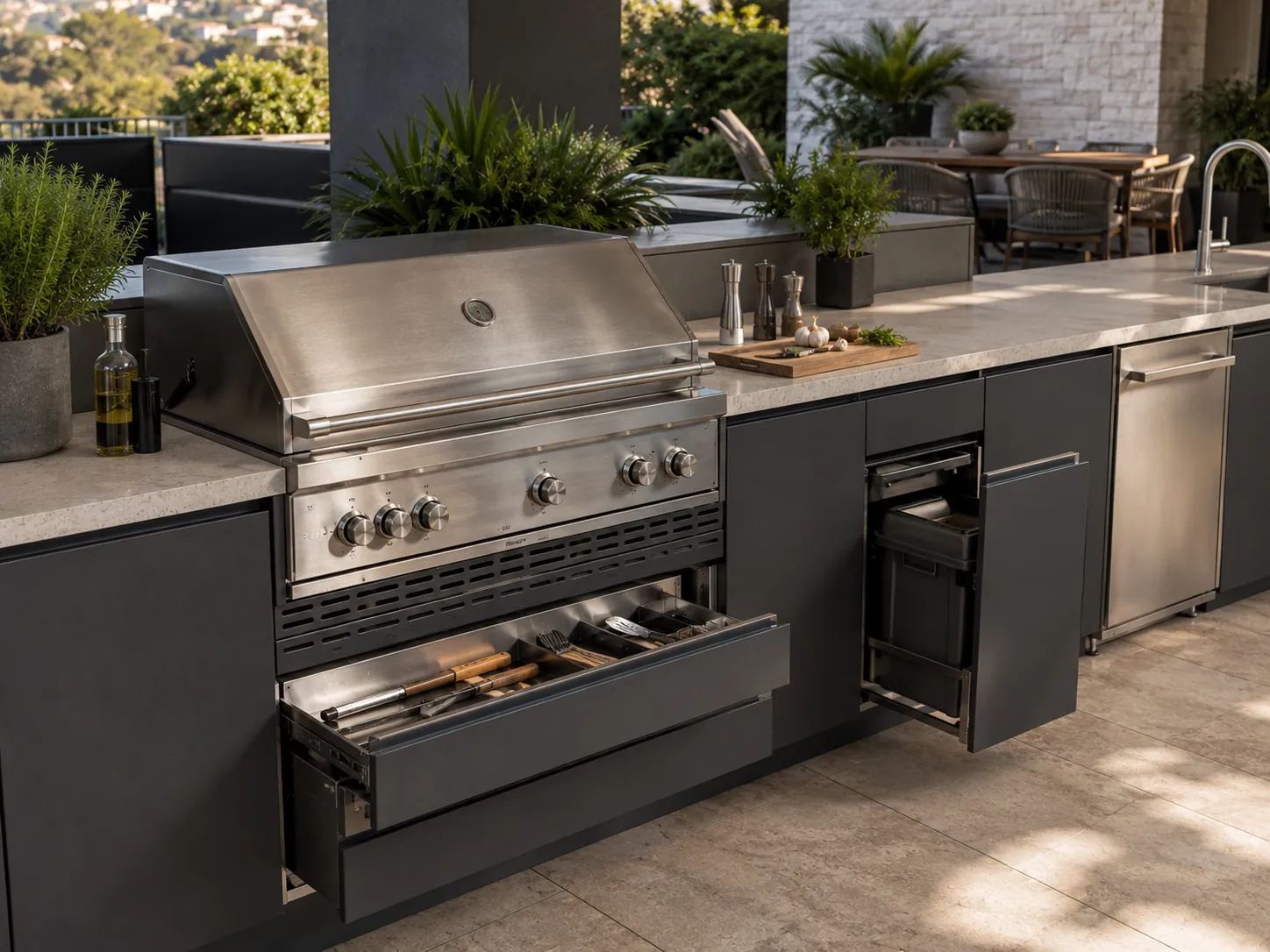
A BBQ cabinet is not the same as ordinary outdoor storage
Ordinary outdoor storage may hold cushions, tools or garden items. An outdoor BBQ cabinet supports cooking. That changes the cabinet requirements. It needs suitable worktop space, durable surfaces, accessible storage and safe planning around appliances.
Grill heat and ventilation should be planned before the cabinet layout
Do not place a grill into a cabinet layout as the final step. The grill position affects countertop size, cabinet spacing, ventilation, surrounding materials and cleaning access. Heat and airflow should shape the layout from the beginning.
Separate cooking, cleaning, trash and storage zones
A practical BBQ cabinet often needs separate zones: cooking near the grill, cleaning near the sink, trash close to prep work, drawers for tools and closed storage for outdoor dining items. This keeps the space usable, not just photogenic.
Which Materials Work Best for a Weather Resistant Outdoor Cabinet?
After checking the weak points, material selection becomes clearer. The best material is not simply the strongest one on paper. It is the material that fits the climate, location, function, budget and maintenance expectation.
Stainless steel is often used for modern outdoor kitchen and BBQ cabinet designs because it suits clean, durable outdoor settings. Aluminum and powder-coated metal can support lighter cabinet structures. Stone or sintered stone countertops can work well for prep zones, BBQ areas and spaces that need easy cleaning.
However, a weather resistant outdoor cabinet should be specified as a full system. The cabinet body, countertop, finish, hardware and installation details should work together. A strong countertop with weak hardware, or a strong metal body with poor drainage, still leaves the design exposed.
Stainless steel for durability and clean modern outdoor spaces
Stainless steel can suit outdoor kitchens, BBQ zones and modern patio areas where durability and easy cleaning are important. It also pairs well with stone countertops, dark panels, warm wood-look accents or minimalist villa architecture.
Aluminum and powder-coated metal for lighter outdoor cabinet structures
Aluminum and powder-coated metal can be useful where lighter cabinet structures or refined color finishes are needed. The quality of coating, hardware and installation details still matters.
Stone or sintered stone countertops for heat and cleaning demands
For outdoor BBQ areas, the countertop must handle prep work, cleaning, sunlight and sometimes heat from nearby cooking. Stone or sintered stone can be practical choices when properly detailed and supported.
Why material choice should match climate and location
A shaded patio, poolside deck, rooftop terrace and coastal villa do not create the same demands. Material choice should follow exposure level, moisture, cleaning frequency, salt air risk and the amount of roof coverage.
A Pre-Order Checklist for Custom Outdoor Cabinets
Before ordering a custom weather resistant outdoor cabinet, prepare more than a preferred color and approximate size. Good information helps the manufacturer design the cabinet around the real space.
Start with the installation location. Is it covered, semi-covered or fully exposed? Does rain hit the cabinet directly? Where does water flow after cleaning or storms? Then confirm the equipment list: grill, sink, refrigerator, trash pull-out, gas area, electrical outlet or storage drawers.
Also prepare photos, rough dimensions or drawings if available. For overseas projects, this information reduces guesswork and helps the cabinet supplier understand both the design expectation and the site conditions.
Measure the space and confirm exposure level
Measure the available length, depth and height. Note nearby walls, columns, doors, windows, pool edges, roof coverage and drainage points. Exposure level affects material and structure decisions.
List grill, sink, appliance and storage requirements
List the grill type, sink size, countertop needs, trash storage, drawers, doors, refrigerator or other outdoor appliances. Cabinet layout should follow function first.
Prepare drainage, electrical and gas information if needed
If the cabinet includes a sink, grill, refrigerator or lighting, confirm where drainage, power or gas connections are located. These details should be discussed before production, not after the cabinet arrives.
Share photos or drawings with the cabinet manufacturer
Photos help the manufacturer understand the real project. A simple phone photo of the patio floor, wall, roof coverage and BBQ location can be more useful than a long written description. Drawings are even better when available.
Frequently Asked Questions
Is a weather resistant outdoor cabinet fully waterproof?
Not always. Weather resistant means the cabinet is planned to handle outdoor exposure better than an indoor cabinet, but it still needs suitable drainage, installation and maintenance. Standing water, poor sink detailing or direct heavy rain without protection can still create problems.
Can outdoor cabinets be installed next to a BBQ grill?
Yes, but the grill area must be planned carefully. Heat clearance, ventilation, surrounding materials and cleaning access should be confirmed before the cabinet layout is finalized. A BBQ cabinet should not be treated as ordinary outdoor storage.
What material is best for a patio outdoor cabinet?
There is no single best material for every patio. Stainless steel, aluminum, powder-coated metal, stone and sintered stone can all be suitable in different conditions. The right choice depends on exposure, climate, design style, maintenance needs and the cabinet function.
Does an outdoor cabinet with sink need special drainage planning?
Yes. The sink position, drainage point, pipe route, countertop seam and cabinet protection should be confirmed before production. This helps avoid trapped water and difficult site adjustments during installation.
How much maintenance does an outdoor cabinet need?
Maintenance depends on material, climate and exposure. Most outdoor cabinets benefit from regular cleaning, checking hardware, keeping drainage areas clear and avoiding long-term standing water. Coastal, poolside or fully exposed areas may need more frequent attention.
Final Check Before Ordering an Outdoor Cabinet
A weather resistant outdoor cabinet should be selected with the whole outdoor environment in mind. Before focusing on color or door style, check the five areas that often decide long-term performance: base design, sun-facing finishes, outdoor-suitable hardware, sink and countertop drainage, and BBQ heat with ventilation.
For a patio, garden, rooftop or villa BBQ area, the best cabinet is not only the one that looks refined in a photo. It is the one planned around water movement, heat, cleaning and daily use. If you are preparing a custom outdoor BBQ cabinet project, collect the site dimensions, exposure level, equipment list, drainage information and preferred materials before requesting a design or quotation.
That small amount of preparation can help the cabinet design become more accurate, more practical and better suited to real outdoor living.