English
  日本語
日本語  العربية
  Deutsch
  Español
  Français
  한국어
한국어  Português
  Татар теле
  Русский
 A built in tv wall cabinet with storage should not begin with door colors or display shelves. It should begin with the wall, the television, and everything that must work behind the finished elevation. When those conditions are decided late, a clean-looking design can create visible cables, trapped equipment, awkward doors, or difficult installation.
The most dependable process is to confirm technical and site conditions first, assign every storage zone a purpose second, and refine the visual composition third. That order helps the finished wall feel calm while remaining practical to use, service, and install.
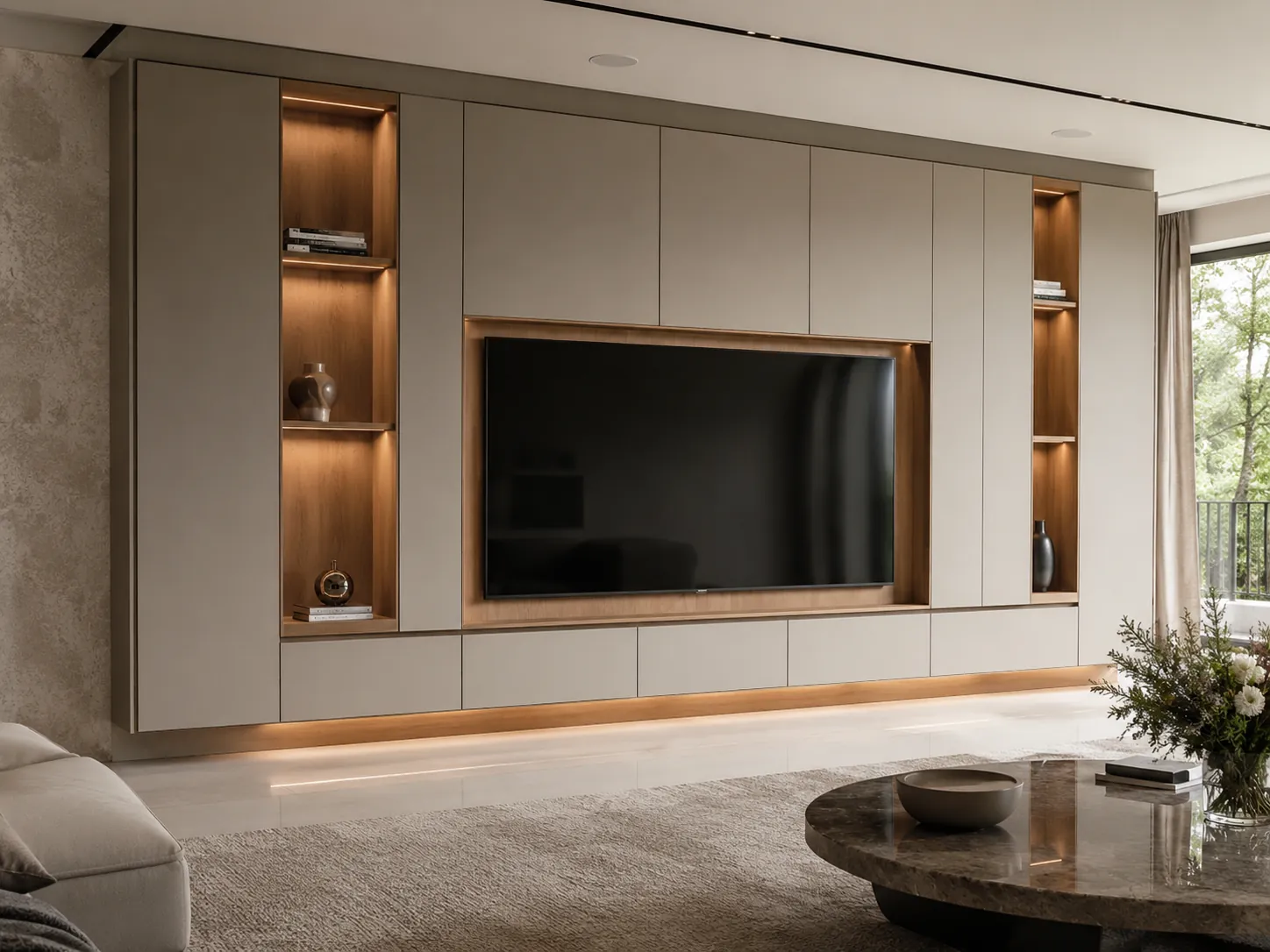
The Cabinet Is Only as Good as the Wall Brief
Before an elevation is approved, create a wall brief: a record of the television, viewing position, room dimensions, wall construction, electrical points, floor and ceiling conditions, and anything that may interrupt installation. This information determines what the cabinet can realistically conceal and how precisely it can meet the surrounding surfaces.
Fix the television and viewing relationship
Confirm the intended television model or, at minimum, its actual width, height, depth, mounting pattern, connection locations, and manufacturer requirements. Screen size alone is not enough. Two televisions with the same advertised size can have different bodies, ports, brackets, and ventilation needs.
The screen position should also relate to the principal seating position. Decide the viewing height before locating the central opening, floating console, or surrounding doors. If the television may be replaced later, discuss how much tolerance the design should provide without making the opening look unnecessarily large.
Record the wall and installation conditions
Measure the full wall rather than only the visible center area. Record the floor-to-ceiling height at several points, wall width, corners, skirting boards, sockets, switches, air-conditioning controls, curtains, door swings, and nearby furniture clearances. Note whether the wall is masonry, concrete, or a framed partition, because fixing methods and mounting responsibilities may differ.
Built-in cabinetry also needs a considered relationship with imperfect site surfaces. Walls and ceilings are not always perfectly straight. The drawing should identify where fillers, scribes, shadow gaps, or closure panels may be needed so the installation team has a realistic way to finish the edges.
Map Technical Zones Before Storage Zones
The cleanest TV walls usually have the most carefully planned technical routes. Power, signal cables, media devices, speakers, lighting drivers, and future service access should be mapped before shelves and drawers are finalized.
Plan power, signal, and service access
List every device that will connect to the wall: television, router, streaming box, game console, sound system, lighting, or other regional equipment. Then decide where each device lives, where its sockets sit, how cables travel, and how a person can reach the connections after installation.
Avoid creating a beautiful central panel that must be removed whenever a cable changes. Where practical, provide an accessible route between the television and the equipment zone. Keep power and signal planning coordinated with the local electrician and applicable electrical requirements. The cabinet drawing should show openings and access positions, but final electrical work should be confirmed by qualified project professionals.
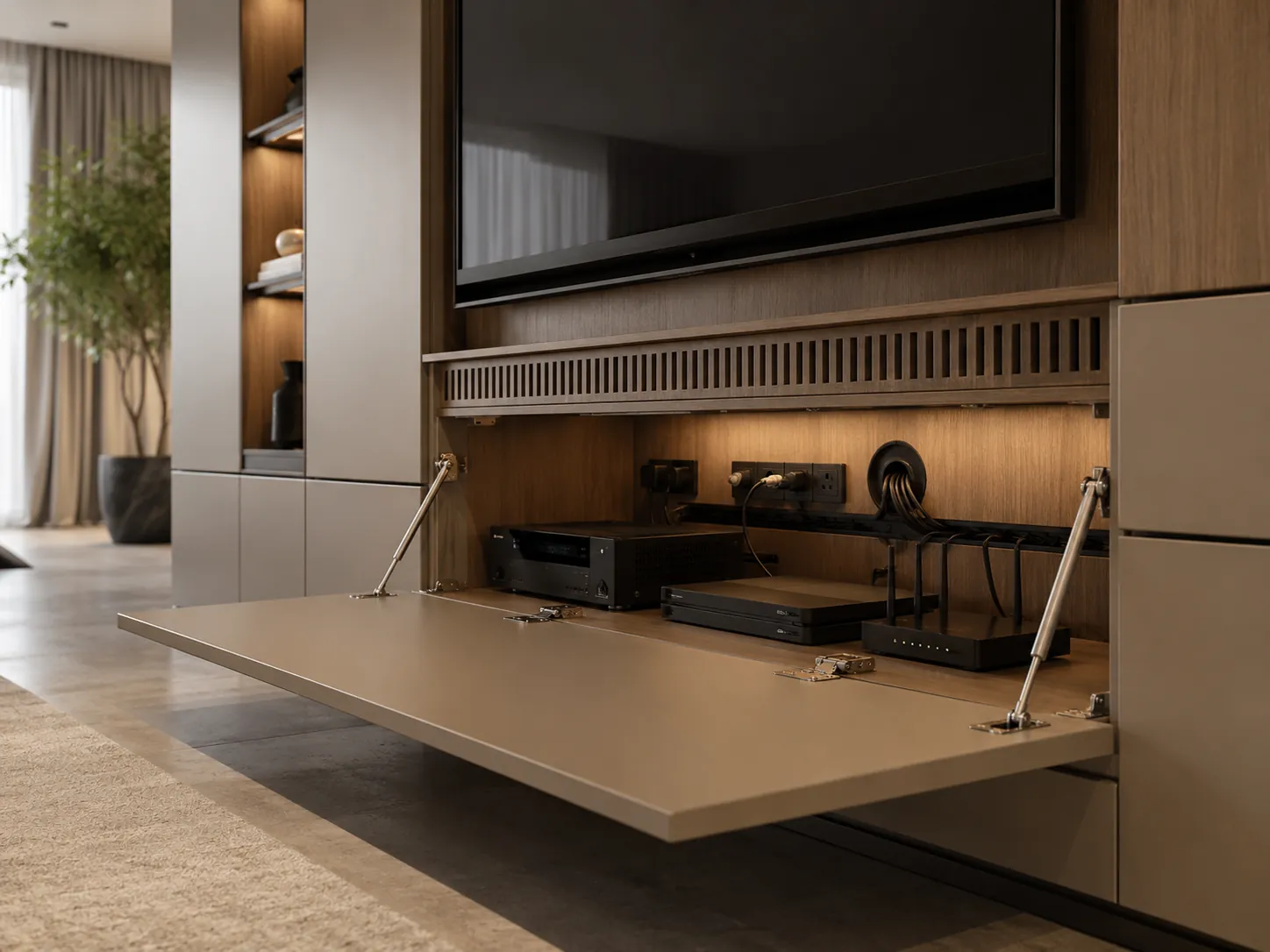
Protect ventilation and equipment access
Media equipment can produce heat, and closed compartments can restrict airflow. Ventilation must follow the requirements of the actual devices rather than a universal rule. A project may use discreet openings, ventilated panels, suitable gaps, or a more open equipment zone, depending on the design and equipment.
Check door and drawer movement around the equipment area as well. A remote-control signal, cable plug, or ventilation opening should not be blocked by a shelf edge or stored object. The goal is not merely to hide devices; it is to keep them usable and serviceable.
Give Every Storage Zone a Job
A large wall of cabinets can still be poor storage if every compartment is designed as a generic box. Divide the wall according to frequency of use, object type, visual importance, and access needs.
Closed storage for everyday visual calm
Use closed cabinets for items that would make the living room feel visually busy: spare cables, controllers, household documents, toys, cleaning accessories, or seasonal objects. Lower cabinets are often easier for frequently handled items, but door and drawer choices should reflect the available circulation space and how people use the room.
Deep cabinets are not automatically better. Excess depth can make small objects difficult to reach and can increase the visual weight of the wall. Match internal depth and shelf spacing to the objects that are actually intended for each zone.
Display zones need restraint
Open shelves and glass cabinets can lighten the composition, but they also require deliberate styling and cleaning. Use them where the contents deserve visibility, not merely to fill an empty area. A small number of well-proportioned niches can create more visual control than many narrow shelves.
If glass cabinetry or integrated lighting is included, confirm the glass type, shelf support, cable route, driver access, switch or control method, and the way light reflects from the displayed objects.
Media zones should remain adaptable
The central media area should accommodate the intended equipment without becoming a collection of exposed cables and mismatched boxes. Removable shelves or carefully planned spare capacity may help when equipment changes, but adaptability should be intentional rather than oversized everywhere.
For a coordinated living room, the TV wall can also share finish, alignment, and storage logic with other custom living room cabinetry.
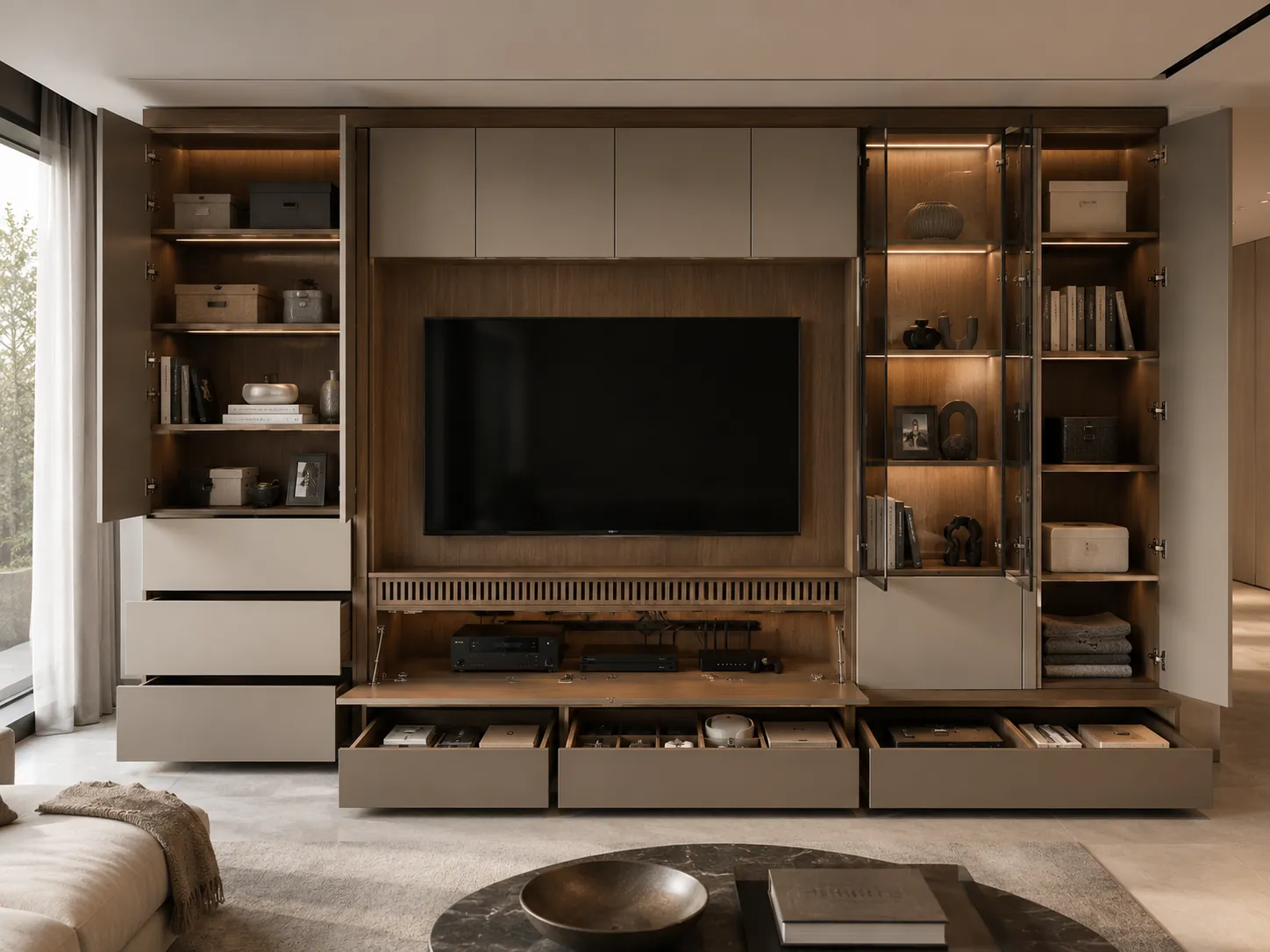
Control Proportion Without Losing Capacity
Integrated living room storage occupies a large visual area. Its proportions therefore matter as much as its capacity. The aim is to make the wall read as one composed architectural surface rather than a stack of unrelated cupboards.
Use alignment, depth, and negative space
Start with the major horizontal and vertical lines: the television center, console height, tall-unit edges, open niches, and nearby architectural features. Repeating or deliberately relating these lines makes the design feel controlled.
Not every section needs the same depth. A shallower display zone, recessed television panel, floating console, or limited area of open wall can reduce visual heaviness. Negative space is useful; it gives the television and selected objects room to sit within the composition.
Door widths and joint lines also affect the final rhythm. Very wide doors may need suitable hardware and careful review, while too many narrow doors can make the wall look busy. Final panel sizes and hardware should be confirmed against the chosen material, construction, and supplier specifications.
Treat lighting as an integrated detail
Lighting should support the cabinet rather than compensate for an unresolved composition. Use it selectively in display niches, glass sections, or beneath a floating element when it has a clear purpose. Confirm color temperature, diffuser appearance, cable routes, driver access, control method, and whether components can be replaced later.
The best result is usually not the wall with the most lighting. It is the wall where storage, display, television, and light share a clear hierarchy.
Turn the Design into a Production-Ready Brief
A rendered elevation communicates appearance, but production and installation require more. Before drawings are frozen, review the project as a coordinated set of facts rather than a single front view.
| Confirm before production | Why it matters |
|---|---|
| Final television model, bracket, ports, and required clearances | Defines the screen zone, mounting, cable access, and ventilation approach |
| Wall width, height, construction, and site irregularities | Affects fixing, fillers, closure panels, and installation planning |
| Socket, signal, lighting, and cable-route positions | Prevents conflicts and inaccessible connections |
| Media devices and service-access method | Keeps equipment usable after the wall is installed |
| Storage inventory and access frequency | Prevents generic compartments that do not suit real objects |
| Door, drawer, and nearby furniture clearances | Avoids collisions and restricted circulation |
| Materials, finishes, glass, hardware, and lighting components | Aligns the visual design with buildable specifications |
| Delivery route and installation responsibilities | Helps the project team plan modules, access, and site coordination |
Ask for drawings that show the front elevation, key dimensions, relevant sections, cabinet depths, functional zones, material notes, and installation interfaces. When working across locations, record decisions clearly so the designer, manufacturer, electrician, and installer are coordinating the same information.
This is also the right stage to identify what remains provisional. A detail that is not confirmed should be marked as pending rather than quietly assumed.
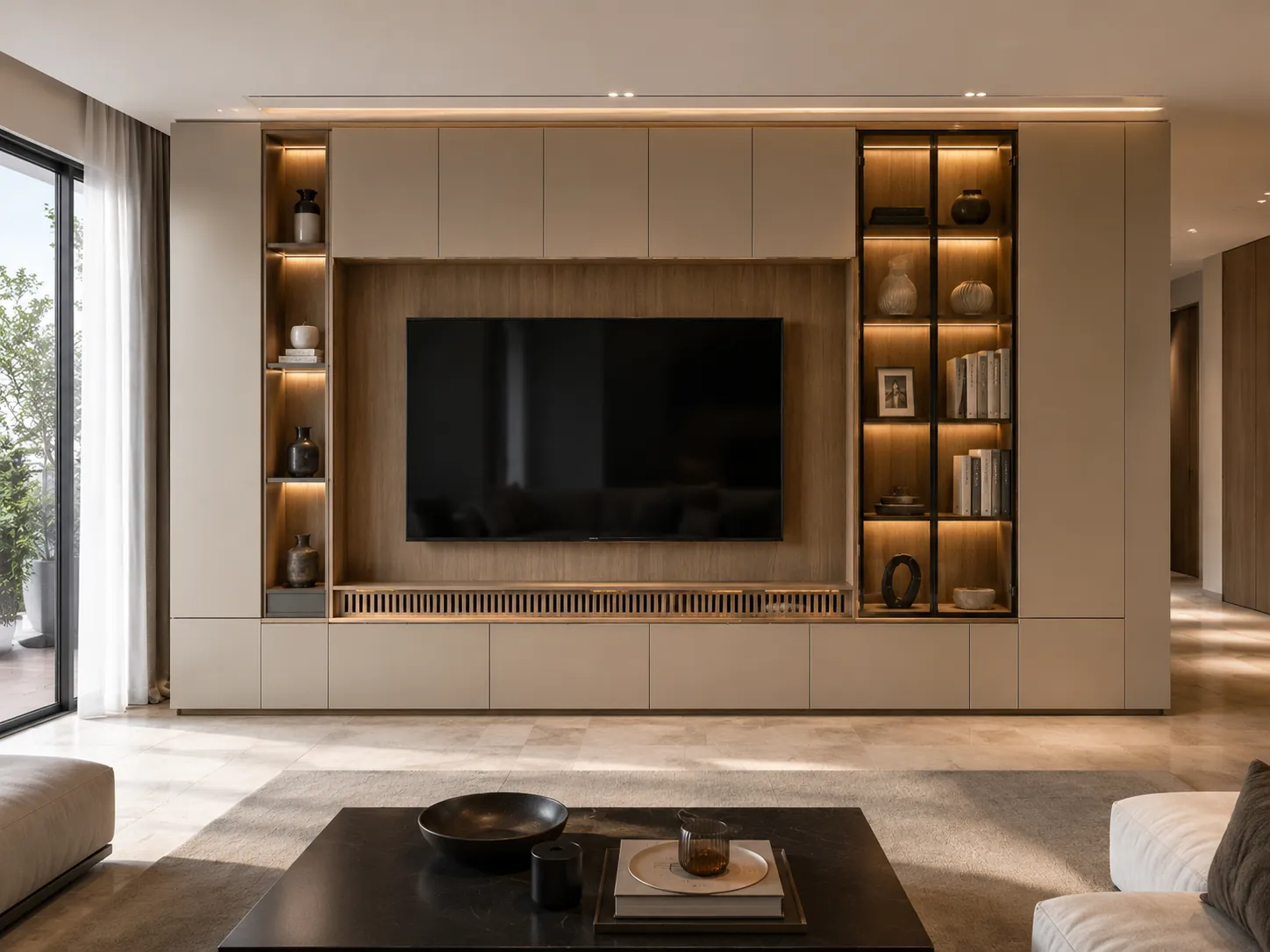
Frequently Asked Questions
Should the television be purchased before the cabinet is designed?
Ideally, confirm the final television model before production drawings are frozen. If that is not possible, provide accurate dimensions, mounting information, connection locations, and a clearly agreed tolerance strategy. Do not rely only on the advertised screen size.
How can cables stay hidden but remain accessible?
Plan a deliberate route between the television, sockets, and equipment zone, with access points that do not require destructive removal of finished panels. Coordinate the route with the cabinet designer and qualified electrical professionals.
Does a closed media cabinet need ventilation?
It may, depending on the equipment and compartment design. Follow the equipment manufacturer’s requirements and confirm an appropriate airflow and service-access strategy for the specific project.
How do you prevent a full TV wall from looking too heavy?
Use a controlled hierarchy of closed storage, limited display, aligned joints, depth changes, and negative space. Capacity should be assigned to real storage needs rather than maximized uniformly across the wall.
What measurements are needed before ordering?
Record the full wall width and height, site irregularities, wall construction, sockets, switches, nearby doors and curtains, floor and ceiling conditions, skirting boards, and installation access. The manufacturer or installer may request additional project-specific measurements.
A Better TV Wall Starts Before Production
A successful built in tv wall cabinet with storage is not defined only by how much it hides. It is defined by whether the television sits correctly, cables remain manageable, equipment can breathe and be serviced, storage matches real objects, and the cabinetry can be installed cleanly against the actual wall.
Before approving the final appearance, freeze the facts behind it. For homeowners, designers, contractors, or project buyers preparing a custom TV wall, a clear wall brief and coordinated drawing set provide a stronger starting point for a practical discussion with a cabinetry manufacturer.